

Switzerland 2-1 Canada
The roar inside BC Place was not for the home side. It was for the Swiss, who left Vancouver with a 2-1 victory over Canada that reshuffled the early calculations in Group [X] of the 2026 FIFA World…
Published: June 24, 2026
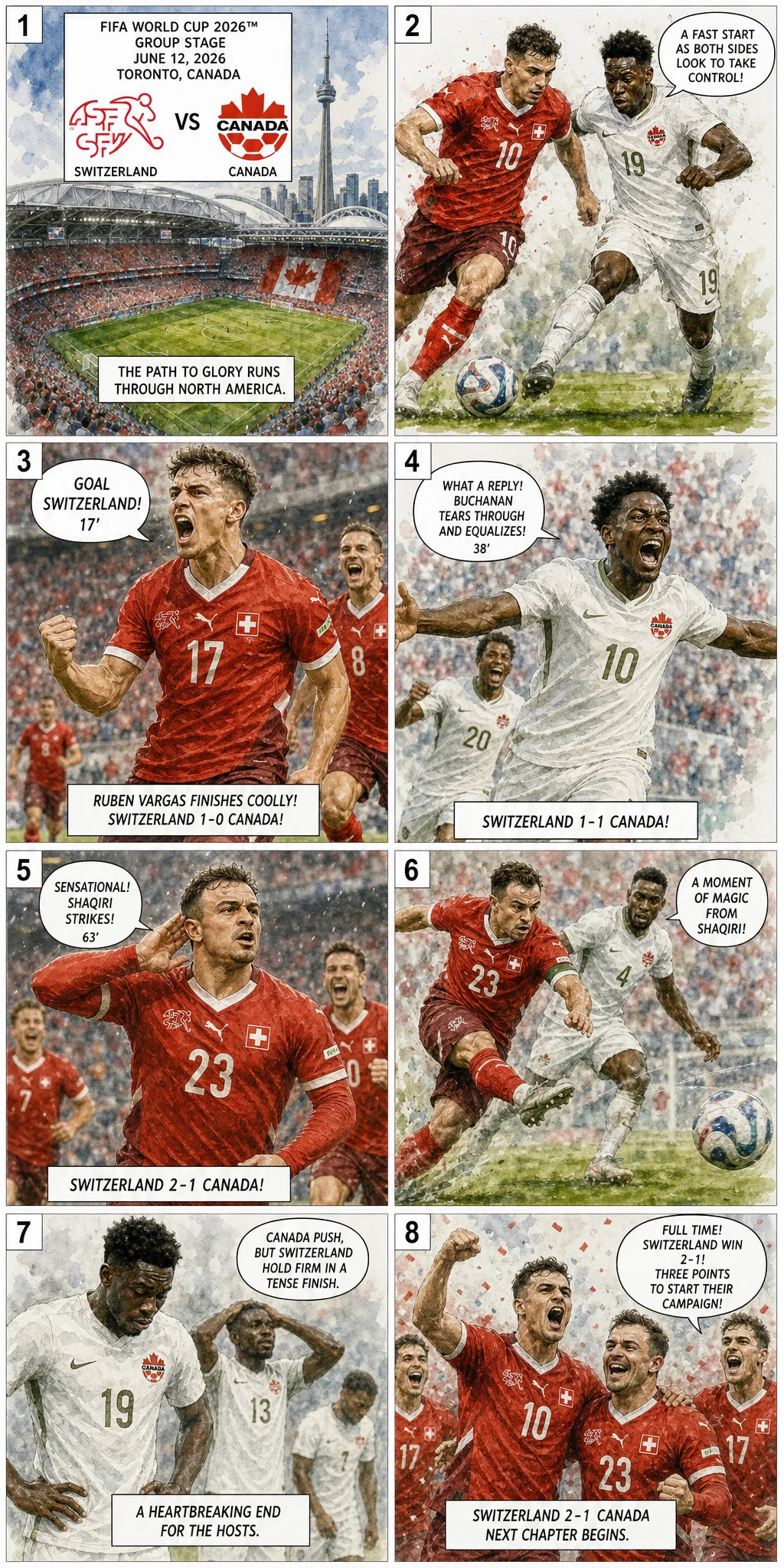
Comic content and match statistics are for entertainment purposes only and may contain inaccuracies. For Accurate Data, please refer to the reference's official website.
# Switzerland 2-1 Canada
The roar inside BC Place was not for the home side. It was for the Swiss, who left Vancouver with a 2-1 victory over Canada that reshuffled the early calculations in Group [X] of the 2026 FIFA World Cup. For the host nation, the result was a deflating start to a campaign that had been built on years of rising expectations. For Switzerland, it was a statement of pragmatic efficiency: they conceded the emotional momentum of the occasion, absorbed pressure in patches, and still found two goals where Canada found only one.
The match at BC Place unfolded in a way that will frustrate Canadian analysts for weeks. Canada, playing in front of a crowd that leaned heavily red and white, carried the bulk of territorial advantage for significant stretches. Their approach was direct, energetic, and built on width. They pressed high, forced turnovers in midfield, and created half-chances that required sharp reactions from the Swiss goalkeeper. But football at this level punishes generosity in front of goal, and Switzerland have made a habit of turning minimal openings into match-winning moments. The first goal, when it came, was not a product of sustained pressure but of a single defensive lapse that left a Swiss forward with time and space inside the box. The finish was clinical, the sort of composure that Canada’s young squad is still learning to replicate.
Canada’s response was immediate and driven by emotion. They equalised before the interval, capitalising on a set piece situation that caught the Swiss backline momentarily flat-footed. The goal came from a corner or free kick—the kind of chaotic scramble where bodies collide and the ball finds a foot. The stadium erupted. For a few minutes, the momentum belonged entirely to the hosts. They pushed for a second, forcing saves and blocking clearances, but the half ended level, and with it, perhaps, Canada’s best chance to seize control.
The second half belonged to Switzerland’s game management. They did not dominate possession. They did not need to. Instead, they tightened the defensive lines, reduced the space between midfield and defence, and waited for Canada to overcommit. The winning goal arrived on a transition sequence that started with a Swiss interception in their own half. Three quick passes bypassed Canada’s midfield press. A runner angled into the channel, received the ball on the turn, and drove toward the penalty area. The cross—low and driven—was turned home by a second wave of attack. It was not a spectacular goal, but it was a structurally sound one, the kind that tournament teams manufacture when they sense vulnerability.
Canada pushed for an equaliser in the final 20 minutes. They changed personnel, introducing fresh legs and shifting shape. They forced corner after corner, threw bodies forward, and left gaps at the back that Switzerland nearly exploited twice on breakaways that ended with wayward shots or rushed decisions. The Swiss goalkeeper, often the busier of the two, made a series of saves that will not appear in highlight packages but were critical—smothering a low drive from the edge of the box, tipping a looping header over the bar. The final whistle arrived with Canada still pressing, their players collapsing onto the turf, the crowd’s energy replaced by a hollow silence.
What does this mean for Group [X]? Switzerland, with three points, have placed themselves in a commanding position. Their opening fixture was always going to be the most unpredictable: a home nation in a cauldron, the pressure of being the first opponent to face Canada on home soil. They navigated it with discipline and a clinical edge. The result allows them to approach their second group match with flexibility—they can afford to be more cautious, or they can push for an early knockout spot. Their squad is experienced in tournament football, and they demonstrated why. They absorbed moments of Canadian intensity without losing shape, and they scored when opportunities presented themselves. That is the hallmark of a side that knows how to progress beyond the group stage.
For Canada, the calculus becomes steeper. Defeat in the opening match, especially at home, creates immediate pressure. Their remaining group games will require points. The performance offered reasons for optimism—they created chances, they held their own for long periods, they showed they can compete at this level. But the result is all that ultimately matters in the group table, and they are now chasing. The path to the knockout rounds runs through must-win territory. Canada’s squad is young, dynamic, and capable of producing moments of brilliance, but tournaments are unforgiving to teams that fail to convert dominance into goals. They will need to refine their finishing, tighten their defensive organisation on transitional plays, and find a way to manage the psychological weight of playing in front of a nation that expects progress.
The venue itself played a role. BC Place, with its retractable roof and bowl-like acoustics, was not neutral. The crowd noise amplified every Canadian tackle, every surge forward. It pushed the team through spells of fatigue. But it also created a certain tension. When the equaliser arrived, the energy was intoxicating. When Switzerland scored their second, the silence was suffocating. The psychological swing of a home crowd can be a double-edged sword, and Canada will need to learn how to harness it without being destabilised by the letdown.
There were no standout individual performances that dominated the narrative—no hat-tricks, no heroic saves that defined the match. Instead, it was a game of collective virtues and vices. Switzerland’s defensive block was compact and disciplined. Their midfield, though not spectacular, was efficient in breaking up play and distributing quickly to wide areas. The forwards worked hard to press Canadian defenders when they had the ball, forcing hurried clearances that often went straight to Swiss shirts. Canada’s full-backs, by contrast, were energetic in attack but were caught too high on the decisive second goal. The midfield axis lost shape in moments of Swiss transition, leaving gaps that a more experienced side might have exploited even more ruthlessly.
Tactically, the match was a study in contrasting philosophies. Canada sought to impose tempo from the opening whistle, using quick vertical passes and overlapping runs to stretch the Swiss back three or four—whichever shape Switzerland deployed changed in the second half. Switzerland, in turn, ceded the wide areas in the first period, forcing Canada to cross into a crowded penalty area where the Swiss defenders, both tall and well-organised, could clear. The adjustment came after the equaliser: Switzerland dropped deeper, dared Canada to find a way through a congested middle, and then countered with speed. It was a simple but effective shift.
The opening minutes had suggested a different outcome. Canada began with a ferocity that unsettled the Swiss. Their high press forced errors in the Swiss third, and early crosses flashed across the six-yard box without a finishing touch. The crowd rose for every near-miss, convinced that a goal was imminent. But the longer the first half went without a breakthrough, the more composed Switzerland became. They slowed the tempo when they had possession, used short passes to relieve pressure, and waited for Canada’s intensity to dip. That dip came, as it often does, around the 30-minute mark. A misplaced Canadian pass in midfield was the trigger. Switzerland moved forward in a compact unit, and the first goal followed shortly after—not a moment of genius, but a well-rehearsed move that caught Canada’s defence shifting sideways rather than stepping up.
The second half lacked the same open flow. Canada’s equaliser had come from a set piece, which offered them a template for how they might break Switzerland down again. They won several corners and free kicks in dangerous areas, but each was dealt with by Swiss defenders who appeared to have done their homework. The winning goal, when it came, was a sucker punch. Canada were pushing, their full-backs high, their midfielders committing forward to support the attack. A Swiss clearance was flicked on, and suddenly three red shirts were sprinting toward the Canadian penalty area. The finish was composed, but the damage had been done by the defensive shape collapsing.
Injury time added a frantic edge. Canada threw caution aside, the goalkeeper advancing for a late corner. The ball was cleared, the Swiss broke again, and only a desperate recovery run from a Canadian midfielder prevented a third goal. The referee’s whistle was a mercy.
Switzerland’s coaching staff embraced on the sideline. They knew what this result meant in the broader context of the group. A draw would have been acceptable; a win over the home nation is a massive step toward the round of 16. They celebrated with the away section, a pocket of Swiss supporters who had made the trip across the Atlantic. For Canada, the locker room would be quiet. The post-match interviews would include phrases like “we learned a lot” and “it’s a long tournament,” but the reality is that history is not kind to host nations who lose their opener.
This was not a classic, not a match that will be replayed for its aesthetic beauty. It was a tournament grinder, the kind of game that separates the teams who progress from the teams who go home early. Switzerland did what they needed to do. Canada did many things right but fell short where it mattered most: on the scoreboard. The group remains open, but the path is now steeper for the hosts. For Switzerland, the view from the top of the table is exactly where they wanted to be after 90 minutes at BC Place.