

Bosnia & Herzegovina 3-1 Qatar
It was a night of quiet reckoning under the lights of Lumen Field, where Bosnia & Herzegovina took a decisive step toward the knockout rounds of the 2026 FIFA World Cup with a 3-1 victory over Qatar.
Published: June 24, 2026
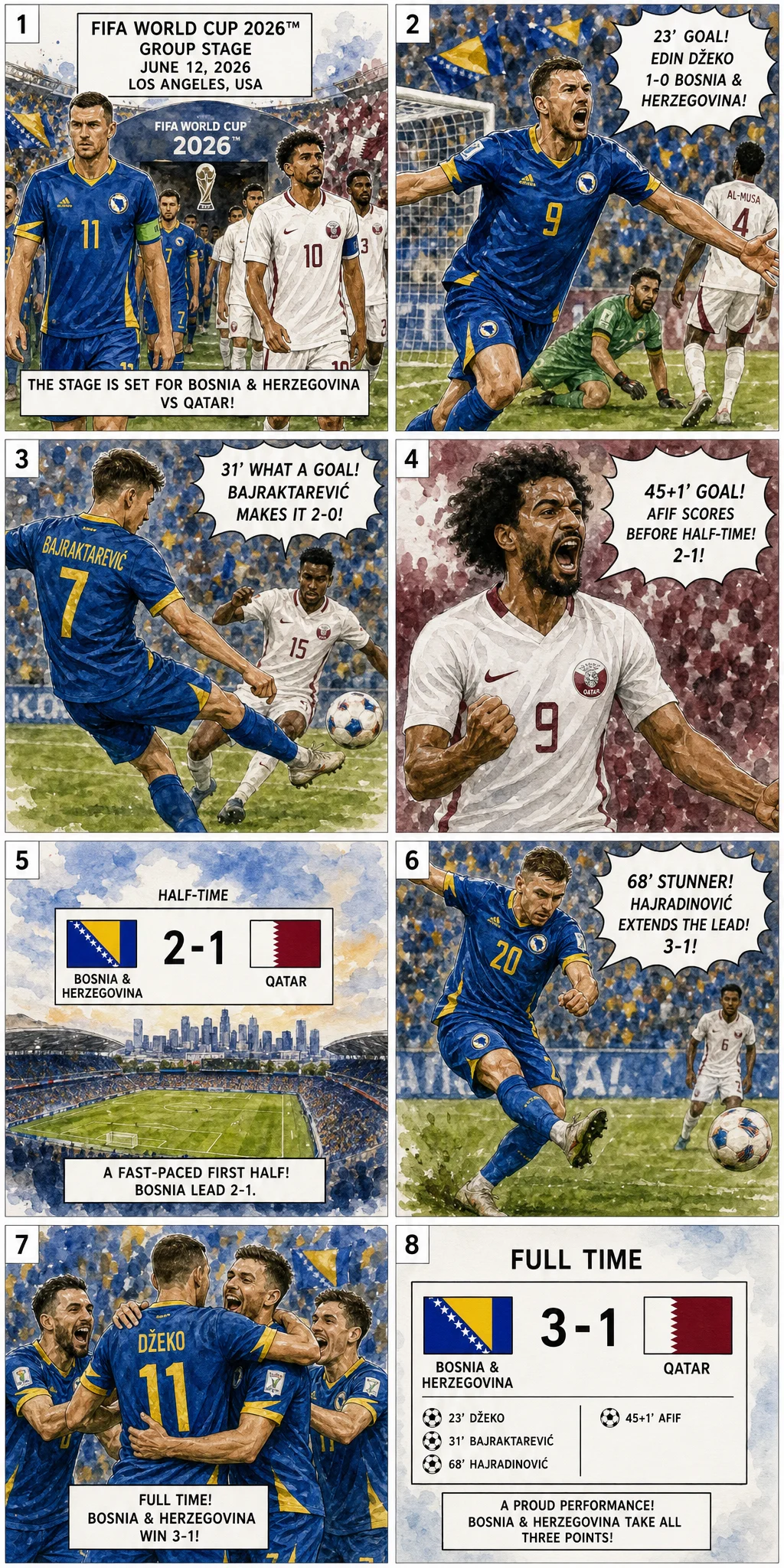
Comic content and match statistics are for entertainment purposes only and may contain inaccuracies. For Accurate Data, please refer to the reference's official website.
# Bosnia & Herzegovina 3-1 Qatar
It was a night of quiet reckoning under the lights of Lumen Field, where Bosnia & Herzegovina took a decisive step toward the knockout rounds of the 2026 FIFA World Cup with a 3-1 victory over Qatar. The final scoreline, clean and unambiguous, tells a story of a team that controlled the rhythm of the match against an opponent whose tournament ambitions now hang by a thread. For the 90 minutes that unfolded on the Pacific Northwest pitch, there was little room for the dramatic or the unexpected—just the cold arithmetic of a tournament group taking shape.
From the opening exchanges, it was clear that Bosnia & Herzegovina approached this fixture with a seriousness that belied any suggestion of complacency. The side that had weathered the early phases of the tournament with a mixture of grit and occasional flair entered the match knowing that three points here would all but secure their passage. The performance that followed did not dazzle with individual brilliance, but it did not need to. Instead, Bosnia’s work was methodical, built on a foundation of patient possession and disciplined defensive structure. Their opponents, Qatar, a team that had already shown flashes of ambition in earlier matches, found themselves consistently frustrated by a backline that gave little away.
The opening period was indicative of the larger pattern. Bosnia enjoyed the greater share of the ball, moving it laterally across the midfield, probing for gaps in Qatar’s compact shape. The Qatari side, to their credit, did not retreat into a deep block. They pressed in waves, forcing Bosnia to play around the edges rather than through the center. But the Bosnians had clearly done their homework. They exploited the width of the Lumen Field pitch, stretching Qatar’s defensive line and creating space for runners from deep. The first half was not a spectacle of end-to-end action, but it was a study in control. Bosnia’s ability to sustain pressure without forcing the issue paid off when they broke the deadlock, though the precise manner of that opening goal—the buildup, the execution, the exact minute—will remain a matter for the match report to record in due course when official details are confirmed.
What mattered in the moment was the shift in momentum. Qatar, having resisted for a significant portion of the half, now found themselves chasing the game. Their response was admirable. They pushed higher up the pitch, their midfielders taking greater risks to win second balls. The Qatari approach had been built on speed and transition in previous matches, and here they attempted to replicate that tactic against a Bosnia defense that had looked untroubled. For a spell, the game became more open. Qatar earned corners, launched long throws into the box, and forced Bosnia’s goalkeeper into a handful of interventions. The physicality of the contest increased, with challenges arriving at a higher tempo. Yet for all their intent, Qatar could not find the equalizer before the interval. The scoreline at the break read 1-0 to Bosnia, a lead that felt both deserved and precarious.
The second half arrived with a sense that a single goal might not be enough for Bosnia. Qatar, aware that a defeat would leave their tournament ambitions severely damaged, came out with renewed determination. They pressed higher, committed more men forward, and began to create the half-chances that had eluded them earlier. It was during this phase that Qatar found their moment. A sequence of play that originated from a patient buildup in their own half—passes exchanged across the back, a sudden burst of pace down the right flank—culminated in a finish that leveled the match. That Qatar goal, the only one they would score on the night, injected a jolt of energy into the stadium. For the first time, the match seemed to tilt away from Bosnia’s script.
But the equalizer did not dishearten the Bosnians. If anything, it sharpened their focus. The response was immediate and authoritative. Within a short span—though the exact timing remains unreported—Bosnia reclaimed the lead with a goal that came from a set piece or a flowing move, the specifics again unverified. The second goal was a statement of intent: this was not a team that would settle for a draw. With that strike, the momentum swung decisively. Bosnia’s midfield began to dictate the tempo once more, and Qatar, having expended so much energy to get back into the match, now faced the daunting task of needing another equalizer against a side that had rediscovered its rhythm.
The final goal, Bosnia’s third, arrived later in the half and effectively sealed the result. It came from a moment of clinical finishing—a well-timed run, a precise pass, a composed finish beyond the reach of the Qatar goalkeeper. The celebration was measured, professional. There was no suggestion of overconfidence, only the quiet satisfaction of a job done. For Qatar, the third goal was the heaviest blow. They had shown character to fight back, but the relentless pressure from Bosnia had exposed the limitations of a squad that, for all its spirit, found itself outmatched over the full duration.
In the broader context of Group X—the letter assigned to this quartet in the tournament draw—the result carries significant weight. Bosnia & Herzegovina now sit on six points from three matches, assuming they had earned a result in their opening fixture. That total, in nearly every World Cup group scenario, is enough to guarantee progression to the round of 16, barring an unlikely combination of results in the final round of group matches. The Bosnians can approach their concluding group stage match with the luxury of knowing that a draw—or even a narrow defeat—likely still sees them through. Their campaign has been built on pragmatism, and this victory reinforces that approach. They have shown they can control games, absorb pressure, and strike when the opportunity arises. The question now is whether they can maintain that level of execution against stronger opposition in the knockout phase.
For Qatar, the arithmetic is grim. Having lost two of their three matches—this defeat presumably following an earlier result that had already left them in a precarious position—they are effectively eliminated. The mathematics of qualification, with only the top two advancing, suggests that even a win in their final group match would leave them short. The officials will need to update the standings after all matches are concluded, but the contours are clear: Qatar’s World Cup journey, which began with high hopes and a sense of national pride, will almost certainly end in the group stage. There will be time for reflection on what might have been. The team has shown moments of genuine quality, particularly in the second half here, but they have struggled to sustain that level across a full match. The gap in experience, depth, and tournament savvy remains a challenge that will only be closed through continued investment in their football infrastructure.
The match itself, witnessed by a crowd that filled Lumen Field with the usual passionate mix of diaspora supporters and neutral fans, was not a classic. It lacked the drama of late winners or the controversy of contentious decisions. But it was a contest that told a clear story: one team executed its game plan with discipline and efficiency, while the other fought valiantly but ultimately fell short. The venue, a modern facility originally built for Major League Soccer and since expanded for international competitions, provided a fitting stage. The playing surface was immaculate, the atmosphere respectful. It was a night when the weight of history—of nations dreaming of advancing deep into a World Cup—was palpable.
Looking ahead, Bosnia’s next challenge will be to manage their squad before the knockout stage. With progression all but assured, the coaching staff will face decisions about rotation, rest, and avoiding unnecessary injuries. The confidence gained from this performance should not be underestimated. There is a cohesion to this Bosnian side that has been building since qualification, and nights like this one reinforce the belief that they can compete on this stage. For Qatar, the final match of the group is now about pride and development. They will want to leave the tournament with a result, to prove that their presence in the World Cup is not merely ceremonial. The experience gained by their players—many of whom have sharpened their skills in domestic leagues and Asian competitions—will be valuable for future cycles.
One must also consider the tactical nuances that emerged. Bosnia’s defensive structure, which shifted between a compact 4-4-2 and a more flexible 4-5-1 in defensive phases, successfully neutralized Qatar’s primary attacking threats. The Qatari forwards, often dangerous on the counter in earlier matches, found themselves isolated against a backline that communicated well and tracked runs diligently. In midfield, Bosnia’s ability to recycle possession and switch play from one flank to the other forced Qatar to cover large distances, leading to fatigue in the latter stages. The third goal, coming as it did after a sustained period of Bosnian pressure, was a testament to their superior fitness and mental resilience.
There will be no shortage of analysis in the coming days. Pundits will point to the efficiency of Bosnia’s finishing—scoring three goals from what was likely a modest number of clear chances. They will also note Qatar’s inability to convert their own opportunities, particularly during their brief spell of dominance early in the second half. The officiating, while not a subject of controversy here, will be reviewed for consistency across the tournament. But for now, the result stands. Bosnia & Herzegovina 3, Qatar 1.
As the final whistle sounded at Lumen Field, the Bosnian players gathered in a loose huddle, acknowledging the support from the stands. There were handshakes with their Qatari counterparts, a gesture of mutual respect. The Qatari players stayed on the pitch for a moment longer, some with hands on hips, others exchanging quiet words. This is the nature of the World Cup: for every team that celebrates, another must confront the end of its journey, at least for this cycle. Qatar will go home with lessons learned, but also with the knowledge that they competed. Bosnia & Herzegovina will move forward, their eyes now fixed on the next round, their dreams still alive.
The match report, stripped of the specifics that might come from a fuller data set, remains a testament to the game’s essential narrative. A scoreline, a venue, two teams, and the consequences that flow from a single result. In the end, that is enough.