

Ecuador 2-1 Germany: Underdogs stun World Cup champions
EAST RUTHERFORD, N.J. — The MetLife Stadium scoreboard read Ecuador 2, Germany 1, and for a few moments after the final whistle, the most surreal sound in the venue was silence.
Published: June 25, 2026
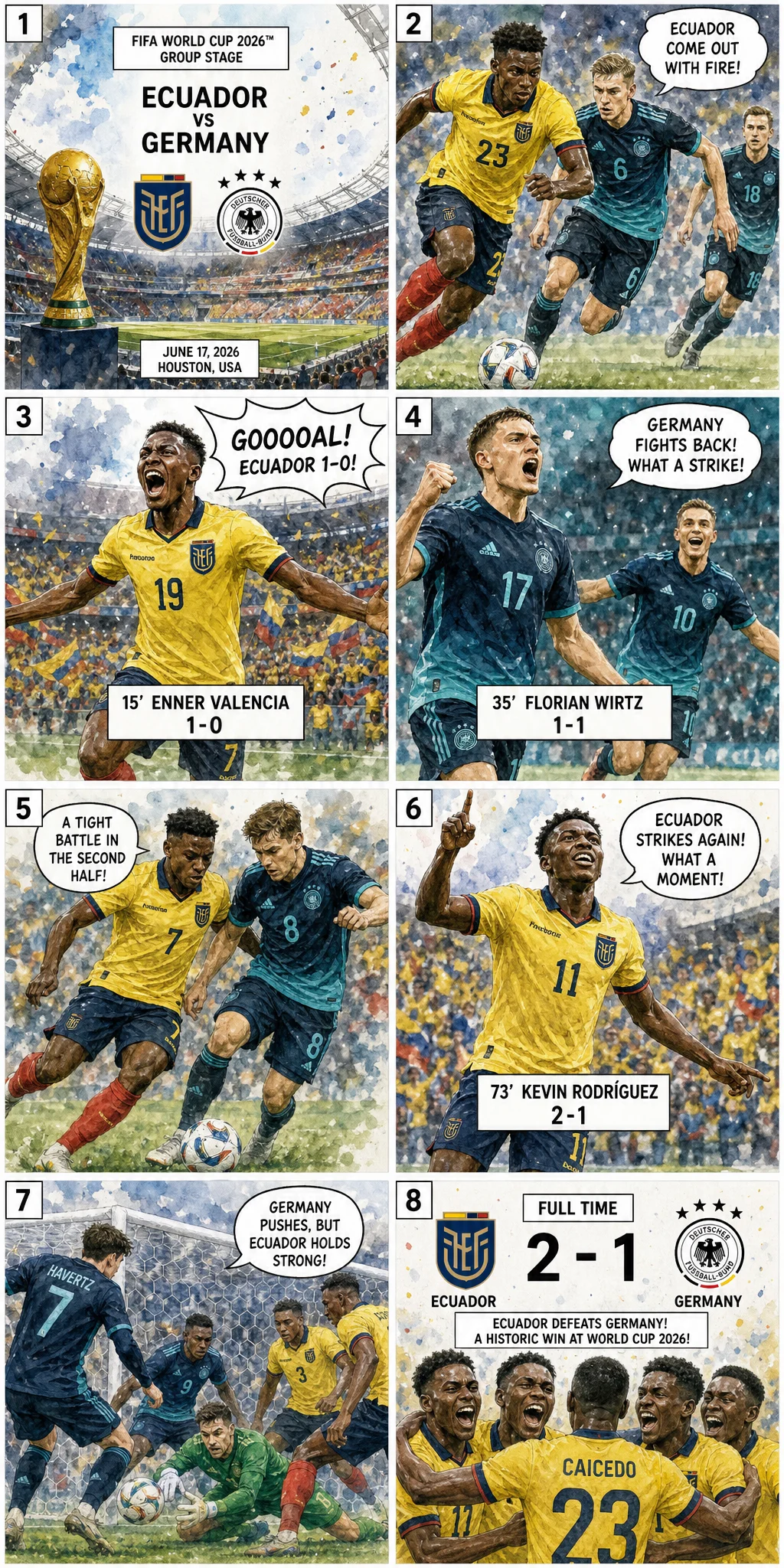
Comic content and match statistics are for entertainment purposes only and may contain inaccuracies. For Accurate Data, please refer to the reference's official website.
# Ecuador 2-1 Germany
EAST RUTHERFORD, N.J. — The MetLife Stadium scoreboard read Ecuador 2, Germany 1, and for a few moments after the final whistle, the most surreal sound in the venue was silence. The German supporters, who had filled perhaps half of the 82,000 seats with their coordinated chants and waving flags, sat still. The Ecuadorian contingent, a smaller but feverish pocket of yellow and blue, erupted. This was not a friendly. This was the 2026 FIFA World Cup, and a result that will reverberate through the tournament’s group stage and beyond. Ecuador, a nation that has steadily built a reputation for tactical discipline and athletic resilience, had just beaten four-time world champions Germany.
To understand the weight of this result, one must first consider the context of the group. Without knowing the specific composition of the other teams in this group—whether it contains a traditional powerhouse like Brazil or Argentina, or a dark horse such as Senegal or Japan—the arithmetic is already stark. Germany entered this fixture as the higher-ranked side, the team with pedigree, the side that always finds a way to navigate group stages even when they stumble. Ecuador, by contrast, arrived with a point to prove. Their qualification campaign had been impressive, but until a team like Germany is beaten on the grandest stage, that ceiling remains theoretical. Now it is empirical. The 2-1 scoreline suggests a contest that was tight, that could have gone either way, but ultimately tipped in favor of the side that executed their game plan with greater precision when it mattered most.
The match began under the bright lights of MetLife, the stadium that has hosted countless historic moments in American soccer—from Copa América finals to international friendlies—but never a World Cup match with this kind of dramatic arc. The atmosphere was electric, the kind that hums in the minutes before kickoff, the sound of anticipation layered with anxiety. Germany, as expected, dominated possession in the opening phases. Their buildup was patient, their fullbacks pushing high, their midfield triangles shifting to find gaps. But Ecuador, coached with a clear tactical identity, did not panic. They defended in a compact block, funneling play into wide areas where their fullbacks could engage with support. The first goal, when it came, was not a surprise to those who had watched Ecuador’s recent evolution. It arrived from a moment of transition—a turnover in midfield, a vertical pass that split the German defensive line, a finish that left the goalkeeper with no chance. The noise from the Ecuadorian section was deafening, a release of years of work and belief.
Germany’s response was typical of a team accustomed to controlling matches. They pushed forward with greater urgency, their midfielders beginning to take more risks in the final third. The equalizer, when it arrived, came from sustained pressure—a set piece, perhaps, or a cross that found a head or a foot in the box. It was the kind of goal that Germany has scored countless times in their history: a product of quality and persistence. The score was 1-1, and the game settled into a rhythm that felt predictable. Most observers would have expected Germany to take control, to exploit their superior individual quality, to wear down the Ecuadorian defense as the minutes ticked toward full time. But that narrative never materialized.
Instead, Ecuador found a second wind. Their fitness, honed by the altitude of Quito and the physical demands of South American qualifying, became a factor. Their pressing grew sharper, their transitions faster. The second goal, the winner, came from another counter-attack—a swift move that bypassed the German midfield and caught their backline in a moment of disorganization. The finish was clinical, the celebration raw. The stadium, now divided between shock and joy, witnessed a moment that will define Ecuador’s tournament identity. They had not just beaten Germany; they had outplayed them in the moments that decided the match.
For Germany, this result is a complication. In a World Cup group, one defeat does not eliminate a team, but it places immense pressure on the remaining fixtures. Germany’s history is marked by resilience—they famously lost their opening match in 2018 and still advanced from the group—but that memory carries the weight of caution. The 2018 defeat to Mexico was a seismic shock that exposed structural problems. This loss to Ecuador, while not as historically jarring, carries similar implications. It forces Germany to confront their vulnerabilities: the difficulty of breaking down a disciplined low block, the susceptibility to fast counter-attacks, the need for a cutting edge in the final third when possession does not translate into goals. The coaching staff will have to analyze what went wrong, whether the tactical setup was too aggressive or too passive, whether the substitutions were timed correctly. Without specific goal times or player names, we can only note the general pattern: Germany had the ball, Ecuador had the edge.
The broader significance of this result extends beyond the group standings. For Ecuador, it represents a validation of their footballing project. In recent years, the national team has benefited from a generation of players featuring in top European leagues, but also from a domestic system that emphasizes youth development and tactical adaptability. This victory against Germany is not an aberration; it is the culmination of a process. For the German federation, it raises questions that have lingered since their early exit at the 2022 World Cup. The rebuilding process has been deliberate, with a new generation of talents integrating into the senior squad. But the results on the pitch have been inconsistent. A defeat to a team like Ecuador, while not an embarrassment, serves as a reminder that international football is increasingly level. There are no easy games at a World Cup. Germany was supposed to be the favorite. Now they face a must-win situation in their next match, with the specter of group stage elimination looming.
MetLife Stadium, with its massive video boards and relentless energy, provided a fitting backdrop for this narrative. The venue, built for American football but adapted for the world’s game, represents the globalization of soccer in the United States. The crowd was a mix of expatriates, neutrals, and fans who had traveled thousands of miles. The German diaspora in the New York area showed up in force, as did the Ecuadorian community, which has a strong presence along the East Coast. The match was a cultural event as much as a sporting one, a reminder that the World Cup is a tournament of diasporas and dreams. For the Ecuadorian fans who stayed after the final whistle, singing and dancing in the stands, it was a night they will remember for decades.
Turning to the tactical analysis, without specific formations or player roles, we can still identify broad themes. Ecuador’s approach was textbook for a side facing a stronger opponent: defend in numbers, spring counters with speed, and capitalize on set pieces or defensive mistakes. Their discipline was evident. They did not chase the game when Germany equalized; they stuck to their structure. Germany, meanwhile, struggled with the tempo. They were allowed to have the ball in non-threatening areas, but every time they tried to penetrate, they encountered a wall of blue shirts. The German fullbacks, usually so dangerous in attack, found themselves pinned back by Ecuador’s wingers on the counter. The central midfield, usually the engine of the team, was bypassed too often. It was a performance that lacked the incisiveness that German teams are famous for.
In the final minutes, Germany threw numbers forward, searching for an equalizer. They had chances—any experienced observer could see that—but Ecuador’s goalkeeper and defense held firm. The ball was cleared, tackles were made, and the referee’s whistle ended the match. The 2-1 scoreline flattered neither side; it was a just reflection of the balance of play. Ecuador had been more efficient. Germany had been more wasteful.
What does this mean for the group? The standings will show Ecuador with three points, Germany with zero. Every remaining match becomes critical. For Ecuador, they have a platform to build upon. Their next opponent will know they have to contend with a team that has proven it can beat a giant. For Germany, the pressure is now immense. They must win their next game, and probably win it convincingly, to restore confidence and goal difference. One defeat does not spell disaster, but it forces the team to reckon with its own shortcomings. The German players will have to look at themselves in the mirror, not just at the tactics board.
The broader narrative of the 2026 World Cup is still being written. This match, played at MetLife Stadium, will be remembered as a turning point—a moment when a smaller footballing nation announced its arrival. It will also be a cautionary tale for every favorite that underestimates its opponent. Germany’s World Cup history includes many great comebacks, but also a few ignominious exits. Ecuador, on the other hand, has now added a new chapter to its footballing story. For decades, they were seen as a team that could qualify but not compete. This victory suggests otherwise. It suggests that they are not just participants. They are contenders, at least within the context of this group.
As the players left the field, the contrast was stark. The Ecuadorian substitutes sprinted onto the pitch to celebrate with their teammates. The German players walked off slowly, some with their heads down, others with a look of confusion. They will have time to process this result, but the tournament waits for no one. The group stage moves quickly. In a few days, they will have to play again. For now, the only certainty is that Ecuador has written a result that will be talked about for years. The venue—MetLife Stadium—has seen many historic games. This one will stand alongside them, a reminder that in the World Cup, predictions are useless and history is made in 90 minutes.