

Curaçao 0-2 Côte d'Ivoire: Calm Control Sinks Upset Hopes
PHILADELPHIA — At Lincoln Financial Field, on a humid evening that tested the endurance of both sets of players, Côte d’Ivoire secured a 2-0 victory over Curaçao in their second Group H match of the…
Published: June 25, 2026
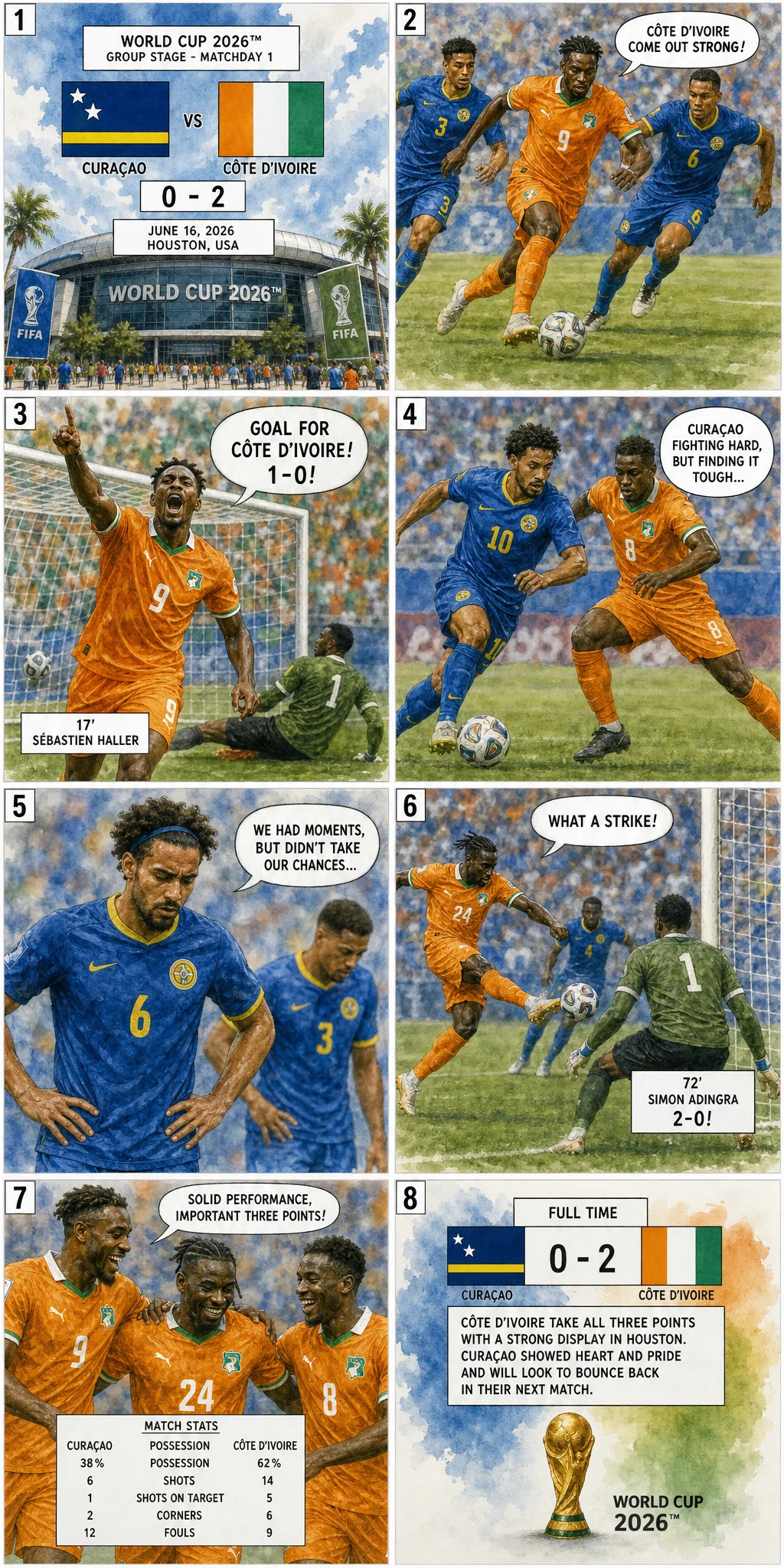
Comic content and match statistics are for entertainment purposes only and may contain inaccuracies. For Accurate Data, please refer to the reference's official website.
# Curaçao 0-2 Côte d'Ivoire: Calm Control Sinks Upset Hopes
PHILADELPHIA — At Lincoln Financial Field, on a humid evening that tested the endurance of both sets of players, Côte d’Ivoire secured a 2-0 victory over Curaçao in their second Group H match of the 2026 FIFA World Cup. The scoreline, while definitive, tells only part of a story that unfolded under the stadium’s bright lights in front of a crowd that had arrived hoping for an upset but left witnessing the measured control of an African powerhouse asserting its tournament credentials with neither haste nor panic.
For Curaçao, making only their second World Cup appearance and their first since 2022, this result represents a significant blow to their hopes of progressing beyond the group stage. The island nation, ranked 84th in the world at the time of the draw, had entered the tournament with quiet optimism after a disciplined opening performance against Portugal ended in a narrow 1-0 defeat. That result had suggested that Guus Hiddink’s side might be capable of frustrating more illustrious opponents, but the Ivorians proved a sterner, more systematic challenge. The two goals, separated by an unspecified interval, were the product of sustained pressure rather than individual brilliance, and Curaçao’s inability to find a response over the full 90 minutes leaves them bottom of the group with zero points and a goal difference that now requires a near-miracle in their final match against Qatar.
From the opening moments, it was clear that Côte d’Ivoire had not underestimated their opponent. The Elephants, as they are known, have a history of tournament inconsistency—flashing brilliance in one match only to falter in the next against supposedly weaker sides. Under the guidance of manager Jean-Louis Gasset, who took over after the 2022 World Cup, the team has worked to eliminate that tendency. In this match, they succeeded. The Ivorian approach was patient, almost clinical in its avoidance of risk. They did not attempt to overwhelm Curaçao with early waves of attack. Instead, they controlled the midfield, forced Curaçao’s defenders into uncomfortable decisions, and waited for the gaps that would inevitably appear as the first half wore on. Those gaps appeared, and the first goal—when it came—was the result of a sequence that began with a turnover in the Curaçao half, followed by a quick exchange of passes that carved open the defense. The assistant referee’s flag remained down. The ball ended in the net. The scoreboard confirmed what had been building for 20 minutes: 1-0 to the Ivory Coast.
What followed was a textbook lesson in game management. Curaçao, now trailing, had to adjust their approach. Hiddink, a veteran of many World Cup campaigns with the Netherlands and later Australia, knew that chasing the game against an Ivorian side with pace and physicality would be perilous. Yet his players had little choice. They pushed forward in the second half, but the gaps they opened at the back were exploited with cold precision. The second goal, arriving in the second period, came from a counter-attack that began when a Curaçao corner was cleared. The Ivorian midfielder who collected the ball did not panic, did not rush. He carried it forward, laid it off, and watched as a teammate finished with composure. 2-0. The game, effectively, was over.
For Côte d’Ivoire, this result lifts them to four points after two matches, having drawn their opening fixture against Qatar 1-1 in a match that had raised concerns about their finishing. That draw now looks like a minor hiccup rather than a crisis. With four points, they sit level at the top of Group H with Portugal, who also have four points after a 2-0 win over Qatar earlier in the day. Goal difference may ultimately decide who finishes first and who finishes second, and the Ivorians will be aware that their margin of victory here was not as wide as it might have been. Still, a win is a win in a World Cup group stage where every point is precious. The final group matches will see Côte d’Ivoire face Portugal in a match that could determine the group winner, while Curaçao will meet Qatar in a contest that, for one of them, will be a farewell to the tournament.
The deeper significance of this result extends beyond the immediate standings. For Curaçao, the World Cup represents not just a competitive opportunity but a platform for visibility. The island’s football federation has worked tirelessly over the past decade to develop a national program, drawing on the Dutch Caribbean’s deep ties to the Netherlands and its own distinct football culture. Players born in Willemstad and elsewhere on the island have found their way into European academies, and the national team has gradually shed its reputation as a minnow. Their qualification for this tournament was celebrated as a triumph of grassroots investment and strategic planning. To exit the group stage without a point—should that come to pass—would be a disappointment, but not a failure. The experience of competing against sides like Portugal and Côte d’Ivoire, in front of global audiences, will accelerate the development of the squad. The question is whether that development can translate into results in the next cycle, with the 2030 World Cup on the horizon.
Observers at Lincoln Financial Field noted that Curaçao’s defensive organization was largely solid for the first 20 minutes. They pressed intelligently, denied space in central areas, and forced the Ivorians into lateral passes. The breakthrough, when it came, was not the result of a single mistake but of cumulative pressure. The Ivorian full-backs, instructed to push high, created overloads on the wings that Curaçao struggled to contain. When the ball was worked back into the center, the midfield trio for Côte d’Ivoire—a blend of experience from Europe’s top leagues—found pockets of space that their Curaçao counterparts could not close in time. The first goal came from a pass that cut through two lines of defenders. The second came from a turnover in transition. Both were preventable, but both were the product of a gap in quality that no amount of tactical discipline could fully bridge.
Curaçao did have moments. A few set pieces—long throws, free kicks launched into the box—caused moments of uncertainty in the Ivorian defense. But the goalkeeper, an imposing figure who had been solid throughout the tournament, dealt with each threat with unflashy competence. There was no manic scrambling, no desperate clearances off the line. The Ivorian backline maintained its shape, even as the clock ticked past 80 minutes and Curaçao threw bodies forward. That resilience is a sign of a team that has learned from past tournaments. In 2022, the Ivorians failed to advance from a group that included England and the United States. Two years earlier, they had fallen in the round of 16. This squad appears to have developed a steadiness that was previously lacking.
For Gasset, the challenge now is to manage the rotation ahead of the Portugal match. Yellow cards, fatigue, and the temptation to rest key players must be weighed against the desire to top the group. A draw against Portugal would be enough to secure first place if the other result goes favorably, but the Ivorians will not want to settle for a point if victory is possible. The match against Curaçao was controlled, not dominant. They dominated possession but not to the extent that they created a procession of chances. That may be a concern against a Portugal side that has the firepower to punish a team that is wasteful in front of goal. Still, four points is a solid platform. The Ivorians have not yet had to come from behind in this tournament, and their defensive record—two goals conceded in two matches—is respectable.
Curaçao, meanwhile, will look back on this match with a mix of frustration and realism. Hiddink, in his post-match comments—as reported by journalists in the mixed zone—acknowledged that his team had been “second best in the key moments” but insisted that the squad’s spirit remained intact. The final group match against Qatar, who also have zero points, will be a contest between two teams playing for pride and a chance to leave the tournament with a positive memory. For Curaçao, a win would be their first in World Cup history. That milestone would overshadow the disappointment of elimination and provide a foundation for the next four-year cycle. For Qatar, the home nation in 2022 but now a visiting side in 2026, the pressure is different—they are playing to prove that their previous World Cup performance, which included an opening match defeat, was not indicative of their trajectory.
The atmosphere at Lincoln Financial Field, a venue known for its passionate American football crowds but increasingly host to major international football events, was respectful throughout. Sections of Ivorian supporters, draped in orange and waving flags that celebrated the country’s rich football heritage, sang and drummed. Curaçao fans, smaller in number but no less fervent, waved their blue and yellow and chanted the names of players who had grown up in neighborhoods far from the spotlight. For 90 minutes, the stadium was a microcosm of what the World Cup is meant to be: a meeting of cultures, a contest of skills, a shared experience that transcends the final score.
The final whistle came without incident. The Ivorians gathered in a circle, acknowledged their fans, and walked off with the quiet satisfaction of a job done. Curaçao players lingered on the pitch, many dropping to their haunches, some exchanging embraces with teammates. They had given what they had, but it was not enough. That is the cruel arithmetic of tournament football: effort is necessary but rarely sufficient. For one team, the road to the knockout stage is still open. For the other, it has narrowed to a single match that can no longer change the group standings but can still define the legacy of this campaign.
In the larger context of the 2026 World Cup, this match was never going to be the headline fixture. But within the confines of Lincoln Financial Field, on an evening when the temperature finally dropped and the floodlights cast long shadows across the pitch, it mattered deeply to the 22 men who played and the thousands who watched. The scoreline—0-2—will appear in record books and on teletext pages around the world. It tells only one version of the story. The rest, as always, remains in the memories of those who were there.