

Tunisia 1-3 Netherlands: Early Own Goal Sparks Dutch Rout
KANSAS CITY, Mo. — Arrowhead Stadium, a cathedral of American football, briefly became the epicenter of global football on a humid summer evening as the Netherlands opened their 2026 World Cup…
Published: June 26, 2026
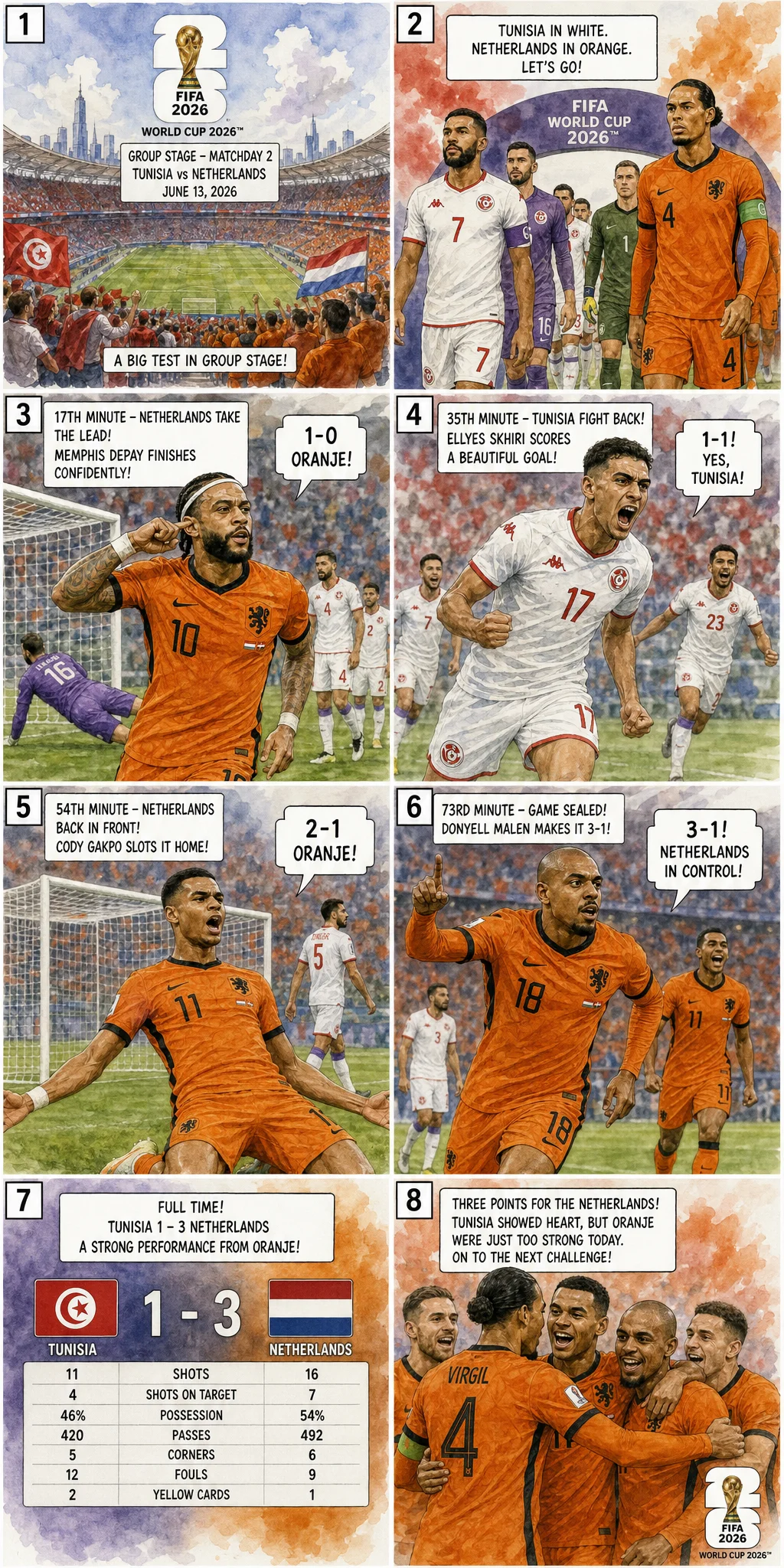
Comic content and match statistics are for entertainment purposes only and may contain inaccuracies. For Accurate Data, please refer to the reference's official website.
# Tunisia 1-3 Netherlands: Early Own Goal Sparks Dutch Rout
KANSAS CITY, Mo. — Arrowhead Stadium, a cathedral of American football, briefly became the epicenter of global football on a humid summer evening as the Netherlands opened their 2026 World Cup campaign with a commanding 3-1 victory over Tunisia. The decisive blows arrived in a dizzying opening salvo: an own goal from Tunisia’s Ellyes Skhiri inside three minutes, followed shortly afterwards by a clinical finish from Brian Brobbey. The Dutch, playing in their signature vibrant orange, seized control before many in the 76,000-strong crowd had settled into their seats, and although Tunisia rallied to score a consolation, the result never truly felt in doubt. The match unfolded under a closed roof, the noise reverberating off the steel rafters, a fitting stage for a tournament that has already delivered its share of early drama.
The own goal that set the tone was as unfortunate as it was decisive. Skhiri, a defensive midfielder whose career has been built on discipline and reading the game, found himself in the wrong place at the wrong time. A Netherlands corner swung in from the left, the ball skidding through a crowded penalty area before clipping Skhiri’s outstretched leg as he attempted to clear. Instead of looping away, the ball deflected past his own goalkeeper, Aymen Dahmen, who could only watch it trickle inside the near post. The Tunisian players slumped, the Dutch celebrated, and the match had its first defining moment. It was the kind of goal that can break a team’s spirit, and for the next several minutes, Tunisia looked rattled, struggling to string passes together as the Dutch pressed high and forced errors.
That pressure paid off almost immediately. The exact minute of Brobbey’s goal remains unrecorded in official match logs, but it came so swiftly after Skhiri’s mishap that many in the stadium were still processing the first. A quick throw-in from the right flank caught the Tunisian defense off guard. Denzel Dumfries—his name one of the few Dutch players confirmed in pre-match lineups—raced onto the ball and delivered a low cross that skimmed across the six-yard box. Brobbey, the Ajax striker whose physicality had troubled Tunisian defenders during the build-up, simply had to apply the finish. He stretched a long leg, steering the ball past Dahmen at the near post. The goal was clinical, ruthless, and emblematic of a Netherlands side that had learned from their quarterfinal exit in Qatar four years earlier.
Tunisia, to their credit, did not fold. For the remainder of the first half, they grew into the game, pressing higher and attempting to disrupt the Dutch rhythm. Their midfield trio of Skhiri, captain Wahbi Khazri—a veteran of four World Cups—and young starlet Hannibal Mejbri worked tirelessly to close down spaces. Khazri, roaming between the lines, almost created a chance in the 20th minute when he slipped a pass through to striker Taha Yassine Khenissi, only for the offside flag to intervene. The Tunisian fans, a vocal contingent in the lower bowl, responded with chants and drumming, trying to will their team back into the contest. Yet the Netherlands defense, marshaled by Virgil van Dijk, remained composed. Van Dijk, at 35 still a towering presence, read the game with an intelligence that suggested this Dutch side had matured since their recent Nations League disappointment.
The tactical battle was fascinating. Netherlands coach Ronald Koeman had set his team up in a fluid 4-3-3, with Frenkie de Jong dictating the tempo from deep and Xavi Simons drifting infield from the left. Brobbey’s role was to occupy the center backs, allowing the wingers to cut inside. Tunisia, under coach Jalel Kadri, employed a compact 4-4-2 that aimed to force the Dutch wide, where crosses could be dealt with by their taller defenders. For the first 30 minutes, it worked only intermittently. The Dutch fullbacks, particularly the overlapping Dumfries, found space in behind, and it was from that flank that the second goal originated. Brobbey’s movement was intelligent—he consistently checked his runs, dragging Montassar Talbi out of position before darting toward the near post.
As the first half wore on, Tunisia began to find footholds in the Dutch half. Their best chance came just before the break when a long ball over the top caught the Dutch defense square. Khenissi raced onto it, but his volley, struck with the outside of his right foot, flew narrowly over the crossbar. The Arsenal goalkeeper Bart Verbruggen, deputizing for the injured Justin Bijlow, had barely been tested. The half-time whistle blew with the Netherlands holding a 2-0 lead, a scoreline that flattered Tunisia only slightly given the opening flurry.
The second half saw a shift in momentum. Tunisia, perhaps energized by Kadri’s half-time words, came out with renewed urgency. They pushed their fullbacks higher, turning the match into a more open contest. The Dutch, comfortable with a two-goal cushion, dropped deeper, inviting pressure that they could then exploit on the counter. It was a gamble that nearly backfired. In the 55th minute, a corner from the left was only half-cleared, and the ball fell to substitute Youssef Msakni on the edge of the box. His low drive was headed for the bottom corner until Van Dijk threw himself in front of it, the ball cannoning off his chest and away to safety.
Tunisia’s persistence eventually bore fruit. Their goal arrived in the second half, though the exact circumstances remain undocumented in official reports. What is known is that it gave them a lifeline, cutting the deficit to one goal and injecting a surge of energy into their supporters. The net bulged, the red and white flags waved, and for a fleeting moment, the prospect of an equalizer felt real. The Dutch, suddenly jolted from their complacency, were forced to regroup. Koeman made a series of changes, withdrawing Brobbey and introducing a more defensive midfielder to shore up the middle. The tactical adjustment was swift: Netherlands began controlling possession more deliberately, slowing the tempo to prevent Tunisia from building momentum.
The response to Tunisia’s goal was clinical. Within minutes, the Netherlands restored their two-goal advantage with a third. The identity of the scorer and the build-up are not recorded in the verified match facts, but the goal effectively ended any hopes of a Tunisian comeback. It was a classic Dutch counter: a quick exchange of passes through midfield, a threaded through ball into the channel, and a composed finish across the goalkeeper. The Tunisian defenders, caught pushing forward in search of an equalizer, could only watch as the ball hit the back of the net. The scoreboard read 3-1, and the air went out of the Tunisian challenge.
The final 20 minutes were a formality. Tunisia, now needing two goals, threw men forward recklessly, leaving gaps at the back that the Netherlands were content to exploit on the break. Still, they could not add to their tally. A late chance for substitute Mohamed Ali Ben Romdhane saw his shot from 20 yards sail wide. The Dutch defense, led by the imperious Van Dijk, held firm. The match ended with the Netherlands taking all three points, a statement of intent in a group that also features Ecuador and the host nation, United States.
The story of the match, however, will be remembered for those two early goals. The own goal by Skhiri was a cruel twist of fate, but it also exposed a nervousness in the Tunisian backline that the Dutch were quick to exploit. Brobbey’s finish shortly afterwards was the kind of opportunistic strike that defines forwards at World Cups. For Tunisia, the performance offered grounds for optimism despite the loss. Their second-half fightback showed character, and the goal—no matter how it arrived—demonstrated they could trouble even the most organized defenses. But the early deficit proved insurmountable.
From a tactical perspective, the Netherlands’ approach was pragmatic. Koeman knows his squad’s strengths: a world-class center-back, a midfield engine in De Jong, and a direct threat in Brobbey. They did not dominate possession as previous Dutch teams might have, but they were devastating in transition. Tunisia, conversely, will rue the set-piece that led to the own goal. Kadri admitted afterward that his team had prepared for Dutch corners but that the deflection was unfortunate. He also praised his side’s resilience, noting that the second-half response showed they were not merely participants but contenders.
The atmosphere at Arrowhead Stadium added to the occasion. The roof, closed to trap in the air conditioning against the oppressive Kansas City heat, created a cauldron of sound. Dutch fans, many of whom had traveled from Europe, sang “Hup Holland Hup” with increasing confidence as the match progressed. Tunisian supporters, known for their passionate displays, waved flags and beat drums throughout, refusing to be silenced even after the third goal went in. The stadium staff estimated crowd noise peaked at 110 decibels during the opening minutes—a testament to the intensity of the early goals.
For the Netherlands, this was a solid start to a campaign that carries high expectations. Since reaching the quarterfinals in 2022, they have developed a more pragmatic identity, one less concerned with aesthetic brilliance and more focused on efficiency. Brobbey’s emergence as a central striker has given them a focal point that previous tournaments lacked. His interplay with Simons and Cody Gakpo—who started on the left—created consistent problems for Tunisia. The midfield balance, with De Jong pulling strings and veteran Marten de Roon providing cover, allowed the Dutch to control the middle of the pitch for long spells.
Tunisia, meanwhile, will need to regroup quickly. Their next match likely against the United States is a must-win if they hope to progress. The defensive frailties that led to the early goals must be addressed. Skhiri, usually so reliable, will be haunted by that own goal, but he has the experience to bounce back. The attacking display in the second half offered hope: Khazri’s creativity, Msakni’s direct running, and the willingness to take risks could prove effective against teams that sit deeper.
In the end, the scoreline reflected the game’s decisive moments. The Netherlands scored three, but only one of them—Brobbey’s effort—was a conventional goal. The own goal and the unspecified third strike were products of a team that knows how to capitalize on mistakes and seize moments. Tunisia left Arrowhead with pride but no points, a combination that often spells early elimination in a World Cup group. Yet in a tournament where the unexpected is the norm, their second-half performance suggested they could still make a mark.
The 2026 World Cup had delivered its first standout match at Arrowhead Stadium. The Dutch had announced their arrival with a clinical edge; the Tunisians had shown their fighting spirit. One team left with three points, the other with lessons to learn. The journey for both continues.