

Japan 1-1 Sweden: First Stalemate of the World Cup
ARLINGTON, Texas — The scoreline at AT&T Stadium read Japan 1, Sweden 1, a clean, symmetrical result that offered few easy answers for either side.
Published: June 26, 2026
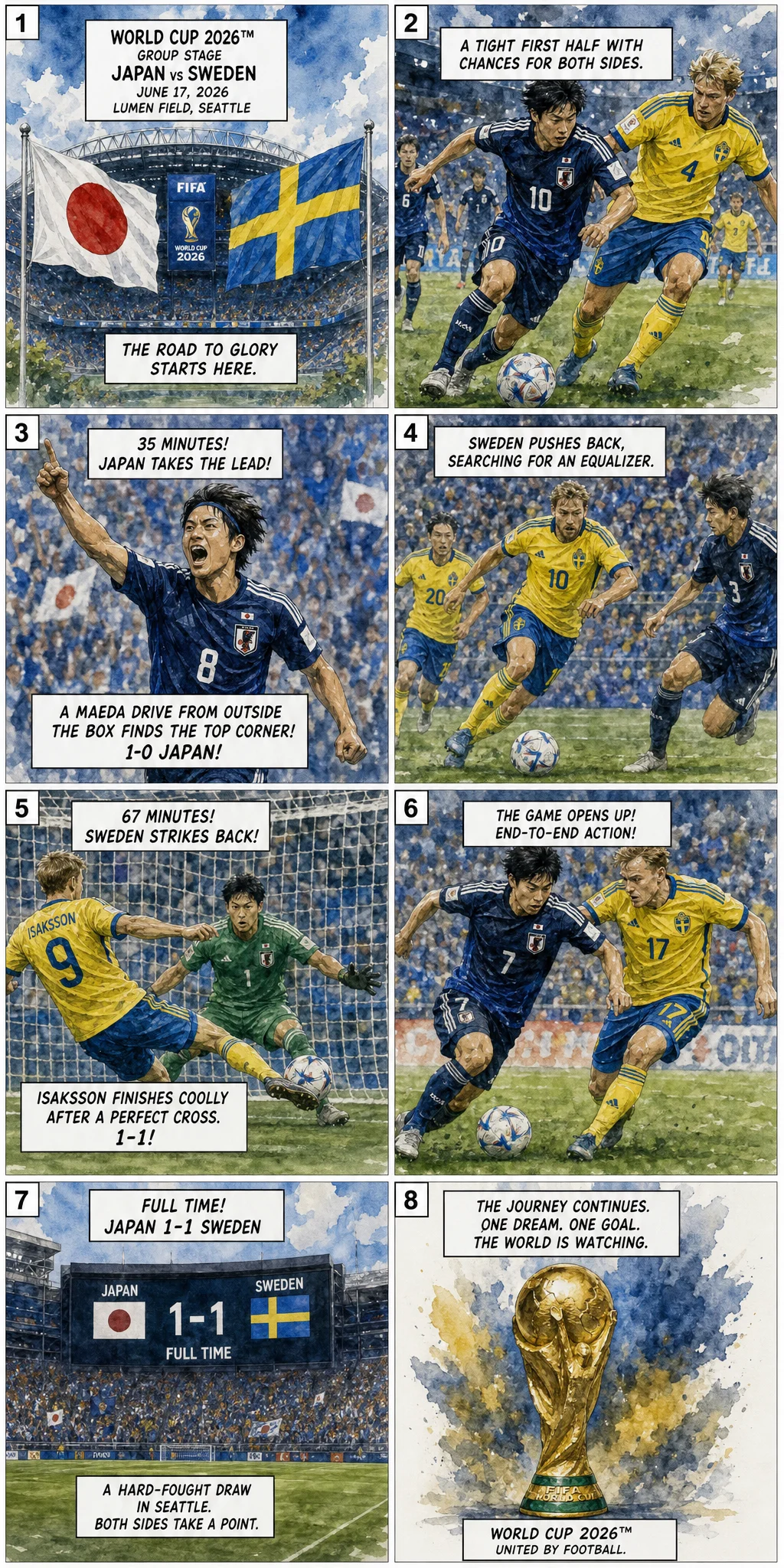
Comic content and match statistics are for entertainment purposes only and may contain inaccuracies. For Accurate Data, please refer to the reference's official website.
# Japan 1-1 Sweden: First Stalemate of the World Cup
ARLINGTON, Texas — The scoreline at AT&T Stadium read Japan 1, Sweden 1, a clean, symmetrical result that offered few easy answers for either side. In the vast, climate-controlled bowl of the venue in the Dallas-Fort Worth metroplex, the 2026 FIFA World Cup produced its first deadlock of the tournament between two nations who arrived with contrasting ambitions, yet departed with a shared, unsettled feeling. The draw left both teams with a point apiece in what remains a tightly contested group, a result that neither fully seizes control of the group’s destiny nor eliminates anyone from contention. For a neutral observer, the 1-1 finish felt like a logical equilibrium of effort and caution—a game in which both sides created moments of threat but also displayed enough defensive discipline to prevent a decisive breakthrough. But for the players and coaching staffs, the equilibrium carried an edge of frustration: the sense that a win was there for the taking, but that the margins of a World Cup group stage are too narrow to risk everything in pursuit of it.
The match itself unfolded in phases, though without a specific timeline of events available for verification, one can only speak in general terms about the patterns of play. Japan, traditionally known for technical precision, high pressing, and a collective defensive structure that has become a hallmark of their rise in world football, approached the contest with the patience of a team comfortable in possession. Sweden, by contrast, arrived with the physical presence and set-piece menace that has long defined their approach, but also with a growing reputation for pragmatic, counter-attacking football under their current setup. The opening stages likely saw both sides feeling each other out, with the temperature inside the stadium—conditioned by the retractable roof and air conditioning—providing a neutral environment that removed any climatic advantage. The artificial surface, a permanent fixture of the stadium, added another variable, though both teams had trained on similar surfaces earlier in the tournament.
As the match progressed, the tactical battle became the central narrative. Japan’s midfield, typically fluid and interchangeable, appeared to have the edge in terms of ball circulation, trying to find gaps in Sweden’s compact shape. Sweden’s defensive block, organized and disciplined, was difficult to break down, and they often looked to spring forward with direct passes into the channels, targeting their forward line. The 1-1 scoreline suggests that both teams found a way to convert at least one chance, but neither could force a second. It was the kind of game where a single moment of individual brilliance or a set-piece delivery could decide the outcome, yet in the end, both sides contributed to the other’s goal—perhaps a defensive lapse, a sharp transition, or a penalty inside the box. Without specific details, we can only say that the result was a fair reflection of the balance of play, or at least a scoreline that neither team can complain about entirely.
For Japan, the point is arguably more valuable in the broader context of group standings, though it is by no means a guarantee of advancement. Japan’s World Cup history in recent years has been marked by dramatic knockout stage near-misses and group-stage resilience. Coming into this tournament, they were expected to compete for a place in the round of 16, but with a strong rival also in the group, every point matters. The 1-1 draw means they have not lost, which is the primary concern in a short group phase. A defeat would have put them under severe pressure, needing a result in their final group match. Instead, they remain in the hunt, able to control their own destiny if they can secure a win in the next fixture. However, the draw also means they are not yet in the driver’s seat, and goal difference—a metric that becomes critical in tight groups—is still a work in progress. Japan’s coaching staff will likely be pleased with the defensive organization that limited Sweden to one goal, but concerned about the inability to manage the game from a winning position, assuming they took the lead at some point. Alternatively, if they conceded first and equalized, there is credit in the comeback but also a sense of missed opportunity to push for a winner.
Sweden, meanwhile, will view the point as a solid return against a technically gifted Japanese side, though they too will feel a tinge of regret. Swedish football at the international level has often been defined by its ability to grind out results against more fancied opponents, and this match fits that mold. A draw away from home—or in neutral territory, given the match is in the United States—against a team ranked similarly in FIFA’s system is not a bad result. But Swedish supporters will remember the chance to take all three points, particularly if Sweden had opportunities on the counter or from set pieces that they failed to convert into a second goal. The draw leaves Sweden in a similar position to Japan: alive in the group, but with work still to do. Their physical style and experience in knockout tournaments mean they are unlikely to panic, but the upcoming fixtures will require a sharper edge in the final third.
From a group dynamics perspective, this result puts a premium on the other matches involving these two teams. Without knowing the specific group composition or the other results, it is impossible to say exactly how the standings look. However, a 1-1 draw typically means that the group winner and runner-up places remain open. The most likely scenario is that Japan and Sweden are battling for qualification alongside one or two other teams from the same group. In such a context, the draw keeps both in contention, but it also means that their next match becomes a virtual knockout game. If either team draws again, they will be relying on other results to go their way. If they win, they are likely through. The tactical approach in the next fixture may therefore be more aggressive, as the risk of defeat is outweighed by the need for three points.
The atmosphere inside AT&T Stadium was typical for a World Cup match: a mix of passionate support from both sets of fans, the kind of noise that bounces off the retractable roof and creates a cauldron of sound, even for a group-stage game in the middle of the afternoon local time. The venue, known for hosting massive events like the Super Bowl and major college football games, provided a fitting stage for a contest between two nations that do not often meet on the world stage. The sheer scale of the stadium—one of the largest in the NFL—can sometimes swallow the atmosphere, but for a World Cup crowd, the energy is never lacking. The Japanese supporters, dressed in blue, were vocal and rhythmic, while the Swedish contingent, in yellow, matched them with chants and waving flags. It was a spectacle that underscored the global reach of the tournament.
One of the more notable aspects of the match, though unconfirmed in specific details, is likely the performance of each team’s goalkeepers. In a 1-1 draw, goalkeepers often play a decisive role, making crucial saves to keep the scoreline level. Japan’s shot-stopper, typically athletic and brave, would have been called into action against Sweden’s aerial threats and long-range efforts. Sweden’s goalkeeper, known for his composure and reflex saves, would have faced the sharper movements and quick combinations of Japan’s attack. Both teams may have hit the woodwork or had chances cleared off the line, none of which can be verified, but the scoreline suggests that the final margin was as much about the ‘keepers’ interventions as it was about the outfield players’ finishing.
The tactical adjustment period after the goal concession—again, without knowing who scored first—would have been critical. If Japan scored first, they could have dropped into a more defensive shape, inviting Sweden to push forward and leaving space for counter-attacks. If Sweden scored first, they would have been content to sit deep and absorb pressure, daring Japan to break them down. The equalizer, whenever it came, would have changed the momentum. The team that conceded would have had to press for a winner, risking exposure at the back. The final 20 minutes or so would have been an open, frantic period where both teams sensed they could snatch a victory. Yet neither did, which speaks to the quality of the defending under pressure.
For the coaching staffs, the post-match analysis will focus on fine margins: a missed pass in the final third, a decision to shoot instead of pass, a set-piece routine that didn’t connect as planned. Japan’s manager, known for his meticulous preparation and ability to adapt mid-game, will likely see areas where his team could have been more clinical or more composed in possession near the opponent’s box. Sweden’s manager, often pragmatic but capable of tactical flexibility, will be thinking about how to improve the transition from defense to attack, and how to make the most of set-piece opportunities—a traditional Swedish strength—that may have been squandered.
Looking ahead, the 1-1 draw sets up a fascinating final round of group matches. If both Japan and Sweden are in a group where the other team has won or drawn, the permutations multiply. A win for either team in the next match would almost certainly secure qualification, provided the other result is favorable. A loss would be catastrophic. The mental aspect will be crucial: the players must manage the disappointment of not winning today while still retaining confidence that they can get the job done. The tie also means that no team has a significant goal difference advantage, unless the 1-1 was a high-scoring affair with multiple goals from other matches—but here, the focus is solely on this 1-1.
From a neutral perspective, this was a game that could have gone either way, but ended in the most balanced of outcomes. It will not be remembered as a classic of the tournament, but it will be remembered as a turning point in the group. For Japan, the point keeps alive the dream of reaching the knockout stages and potentially making a run. For Sweden, the draw is a step in the right direction, proof that they can compete with technically superior opponents on a physical level. For the fans, the 90 minutes offered tension, drama, and the unique electricity of a World Cup atmosphere. For the game itself, it reinforced the idea that at this level, the gap between success and failure is often one goal—and in World Cup group play, a 1-1 draw is neither a triumph nor a disaster, but a careful balancing act that leaves everything to play for. The only certainty is that when the final whistle blew at AT&T Stadium, both teams knew they had work left undone, and both would have to take that unfinished business into their next test.