

Paraguay 0-0 Australia: Goalless Draw Leaves Both Winless
The barren scoreline at Levi’s Stadium in Santa Clara will not linger long in the memory of neutrals, but for Paraguay and Australia, this 0-0 draw at the 2026 FIFA World Cup carries the weight of a…
Published: June 26, 2026
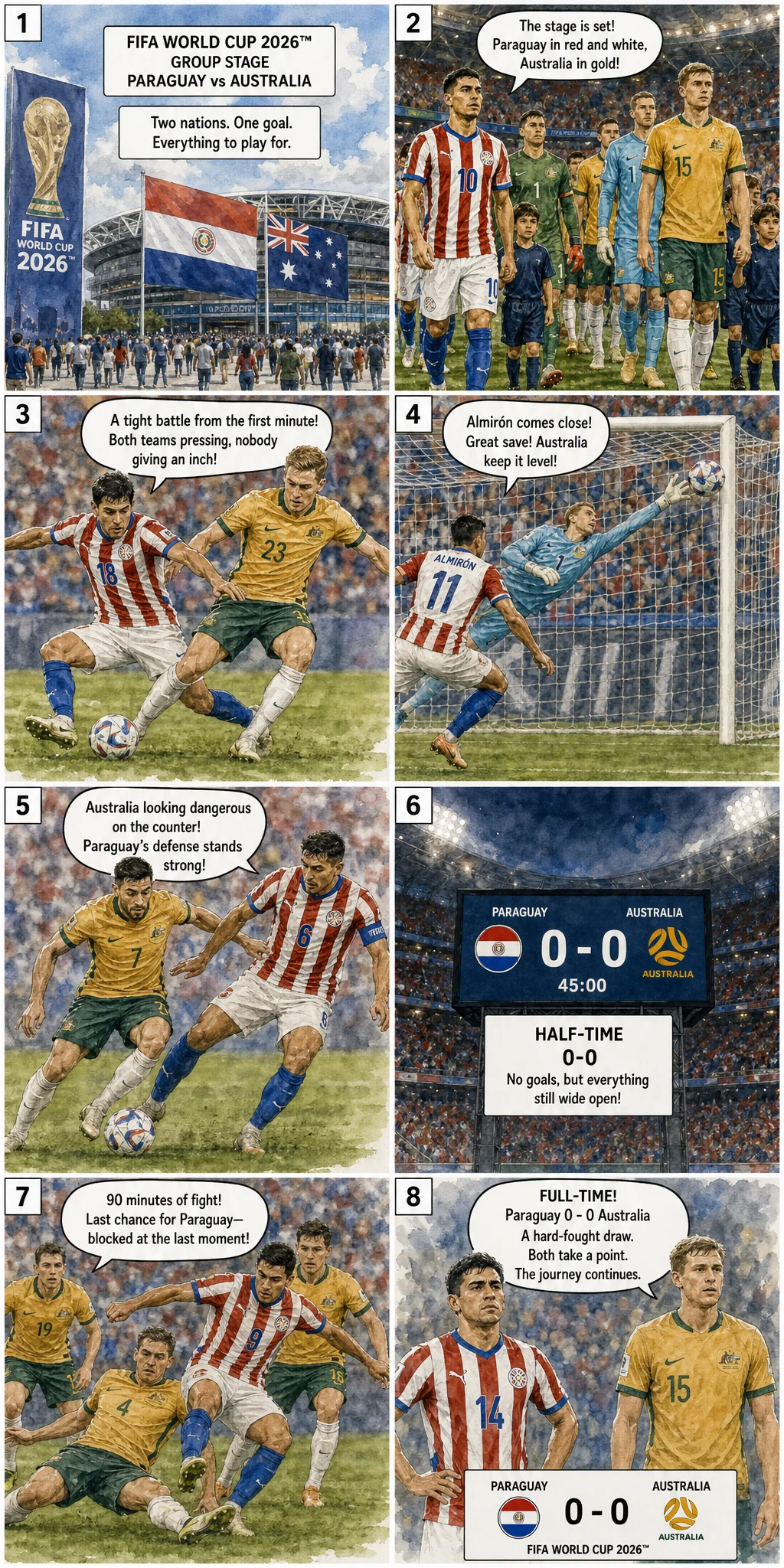
Comic content and match statistics are for entertainment purposes only and may contain inaccuracies. For Accurate Data, please refer to the reference's official website.
# Paraguay 0-0 Australia: Goalless Draw Leaves Both Winless
The barren scoreline at Levi’s Stadium in Santa Clara will not linger long in the memory of neutrals, but for Paraguay and Australia, this 0-0 draw at the 2026 FIFA World Cup carries the weight of a result that leaves both teams still searching for their first win of the tournament. In a group where margins are already razor-thin, the point earned by each side feels less like a foundation and more like a holding pattern — a stoppage of momentum that neither will fully celebrate until they see how the next round of fixtures reshapes their chances. The match itself was a study in mutual caution, a tactical chess match played under the California sun where the primary objective for both managers appeared to be avoiding defeat rather than seizing victory. For long stretches, the game lacked the rhythm and incision associated with World Cup football, yet it was not without significance. The clean sheet here is a small triumph for two defensive units that have historically been questioned on the biggest stage, but the blank scoreline also raises uncomfortable questions about the attacking firepower required to progress beyond the group phase.
Paraguay entered this fixture with a reputation for grit and organisation, traits that have defined their national team identity for decades. Against Australia, they leaned heavily on that identity, compressing space in central areas and forcing the Socceroos into wide positions where crossing opportunities dried up against a well-drilled back four. The Paraguayan defensive structure was disciplined, rarely caught out of shape, and their midfielders tracked runners with a diligence that suggested a side intent on weathering the storm rather than imposing themselves. Yet for all their solidity without the ball, Paraguay offered precious little with it. Their build-up play was ponderous, often retreating into safe sideways passes rather than testing Australia’s defensive line with incisive runs behind. The lack of a clear attacking pattern is a concern that will only intensify if they fail to create meaningful chances in their remaining group matches. The point may stop the rot after an opening defeat — if indeed that was their first result — but it does little to address the fundamental issue of how this team intends to score goals against increasingly well-scouted opponents.
Australia, meanwhile, came into this match knowing that their chances of advancing rest on their ability to turn possession into penetration. Against Paraguay, they had the better of the ball for extended spells, particularly in the first half, but their final-third decision-making betrayed a lack of composure that has plagued them in recent major tournaments. The Socceroos’ full-backs pushed high, their midfielders rotated into pockets of space, yet the final pass or cross frequently missed its intended target or was blocked by a recovering Paraguayan defender. There was no shortage of effort — the Australian players ran hard, pressed in packs, and displayed the physical resilience that has become their hallmark — but effort without precision rarely unlocks a deep-lying block. The clean sheet on the other end, however, should not be overlooked. Australia’s defensive unit, often viewed as the weaker link in their squad, held firm against a Paraguayan side that, while limited in attack, has players capable of punishing individual errors. The communication and coordination between the goalkeeper and centre-backs appeared improved, a product of the weeks of preparation in camp. But the zero on the scoresheet for both teams tells a story of a match where neither side could land a decisive blow, and where the fear of losing outweighed the ambition to win.
The broader context of this result depends heavily on the other match in Group — though without verified details of that game, one can only speculate on the permutations. In a typical four-team group, a draw leaves both Paraguay and Australia with two points from two matches if they both drew their openers, or one point each if they lost their first games. Either way, the arithmetic remains complicated. For Paraguay, the path to the knockout stages likely requires a victory in their final group match, a scenario that will demand far more creativity and conviction than they displayed here. For Australia, the equation is similar, though their superior possession stats and territorial dominance in this match may give them confidence that a breakthrough is imminent. Yet confidence is a fragile commodity in tournament football, and a goalless draw against a similarly pragmatic opponent can just as easily breed frustration as belief. The tactical takeaway from Levi’s Stadium is clear: both teams can defend well enough to earn points, but neither has yet shown the incisiveness required to win matches at this level. That is a worrying sign with the group stage reaching its climax.
Levi’s Stadium, a venue more accustomed to the high-octane spectacle of American football and major concerts, provided a neutral but vibrant backdrop for this encounter. The crowd, a mix of local supporters and travelling fans from both nations, generated a steady hum of anticipation throughout, but the lack of goalmouth action inevitably dampened the atmosphere as the second half wore on. There were brief flurries of excitement — a powerful run down the flank, a desperate sliding tackle in the box, a long-range effort that sailed harmlessly over the bar — but these moments were isolated. The match settled into a rhythm of broken play, fouls, and restarts, with both sets of players appearing content to keep the scoreline intact rather than risk a costly lapse in concentration. In that sense, the game was a reflection of modern tournament football at its most conservative: a contest decided not by who was better, but by who made fewer mistakes. Neither team committed a fatal error, and so neither team won.
From a psychological standpoint, the draw carries different weight for each side. Paraguay will take heart from a clean sheet against a team that pressed them aggressively in the opening stages. The resilience shown in absorbing pressure without conceding is a trait that can serve them well in a tight group. Yet there is a danger in overvaluing defensive solidity at the expense of attacking ambition. Paraguay manager — whose tactical approach has traditionally favoured pragmatism — will face scrutiny if his side fails to score in the next match. The frustration expressed by Paraguayan players at the final whistle, evident in their body language as they trudged off the pitch, suggested they understood that a draw is not sufficient progress. For Australia, the mood may be slightly more optimistic. The Socceroos have often been criticised for their inability to control games against South American opposition, but here they demonstrated that they can compete physically and tactically. The question now is whether they can translate that competitiveness into goals. Their final group fixture will require a different mindset: one that prioritises risk-taking over conservatism.
The historical context of a 0-0 draw at a World Cup is one of caution and missed opportunities. For Paraguay, it evokes memories of previous tournament stalemates where they secured the point but ultimately fell short of the knockout stage due to an inability to score when it mattered most. For Australia, it adds another chapter to a narrative of near-misses and what-ifs. The 2026 edition was supposed to be a chance for both nations to assert themselves on a global stage that increasingly favours European and South American elites. Yet this draw suggests that neither has yet bridged the gap. The technical quality on display was occasionally pleasing, but the final product was lacking. The absence of individual brilliance — that moment of magic that turns a draw into a win — was the most telling absence of the afternoon.
In the days ahead, both coaching staffs will pore over footage, searching for patterns that can be exploited. Paraguay may look to adjust their attacking shape, perhaps introducing a more advanced midfield runner or instructing their full-backs to overlap more aggressively. Australia, meanwhile, will likely work on their crossing accuracy and set-piece delivery, areas where they had some success but not enough to break the deadlock. The match at Levi’s Stadium was not a classic, but it was a lesson in how fine the line is between progress and elimination in World Cup football. One point gained, two points dropped — the math is cold and unforgiving. As the group stage enters its final round, Paraguay and Australia know that a single moment, a single goal, could define their entire campaign. They will have to find that moment somewhere else, against someone else. At this venue, they found only a stalemate, and a reminder that in football, sometimes the hardest thing to secure is the victory that everyone expects.
For the journalists and analysts watching from the press box at Levi’s Stadium, the challenge is to read meaning into a match that provided so little tangible action. The answer lies not in the events that occurred, but in the ones that didn’t — the chances not taken, the risks not accepted, the pass not made. Paraguay and Australia played a World Cup match that ended 0-0, and while that scoreline will never make headlines, it will shape the narratives of both teams for the rest of the tournament. Whether those narratives end in triumph or disappointment remains unwritten, but the blank canvas of this draw leaves everything to play for. That, in itself, is a kind of drama — quiet, tense, and waiting to be resolved.