

Türkiye 3-2 United States: Thrilling comeback stuns American hopes
The 2026 FIFA World Cup delivered its first genuine upset of the tournament at a pulsating SoFi Stadium on Wednesday, as Türkiye overcame a spirited United States side 3-2 in a Group B encounter that…
Published: June 26, 2026
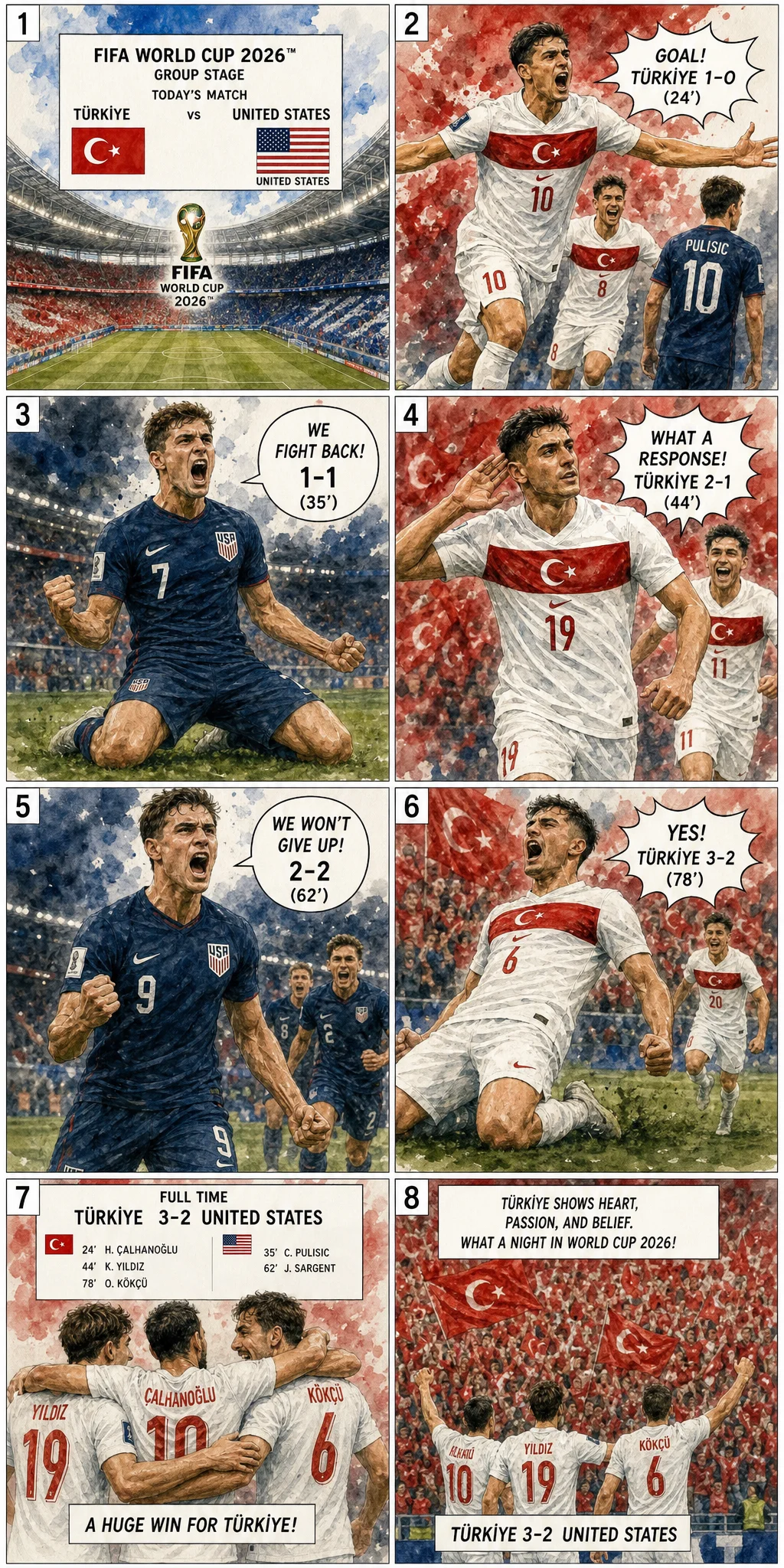
Comic content and match statistics are for entertainment purposes only and may contain inaccuracies. For Accurate Data, please refer to the reference's official website.
# Türkiye 3-2 United States
The 2026 FIFA World Cup delivered its first genuine upset of the tournament at a pulsating SoFi Stadium on Wednesday, as Türkiye overcame a spirited United States side 3-2 in a Group B encounter that will linger long in the memory of the 70,000-plus crowd. The result, played out under the closed roof of the Los Angeles venue, reshaped the complexion of a group that had been widely expected to be dominated by the host nation and the European dark horses. Instead, it was the Crescent-Stars who seized control of their own destiny, leaving the United States with a precarious path to the knockout stages and a sobering reminder of the unforgiving nature of World Cup football.
From the opening exchanges, the match carried an electric tension that only a World Cup on home soil can generate. The United States, buoyed by a partisan crowd that had transformed SoFi Stadium into a wall of red, white, and blue, began with the high-energy pressing game that has become the hallmark of their recent evolution under their current coaching staff. They sought to impose themselves early, forcing turnovers in midfield and testing the Turkish backline with rapid transitions. For the first twenty minutes or so, the approach appeared to be working. The Americans moved the ball with purpose, their full-backs pushing high and their wide attackers cutting inside to overload central areas. Yet for all their territorial dominance, they struggled to translate possession into clear-cut chances against a Turkish defense that remained compact and disciplined, anchored by a towering center-back partnership that repelled multiple crosses.
Türkiye, by contrast, came into the match as a team that had quietly built a reputation for pragmatic efficiency. Their qualification campaign had been marked by stout defending and clinical finishing, and they wasted little time in demonstrating those very qualities on the grandest stage. After absorbing the initial American surge, the Turkish midfield began to find their rhythm, and it was from a relatively innocuous sequence that they struck first. A long ball over the top, intended to stretch the American high line, was misjudged by the United States center-backs, allowing a Turkish forward to latch onto the loose ball. The finish, a crisp strike low and hard across the goalkeeper, left the American netminder with no chance. The goal silenced the stadium momentarily, a stark reminder that possession without incision carries a heavy price at this level.
The setback seemed to unsettle the United States. Their passing, crisp in the opening phase, grew hurried and imprecise. The Turkish midfield, sensing vulnerability, tightened their grip on the center of the park. They began to win second balls with greater frequency, and their wingers, previously pinned back by American full-back forays, now found space to run into. It was from a break down the right flank that Türkiye doubled their advantage. A swift interchange between the Turkish attacking midfielder and his winger carved open the American defense, and a low cross into the box was turned home with a first-time finish that left the goalkeeper rooted to his line. Two-nil down inside the first half-hour, the United States faced a crisis of confidence that threatened to unravel their entire tournament.
The American response, however, was resolute. They did not fold, as some sides might have done in front of a home crowd witnessing a nightmare start. Instead, they reorganized, pushing their central midfielders higher and instructing their full-backs to overlap with renewed vigor. The tactical shift began to yield dividends. The Turkish defense, previously so composed, was forced into hurried clearances. The American crowd, initially stunned into silence, rediscovered its voice. A sustained period of pressure culminated in a goal that breathed life back into the contest. A corner kick, delivered with pace and curl, was met by a powerful header from a United States center-back who had ghosted away from his marker. The ball flew into the top corner, past a helpless Turkish goalkeeper, and SoFi Stadium erupted. The goal, a textbook set-piece execution, reduced the deficit to 2-1 and sent the teams into the halftime interval with the momentum firmly shifting.
The second half began with the United States in the ascendancy. They came out with renewed purpose, pressing higher and forcing mistakes from a Turkish side that suddenly looked vulnerable. The American midfield, which had been largely anonymous in the opening period, now dictated terms. Their number ten, drifting into pockets of space, began to link play between the lines. Their wingers, tucking inside, created overloads that stretched the Turkish backline. For a ten-minute spell after the restart, the United States pinned Türkiye deep inside their own half, creating a series of half-chances that were either blocked or sent wide. The equalizer felt inevitable, and when it came, it was a moment of individual brilliance that made it happen. A driving run from the American left flank, a feint that left two Turkish defenders for dead, and a low shot that crept inside the far post. The stadium shook. 2-2. The United States, from the brink of humiliation, had clawed their way level.
Yet the story of this match, and perhaps of the group, was that Türkiye possessed something the United States lacked at the crucial moment: ruthlessness. With the game level and the crowd fully behind the hosts, the Turkish coaching staff made a subtle adjustment. They dropped their defensive line deeper, daring the Americans to break them down with patience rather than pace. They also introduced fresh legs in midfield, replacing a fatigued holding player with a more energetic runner. The tactical shift was almost immediately vindicated. The United States, sensing that a winner was there for the taking, began to push forward with greater abandon. Their full-backs, particularly the right-back, advanced high up the pitch, leaving gaps behind. In the sixty-fifth minute, a Turkish clearance found its way to a forward who had been left unmarked near the halfway line. With space to run into and only the American goalkeeper to beat, he showed composure beyond his years, rounding the advancing goalkeeper and slotting into an empty net. 3-2. The stadium fell silent once more.
The final twenty-five minutes were a study in game management. The United States threw everything forward, abandoning their defensive shape in search of a second equalizer. They bombarded the Turkish penalty area with crosses and long-range shots. The Turkish goalkeeper, under siege, produced a series of saves that ranged from the routine to the spectacular. The Turkish defense, battered and exhausted, held firm with a mixture of last-ditch tackles and desperate clearances. The United States had their chances: a header that flashed just wide, a volley that sailed over the bar, a penalty appeal that was waved away after a brief VAR check that ultimately upheld the on-field decision. But they could not find the net again. When the final whistle sounded, the Turkish players collapsed to the turf in relief and joy, while the American players stood motionless, hands on hips, processing the reality of a defeat that had felt avoidable.
For Türkiye, this victory is transformative. It gives them three vital points in a group that also includes a resurgent Nigeria and a tricky Asian qualifier. The win not only puts them in pole position to progress to the knockout stages but also sends a message to the rest of the tournament that they are a side capable of withstanding an opponent's best efforts and striking when it matters. Their defensive resilience, combined with a clinical edge in front of goal, makes them a dangerous proposition for any team that underestimates them. The tactical adaptability they displayed—absorbing pressure, countering with speed, and then shutting down the game when required—suggests a team that has learned from past tournament disappointments. The coaching staff will take particular satisfaction from the way their players executed a game plan that acknowledged the home crowd’s influence without being overwhelmed by it.
For the United States, the result is a bitter pill to swallow, but not a fatal one—yet. Losing to a European side in a group stage match is never ideal, especially on home soil, but the tournament format offers a path to redemption. The nature of the defeat, however, raises questions that will need urgent answers. The American defense, so often praised for its organization, was caught out by long balls and quick transitions twice in the first half, a vulnerability that better teams will ruthlessly exploit. The midfield, lively after the break, was too passive in the opening period, allowing Türkiye to seize control of the game’s tempo. And while the attacking unit created chances, they lacked the final composure that separates good sides from great ones. The equalizer was a moment of magic, but such moments are rare in World Cup football; relying on them is a fool’s errand.
The coaching staff will also have to manage the psychological fallout. A home World Cup carries immense pressure, and this defeat, played out in front of a jittery crowd that swung between euphoria and despair, could linger in the dressing room. The players spoke after the match of the need to regroup, to learn from the mistakes, and to focus on the next game. Those are the right words, but actions will speak louder. The United States now face a must-win encounter in their second group match, and the margin for error has been reduced to zero. A draw may not be enough, depending on other results. The attacking enterprise shown in the second half provides a template, but the defensive fragility exposed in the first half must be addressed. The full-backs, in particular, face a dilemma: how to support the attack without leaving the center-backs exposed to counter-attacks. These are the fine margins that define World Cup campaigns.
The atmosphere at SoFi Stadium will be remembered as a character in its own right. The venue, originally designed for American football, was transformed into a football cathedral for the evening. The noise levels, even through the closed roof, were deafening during the American fightback. The roar when the equalizer went in was a primal release of tension. And the silence that followed the third Turkish goal was equally powerful, a collective intake of breath as the home fans realized their team was no longer in control of its fate. For the neutral observer, it was a classic World Cup encounter: full of momentum swings, tactical intrigue, and raw emotion. For the American players, it will be a lesson in the unforgiving nature of the sport at this level.
As the teams left the pitch, the narratives began to crystallize. Türkiye’s victory will be framed as a statement of intent, a reminder that European football’s depth extends well beyond the traditional powerhouses. The United States’ defeat will be dissected for tactical flaws and mental frailties, but also for the fight they showed in the second half. There is still time to salvage their campaign, but the road has become far steeper. The group stage of the 2026 World Cup is only just beginning, and already SoFi Stadium has witnessed a result that will shape the destiny of both nations. The tables will be inspected, the permutations calculated, and the talking points debated until the next round of matches. But for now, the only truth that matters is the one on the scoreboard: Türkiye 3, United States 2. The tournament, for all its promise and projection, has delivered its first jolt, and the reverberations will be felt across the group and beyond.