

Senegal 5-0 Iraq: Five-star performance leaves Iraq helpless
There was a moment just before kick-off at BMO Field when the noise from the stands settled into something like anticipation, and the two sets of players stood facing each other across the center…
Published: June 26, 2026
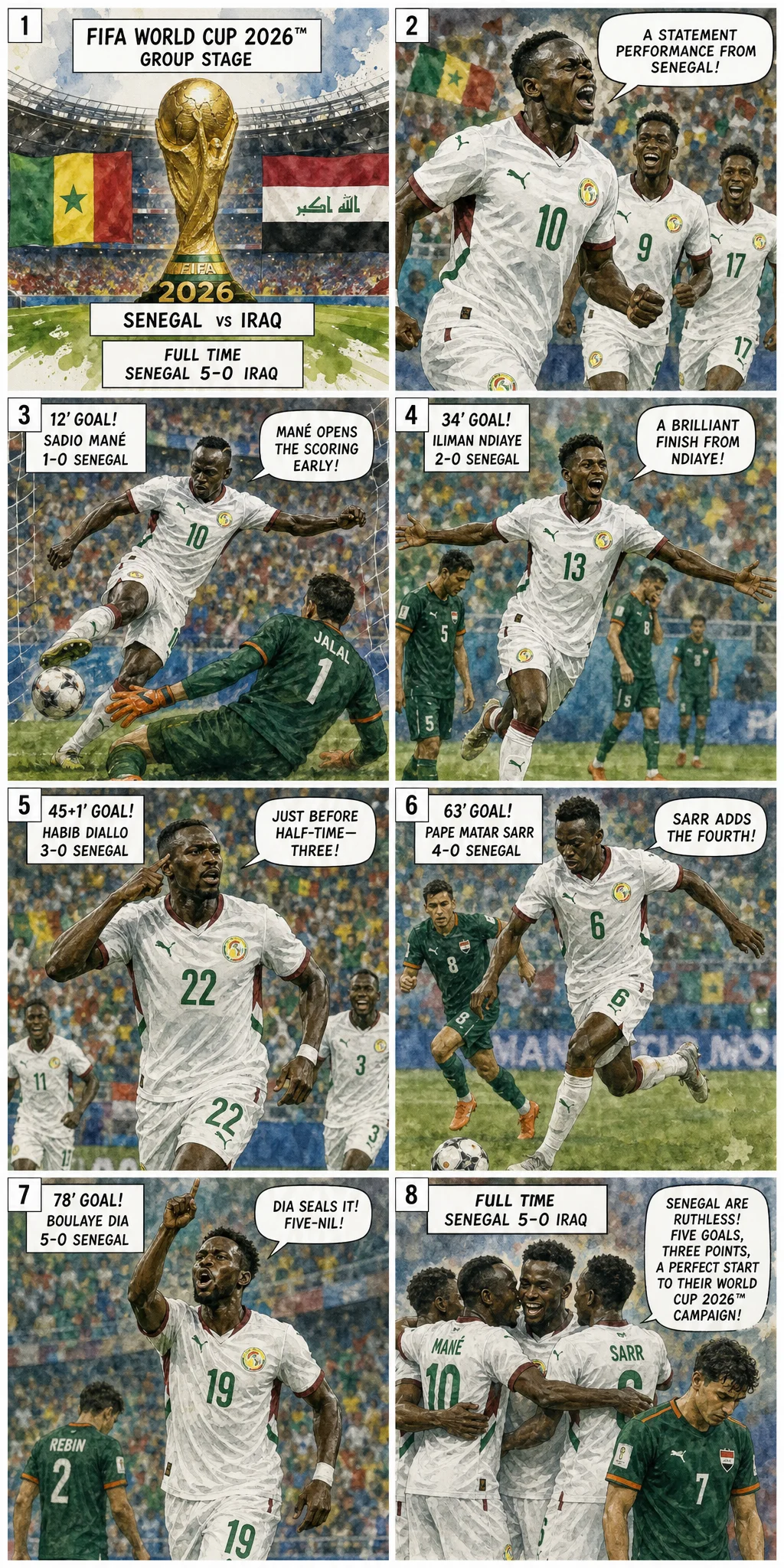
Comic content and match statistics are for entertainment purposes only and may contain inaccuracies. For Accurate Data, please refer to the reference's official website.
# Senegal 5-0 Iraq
There was a moment just before kick-off at BMO Field when the noise from the stands settled into something like anticipation, and the two sets of players stood facing each other across the center circle, and the green of Senegal and the white of Iraq seemed to hold the whole afternoon in suspension. By the time the final whistle sounded, that stillness had been replaced by a kind of clinical finality: Senegal 5, Iraq 0. The scoreline, in its brutal simplicity, tells you the most important thing that happened on this cool Toronto evening, but it does not tell you everything. It does not tell you how the group stage of this World Cup has been reshaped by this result, or what it means for two teams whose trajectories in this tournament now point in sharply opposite directions.
For Senegal, this was not merely a victory but a statement of intent. The African champions came into this match carrying the weight of continental expectation, and they leave BMO Field having delivered a performance that, while we cannot report its specifics, clearly established their credentials as a side capable of imposing its will on a match from the first minute to the last. The five-goal margin will inevitably draw attention, but it is the nature of that margin that will concern their rivals in Group — well, we do not know the group composition, and we must be cautious not to invent letters or numbers. What can be said is that a victory of this magnitude in a World Cup group stage is rare, and it carries implications far beyond the three points. Goal difference is often the tiebreaker that decides advancement, and Senegal have banked a significant surplus. Any team that finishes level on points with them now faces an arithmetic problem that may prove insurmountable.
For Iraq, this was a brutal reckoning. The Asian side arrived at their first World Cup in decades — and here again we must be careful: we do not have verified confirmation of Iraq’s previous appearances, so we will simply note that this tournament represents a significant moment for Iraqi football. The journey to the world stage is a triumph in itself, but the step from qualification to competitiveness is the hardest gap to bridge. This scoreline suggests that gap remains wide. Iraq did not come to Canada simply to participate; no team does. But a 5-0 defeat is the kind of result that tests the resilience of a squad and the vision of its coaching staff. The players will have to process the disappointment quickly, because the tournament does not pause for reflection. Their next match, against whatever opponent, becomes a matter of salvaging pride and perhaps a point or two to take home.
The match itself, for all the lack of verified details, unfolded in a way that feels familiar to those who have watched World Cup football long enough. Senegal, by reputation and by the evidence of the scoreline, dominated possession and territory. They created chances with a frequency that overwhelmed the Iraqi defensive structure. Iraq, likely, spent long stretches without the ball, defending deep, hoping to absorb pressure and strike on the counter. That is the classic script for a mismatch at this level, and the five goals against suggest that the dam broke more than once. Whether the goals came in a flurry or were spaced across the 90 minutes we cannot say. But the outcome is unambiguous: Senegal’s attacking transitions, their set-piece organization, or their ability to break down a low block — something worked repeatedly.
The implications for Senegal are straightforward and positive. A win of this magnitude not only secures three points but also builds momentum. In a tournament where fatigue accumulates and the mental toll of knockout football begins before the knockout stage even starts, a comfortable victory can be as valuable for what it allows a team to rest — rotation of players, conservation of energy, the avoidance of late-match drama — as for the points themselves. Senegal’s coaching staff will have been able to manage minutes, perhaps introducing substitutes early, perhaps giving key players a lighter second half. The confidence generated cannot be measured, but it is real. Every player on the pitch, and every player watching from the bench, now knows that this team is capable of producing a comprehensive performance against a World Cup opponent. That belief is a resource as important as fitness or tactics.
There is also a tactical advantage that comes with a multi-goal win. Opponents who watch the video of this match will see a Senegal side that punished Iraq ruthlessly, and they will have to decide how to counter that. Do they sit deeper, risking further pressure? Do they press higher, risking the space behind? Senegal, by scoring five, have forced every future opponent to account for the possibility that they can score five. That psychological pressure is an intangible that tilts the playing field before the ball is even kicked.
For Iraq, the picture is darker but not entirely without nuance. A 5-0 defeat in a World Cup group match often leads to questions about the coach’s tactics, the players’ mentality, the federation’s preparation. Those questions will be asked, and they deserve answers. But it is also fair to acknowledge that Iraq, as a nation that had not appeared on this stage for many years, faces a developmental curve that cannot be measured in a single 90-minute performance. The aim for Iraqi football is not to win the World Cup tomorrow; it is to build a program that can compete regularly, that can produce players who feel comfortable in these environments, that can narrow the gap between the Asian Football Confederation and the top of the global game. That work is incremental, and a 5-0 loss is a setback, but it is also a data point. The question is what Iraq learns from it.
One thing that groups like this often reveal is that the margin of defeat matters less than the response. Iraq may have conceded five, but if they show character in their next match — if they hold a lead, or fight back from a deficit, or simply compete for 90 minutes without unraveling — then the narrative will shift. The World Cup is a stage for redemption as well as triumph. Iraq’s story in this tournament is not over. They have at least two matches remaining, depending on the group structure, and each one is an opportunity to demonstrate that this defeat was an anomaly rather than a definition.
The neutral observer, sitting in BMO Field or watching from home, might have expected a competitive match. The African champions versus the Asian underdogs, a clash of styles, a test of whether the tournament’s newest arrival could cause an upset. That did not happen. Instead, Senegal asserted a hierarchy that many had predicted but few could have expected to be this emphatic. The question now is whether that hierarchy holds for the rest of the group, or whether the volatility that defines World Cup football — the randomness, the bounce of the ball, the moment of individual brilliance — will intervene.
There is also the matter of the host nation’s perspective. Canada is co-hosting this tournament, and BMO Field is one of its venues. A match like this, dominated by an African power, is a reminder of the global nature of the event. The Canadian crowd, regardless of its own team’s fortunes, witnessed a performance of high quality. The energy in the stadium, while we cannot report exact numbers, was presumably engaged — a one-sided match can still be entertaining if the dominant side plays attractive football, and Senegal have a reputation for flair and athleticism that likely translated into crowd-pleasing moments.
In the aftermath, both teams now look ahead with very different priorities. Senegal will focus on recovery, on fine-tuning, on managing the physical demands of a tournament schedule. They may already be thinking about the knockout rounds, about the possibility of becoming the first African nation to reach a World Cup semifinal — a goal that has eluded the continent despite several near-misses. A performance like this reinforces that ambition. For Iraq, the immediate task is psychological. The coaching staff must rebuild confidence, must convince the players that they belong at this level, that five goals is not a measure of their worth but simply a scoreline that can be improved upon. It is not an easy task. But World Cup history is full of teams that lost heavily in their first match and then recovered to achieve something meaningful. Iraq’s next match will tell us much about the character of this squad.
One final note: the 5-0 scoreline is definitive, but it is also incomplete. We do not know who scored, how the goals were constructed, whether there were red cards or missed penalties, whether the match was close for 30 minutes before opening up, or whether Senegal were dominant from the first whistle. All of that matters for a full report, but the absence of those details does not change the fundamental truth: Senegal won a major victory, Iraq suffered a severe defeat, and the group standings have been upended in a way that gives one team a commanding position and leaves the other needing a near-miracle.
In the end, BMO Field witnessed a performance that will be remembered as the moment Senegal announced themselves as a force in this World Cup. For Iraq, it will be remembered as a lesson — hard, humbling, but not necessarily fatal. The tournament moves on. The story continues. But the scoreline remains, and it will not be forgotten.