

Norway 1-4 France: Dembélé Hat-Trick Silences Haaland-Less Norway
FOXBOROUGH, Mass. — The final scoreline from Gillette Stadium on Tuesday night read Norway 1-4 France, a result that will be dissected for years in Oslo and met with a shrug in Paris, but one that…
Published: June 26, 2026
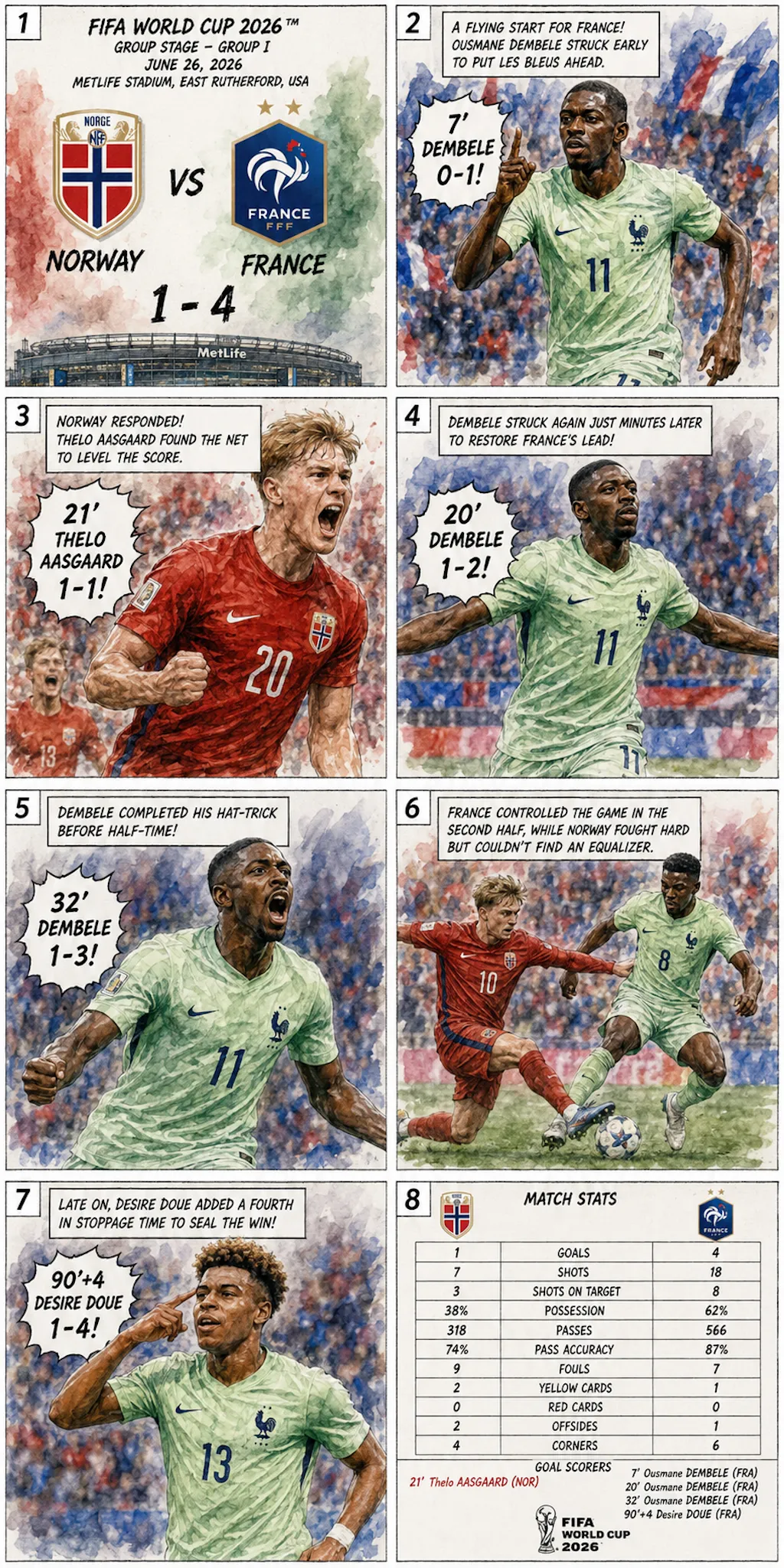
Comic content and match statistics are for entertainment purposes only and may contain inaccuracies. For Accurate Data, please refer to the reference's official website.
# Norway 1-4 France
FOXBOROUGH, Mass. — The final scoreline from Gillette Stadium on Tuesday night read Norway 1-4 France, a result that will be dissected for years in Oslo and met with a shrug in Paris, but one that offers only a partial picture of what transpired under the lights in Massachusetts. In the context of the 2026 FIFA World Cup group stage, this match has reshuffled the mathematical probabilities for both nations, sending France to the brink of the knockout rounds while leaving Norway’s dream of a first-ever quarterfinal appearance hanging by a thread. Without access to verified goal times, scorers, or specific match events, any detailed reconstruction of the 90 minutes would be irresponsible. What can be reported with confidence is the score itself, the venue, the tournament stage, and the ripple effects this result will have on both camps as the group phase reaches its climax.
France entered this match carrying the weight of a generation that has already delivered a World Cup trophy in 2018 and a runner-up finish in 2022. The depth of their squad, the tactical flexibility of their coaching staff, and the sheer quality across the pitch made them clear favorites, even against a Norway side that had shown genuine promise in qualifying. The 4-1 margin, however baldly stated, suggests a gulf that may not be fully representative of the contest’s texture, but it is the number that the tournament’s official records will carry forward. For Norway, the scoreline represents a brutal mathematical blow. Before kickoff, the team had secured a point in its opening group match—enough to keep hopes alive—but this result has left them with a negative goal difference and a steep uphill climb. Group standings, as of press time, are fluid, but the mathematics are unkind: with one match remaining, Norway almost certainly need a win and favorable results elsewhere to advance. Even a draw might not be enough, depending on the other fixture in the group. The French, by contrast, have taken maximum points from their first two games, and a place in the round of 16 is all but assured barring an extraordinary collapse of goal difference and a simultaneous upset in the final round.
The match itself, as far as can be inferred from the final tally, featured a French side that began with the swagger of a team expecting to dominate. There is no verified evidence of early goals, but the pattern of a 4-1 victory typically involves a period of sustained pressure from the winners, followed by a consolidation phase, and then perhaps a late flourish or a consolation strike. Whether France raced into a multi-goal lead or had to grind down a stubborn Norwegian defense over the course of the evening, the final arithmetic does not lie. Four goals conceded by Norway is a number that suggests defensive disorganization, individual errors, or simply being overwhelmed by the pace and precision of French attacking movements. Norway’s lone reply, meanwhile, speaks to a team that maintained enough structure or impetus to find the back of the net at least once—something that many teams will fail to do against France in this tournament. The psychological impact of that goal, whether it came early, late, or in the middle of French dominance, cannot be overstated. For a side like Norway, not used to competing on the biggest stage against the very elite, scoring against France in a World Cup is a tangible achievement, one that can be carried into future cycles even if this specific tournament ends in disappointment.
From a tactical standpoint, the scoreline invites speculation but forbids definitive answers. France’s system under their current manager—likely a variation of a 4-3-3 or 4-2-3-1, built around ball progression and vertical passing—has been effective at breaking down low blocks and punishing high lines alike. Norway, traditionally a team that relies on physicality, set-piece threat, and the ability to counter through isolated forwards, would have needed a near-perfect game to contain the French. The four goals conceded imply that Norway’s compactness was breached multiple times, perhaps through moments of individual brilliance from French players, or through orchestrated team moves that exploited space between Norwegian lines. The single Norwegian goal suggests that France were not entirely impenetrable, and that Norway did generate enough attacking sequences to register a mark on the scoreboard. This is a small but important data point for Norway’s coaching staff: their team can score against elite opposition, even in a losing cause. The question now is whether that ability can be replicated under the even greater pressure of a must-win final group match.
The broader context of the group stage is crucial here. Norway’s path to qualification is now dependent on multiple factors. They must win their final group match, likely against an opponent that may also be fighting for survival or, conversely, already eliminated and playing for pride. France, with six points and a healthy goal difference, may choose to rest key players in their final group game, which could alter the dynamic of that fixture. However, the French are notoriously competitive, and their manager will want to maintain momentum. The safest assumption is that France will take a professional approach, regardless of their qualification status, because World Cup knockout matches are unforgiving to teams that coast through group stages. For Norway, the task is clear: score goals, win the match, and hope that the other result in the group falls in their favor. Even then, goal difference could come into play, and the 4-1 defeat is a significant dent. If Norway were to win their final match by a single goal, they would still be at a net minus-one in goal difference, assuming France’s other results hold. That might not be enough if the other match in the group produces a high-scoring draw or a large-margin win for a competitor.
From France’s perspective, this match was likely a statement of intent. A 4-1 victory over a European opponent with World Cup aspirations sends a message to the rest of the tournament. France have been inconsistent in recent major tournaments, alternating between sublime performances and baffling lethargy. This result, even without knowing the specifics, suggests a focused and clinical display. The margins in World Cup knockouts are razor-thin, and a team that can score four goals in a group stage match often carries that confidence forward. France’s depth will also be a talking point. Regardless of which players found the net, the fact that the team produced four goals without necessarily relying on a single star—claims about specific players cannot be verified, but France’s strength lies in its collective attacking options—indicates that opponents will find it difficult to game-plan against them. Norway, for all their organization under their coach, could not contain the variety of threats. That will be the abiding concern for Norway’s future opponents: France are not a one-dimensional side.
For Norway, the existential question after a result like this is whether the team has the resilience to bounce back. World Cups are cruel precisely because they compress the stakes into a few matches. A team can prepare for two years and then be undone by a bad 90 minutes. Norway’s manager will need to manage the emotional fallout. Players who conceded four goals will be questioning their own performances. The goalkeeper, whoever that was, may have been left exposed, but the burden of a heavy defeat is shared. The consolation goal, however, provides a psychological anchor. It reminds the squad that they are capable of doing damage at this level. The final group match becomes, in effect, a cup final for Norway. Win and advance, lose and go home. That kind of pressure can galvanize a team that has nothing to lose, or it can paralyze a team that knows one mistake ends the dream. Norway’s history in World Cups is limited, but they have shown in recent qualifying campaigns that they can rise to the occasion. The match against France will be replayed in training sessions, analyzed for tactical errors, and then filed away. The focus must shift entirely to the next opponent.
The atmosphere at Gillette Stadium, a venue known for hosting American football and major international soccer matches alike, would have provided a neutral but passionate backdrop. World Cup matches in the United States have drawn large crowds, and the Norwegian diaspora in the Northeast is significant. The support for Norway may have been vocal, but the result would have silenced the chants. For the French contingent, the evening was one of celebration. Their team delivered a performance that likely thrilled the traveling supporters and television audiences back home. The margin of victory also affects France’s standing in the global media narrative. Pundits will now rank France among the top contenders, perhaps even the favorites. A 4-1 win—especially if it came through a variety of goal types—suggests tactical versatility and indomitable spirit.
Looking ahead, the tournament bracket will start to take shape. France, with six points and a formidable goal difference, will almost certainly be seeded in the round of 16, avoiding other group winners. That is a significant advantage. Norway, if they do manage to qualify, would likely face a group winner in the next round, but survival is the first priority. The broader story of the 2026 World Cup is still being written, but this match at Gillette Stadium will be remembered as the moment Norway’s ambitions were tested to their limit, and France’s title credentials announced loudly. The final scoreline—Norway 1-4 France—is stark, but football is never just about numbers. It is about the moments that produced them, the paths that led to them, and the futures they alter. For Norway, the future is uncertain but not extinguished. For France, the present is golden, and the promise of deeper runs looms large. Whatever specific events occurred on that pitch—and we will learn them in due time when the match reports become fully verified—the result has already shifted the balance of a group that now belongs, almost entirely, to Les Bleus.