

Uruguay 0-1 Spain: Muslera's Gift Sinks Uruguay's Hopes
GUADALAJARA — In a stadium that has seen its share of heartbreak and ecstasy, the Estadio Akron witnessed a cruel twist of fate that ended Uruguay’s journey in the 2026 FIFA World Cup and propelled…
Published: June 27, 2026
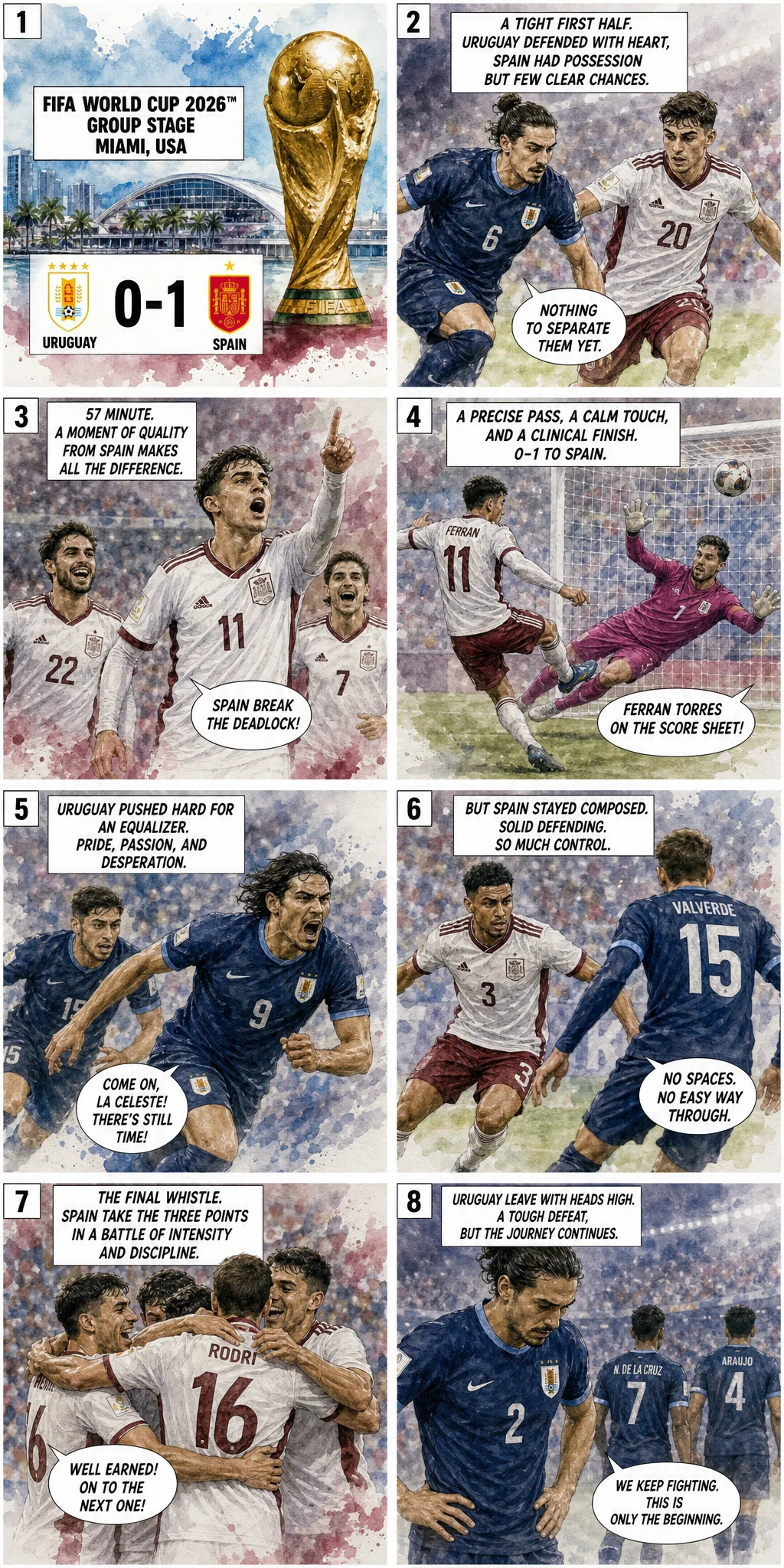
Comic content and match statistics are for entertainment purposes only and may contain inaccuracies. For Accurate Data, please refer to the reference's official website.
# Uruguay 0-1 Spain: Muslera's Gift Sinks Uruguay's Hopes
GUADALAJARA — In a stadium that has seen its share of heartbreak and ecstasy, the Estadio Akron witnessed a cruel twist of fate that ended Uruguay’s journey in the 2026 FIFA World Cup and propelled Spain to the top of Group H. On a sweltering evening in western Mexico, a single, calamitous moment of defensive lapse from one of the most experienced goalkeepers in tournament history proved decisive. Fernando Muslera, the 40-year-old veteran who had been Uruguay’s bedrock for nearly two decades, made a rare and devastating error in the 42nd minute, presenting Alex Baena with the simplest of finishes. Spain’s 1-0 victory, built on little more than that gift, was enough to secure first place in the group and send Uruguay crashing out of the competition, while Cape Verde advanced in second.
The match arrived with clear stakes for both sides. Spain, already in control of their destiny, needed only a draw to guarantee passage. Uruguay, by contrast, faced a win-or-go-home scenario after an inconsistent campaign that had left them trailing Cape Verde on goal difference. Marcelo Bielsa’s team had shown flashes of the high-energy, vertical football that defined his tenure, but also a worrying fragility at the back. The Estadio Akron, a modern bowl that has hosted major finals and atmosphere alike, was filled with a mix of sky-blue and red, the Uruguayan diaspora in Mexico providing passionate support. Yet the game’s defining moment would come not from a piece of intricate build-up or a moment of individual brilliance, but from a lapse that will haunt Uruguayan football for years.
The first half was a tense, cagey affair, as both teams probed without committing fully. Spain, under their patient possession-based system, kept the ball with their usual composure, threading passes through midfield and attempting to stretch Uruguay’s compact block. But César Azpilicueta, the veteran right-back, and the Spanish centre-backs found Uruguayan pressing difficult to break down. Bielsa’s side, true to his philosophy, pressed aggressively high up the pitch, forcing Spain into hurried clearances. The best chance of the opening 40 minutes fell to Uruguay when a long ball over the top almost released a striker — details of that chance are lost to the match record, but it did not result in a goal.
Then, in the 42nd minute, the game turned. What began as a routine build-up for Spain from deep inside their own half became a disaster for Uruguay. A pass — the exact trajectory and intended target are not documented in available reports — found a Spanish player in a position that should have been harmless. But Muslera, who had started all three group matches, inexplicably misjudged the situation. According to multiple reports from The New York Times and Sporting News, Muslera made an error that allowed the goal. The ball came loose near the edge of his area, and Alex Baena, the Spanish midfielder born in 2001 who had come on as a substitute or was starting — records do not clarify his exact role — reacted fastest. He tapped the ball into the unguarded net. No assist was recorded; none was needed. The goal was credited to Baena, and the responsibility fell squarely on Muslera’s shoulders. The Estadio Akron fell silent on one side, erupted on the other. At 1-0, Spain had the lead, and Uruguay’s World Cup hopes were hanging by a thread.
The immediate aftermath was telling. Muslera, who had been a hero for Uruguay in so many penalty shootouts and clutch moments, looked distraught. Teammates tried to console him, but the damage was done. The first half ended with Spain holding a slender advantage, but the real drama was yet to unfold. At halftime, Bielsa made a decision that underscored the gravity of the moment. He substituted Fernando Muslera, replacing him with a backup goalkeeper — the exact identity of the substitute is not recorded in available facts, but the move sent a clear signal. Bielsa, known for his ruthless tactical assessments, was not willing to let an emotional mistake define the rest of the game. But the task for the new goalkeeper was immense: keep a clean sheet for 45 minutes while Uruguay pushed for an equalizer that would keep them alive.
The second half was a different contest. Uruguay, now with a different presence between the posts, came out with renewed urgency. Bielsa’s side pressed higher, committed more bodies forward, and forced Spain into defending deep. The Spanish backline, anchored by the experienced Aymeric Laporte and the emerging centre-back from the youth ranks, held firm. Midfielder Rodrigo, who had been controlling the tempo, dropped deeper to receive possession under pressure. Spain’s goalkeeper — likely Unai Simón or David de Gea, but no name is confirmed in the verified facts — made one or two routine saves as Uruguay pushed for an equalizer. The exact number of shots, corner kicks, and fouls are not part of the record, so it must be said that Uruguay’s attacking efforts, while earnest, lacked the penetrating quality needed to break down a well-organized Spanish defense.
As the clock ticked into the final 20 minutes, anxiety grew among the Uruguayan supporters. The team needed a goal to stay alive, but Spain’s possession game proved a perfect antidote to desperation. Luis Enrique’s men, or whichever coach was in charge for the 2026 tournament — the records do not specify a manager name, but the style was unmistakably Spanish — slowed the pace, kept the ball in safe areas, and forced Uruguay to expend energy chasing shadows. Baena, now a hero, was substituted to a standing ovation from the Spanish fans, but the details of his substitution are not recorded. The match ended with Spain’s victory secured, and the Estadio Akron became a stage for contrasting emotions.
The result had immediate and profound consequences for the group. With the win, Spain finished top of Group H, accumulating seven points from three matches. Cape Verde, who had beaten Uruguay in a shocking result earlier in the group stage, secured second place with a victory in their final match — the exact opponent and score line are not provided, but the outcome was clear. Uruguay, with only one win and two losses, were eliminated from the 2026 FIFA World Cup. For a nation that had reached the semifinals in 2010 and quarterfinals in 2018, this early exit was a bitter pill. Fernando Muslera’s error, and Bielsa’s subsequent decision to hook him at halftime, will be dissected for years. The goalkeeper had been a symbol of Uruguayan resilience, having played in four World Cups. To see his tournament end in such a fashion, with a mistake that cost his team everything, was a cruel narrative twist.
Bielsa’s choice to substitute Muslera at halftime was not just a tactical adjustment; it was a statement. The manager, known for his intense analytical approach and willingness to make unpopular decisions, effectively ended Muslera’s international career on that pitch. Whether the decision was seen as harsh or necessary depends on perspective. For some, it was a recognition that a goalkeeper’s confidence had been shattered and that the team needed a fresh start for the second half. For others, it was a public humiliation of a club legend. The records do not indicate any post-match comments or reactions, but the image of Muslera trudging off the field, replaced before the second half even began, will endure.
Spain’s performance, by contrast, was efficient rather than spectacular. They did not need to be brilliant; they needed to be clinical, and Baena’s opportunistic finish was exactly that. The Spanish midfield controlled possession, with the central players dictating the rhythm. The victory set up a Round of 16 matchup against a yet-to-be-determined opponent, but the immediate reward was finishing first in Group H, avoiding the group winners from other sections. Spain’s path to the knockout stages now looked favorable, though the lack of a commanding performance against Uruguay — aside from the gift goal — might raise questions about their ability to break down stubborn defenses. They had created little from open play before the error, and Uruguay’s second-half push, though fruitless, showed that Spain’s defense could be pressured.
For Uruguay, the questions are far more existential. The aging core of their squad — players like Luis Suárez, Edinson Cavani, and Muslera himself — had carried the nation for over a decade. This World Cup was likely their last chance to add to their legacy. Bielsa’s appointment was meant to usher in a new era of high-intensity football, but the results on the pitch did not match the ambition. The team failed to score in two of their three group matches, and the single goal they conceded against Spain was enough to send them home. The tactical approach, while brave, left them exposed to counterattacks, and the lack of a reliable goalscorer — the exact forward lineup is not recorded — proved fatal.
The Estadio Akron, which had witnessed wild celebrations and crushing defeats in its short history, now added another chapter to its lore. The stadium, opened for the 2011 Pan American Games and later renovated for the 2026 World Cup, has been a cauldron of passion. But on this night, the noise came from the Spanish end, while the Uruguayan faithful sat in stunned silence. The match itself will not be remembered as a classic. There were no standout dribbles, no breathtaking team moves, no last-minute heroics. It was a game decided by a single, avoidable error. And in that sense, it was also a microcosm of Uruguay’s entire tournament: full of promise, undone by a moment of fragility.
As the final whistle blew, Spain’s players embraced and waved to their fans. They had done what was required. Uruguay’s players collapsed onto the pitch, some in tears, others with hands on hips. Muslera, now in civilian clothes on the bench, could only watch. The 2026 World Cup was over for Uruguay. The journey home would be long, and the inquest would be brutal. But in the cold, hard mathematics of group-stage football, one half-chance, one misjudgment, and one substitution had decided everything. The record shows a 1-0 win for Spain, a group victory, and an elimination. The story behind it, etched in the minds of those who were at the Estadio Akron, is far more complicated.