

Cabo Verde 0-0 Saudi Arabia: Neither side finds the net
The mathematics of Group H were brutal, reductive, and absolute. For Saudi Arabia, the equation required a win.
Published: June 27, 2026
Comic content and match statistics are for entertainment purposes only and may contain inaccuracies. For Accurate Data, please refer to the reference's official website.
# Cabo Verde 0-0 Saudi Arabia
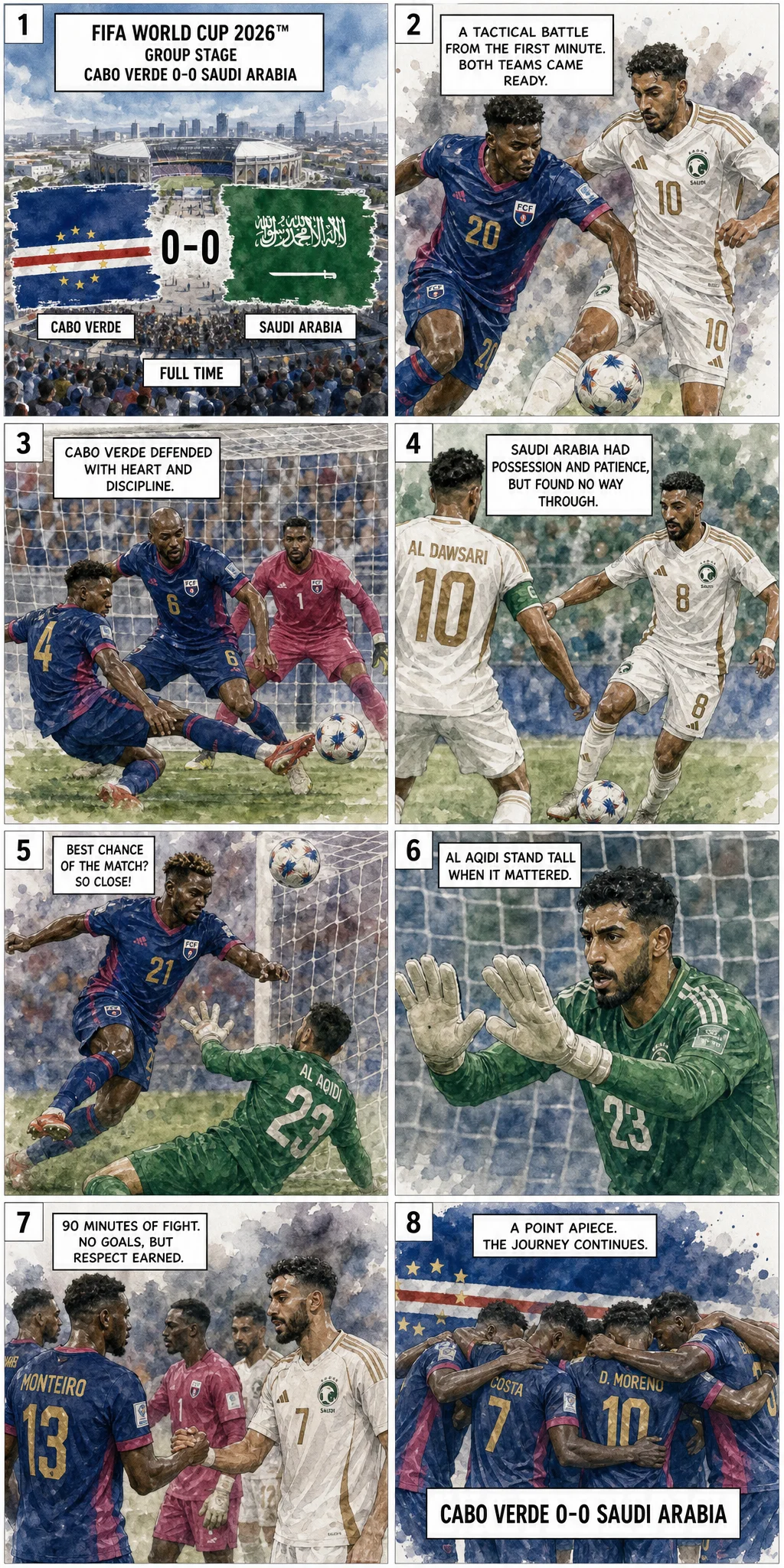
The mathematics of Group H were brutal, reductive, and absolute. For Saudi Arabia, the equation required a win. For Cabo Verde, a debutant nation playing for a place in the knockout phase of the FIFA World Cup for the first time in its history, a draw was enough, provided the other result in the group did not deliver an upset of seismic proportions. And so, under the closed roof of NRG Stadium in Houston, Texas, a game of football became an exercise in patience, pressure, and, ultimately, the cold arithmetic of elimination. The final scoreline—Cabo Verde 0, Saudi Arabia 0—told a story of a defensive structure that held firm, a goalkeeper’s decisive intervention, and a side that did just enough to survive, while another saw its World Cup dream end not with a roar but with the slow deflation of a cross that found only heads and gloves.
From the opening whistle, the tactical shape of the game was locked in. Saudi Arabia, needing three points to have any chance of progressing, pressed forward with an urgency that bordered on desperation. Yet urgency alone does not breach a well-organized low block, and Cabo Verde, under the stewardship of a coach who had drilled defensive discipline throughout a group stage defined by parity, were content to absorb pressure and strike on the counter. The first half hour was largely spent in the middle third, with Saudi Arabia’s midfield trio attempting to find pockets of space between the lines. The Cabo Verdean defensive line, compact and narrow, offered little room. Full-backs tucked in, central defenders communicated in rapid Creole, and the two holding midfielders—whose names would later be written into the match report only through their positional discipline—never allowed Saudi Arabia’s creative players to turn and face goal.
The rhythm was broken by moments of promise that never quite matured into clear chances. Saudi Arabia’s wide attackers cut inside onto their stronger feet, only to find a wall of blue shirts. A looping cross from the left was claimed cleanly by the Cabo Verdean goalkeeper, who had been well protected by his back four. Cabo Verde’s own attacking forays were sporadic but not without menace. They won a corner during the first half—a detail that, in a match of such statistical poverty, carries weight. The corner was delivered into a crowded six-yard box, headed away by a Saudi defender under pressure, and the danger evaporated. It was, for a long stretch, the closest either side came to a defining moment.
Then came the save. Mohammed Al Owais, Saudi Arabia’s experienced goalkeeper, had been a spectator for much of the half, his only involvement a few routine claims and a punched clearance. But the game’s singular moment of high-quality execution arrived from an unexpected source. Cabo Verde, breaking quickly after a Saudi attack broke down, found Laros Duarte in space at the centre of the box. The shot was a right-footed strike, struck with venom and aimed low towards the corner. Al Owais, reading the trajectory instantly, dropped to his left, extending every inch of his frame. His fingertips redirected the ball around the post, a save that preserved the scoreline and, for a few more minutes, Saudi Arabia’s faint hopes. The stadium, half-filled with supporters draped in green and others in the blue and white of Cabo Verde, rose in collective appreciation of a moment of genuine athletic brilliance. Duarte, his head in his hands, knew he had come as close as anyone would come all evening.
That save was the fulcrum around which the rest of the match swung. Saudi Arabia, emboldened by the escape, pushed harder. But there is a psychological weight to a missed opportunity, and for Cabo Verde, the near-miss seemed to galvanize rather than deflate. They retreated deeper, inviting Saudi Arabia to play in front of them, trusting that the final ball would be lacking. And it was. Saudi Arabia’s passing grew increasingly lateral, their crosses too deep or too high, their shots from distance veering off target. The final twenty minutes became a test of nerve. Every time a Saudi player received the ball in the final third, the crowd—or at least those supporting the Green Falcons—held its breath. But the Cabo Verdean defenders, many of whom had not faced a World Cup elimination game before this tournament, showed no signs of panic. They cleared headers, blocked shots, and stood firm at set pieces.
As the clock ticked past 80 minutes, the mathematics began to shift. News filtered through from the other group match—though no specific details were available to those on the pitch—that the result that would keep Cabo Verde alive seemed to be holding. But the players in blue had no room for vigilance. Saudi Arabia, now throwing numbers forward, had their best chance from a free kick on the edge of the box. The wall stood tall, the shot deflected wide. Another corner, another aimless header. The referee’s whistle blew for a foul, breaking the rhythm. It was, in many ways, the story of Saudi Arabia’s tournament: moments of pressure without incision, possession without penetration, effort without end product.
The final ten minutes were a study in game management. Cabo Verde, sensing the finish line, began to time-waste with subtlety: a goalkeeper holding the ball an extra second, a substitution made with deliberate slowness, a throw-in taken from the wrong spot to force a reset. Saudi Arabia grew frustrated. A challenge from behind earned a yellow card. Bodies began to tire. The energy that had carried them through the first hour dissipated into long punts forward that the Cabo Verde centre-backs, strong in the air, headed away with metronomic regularity.
When the referee finally blew the full-time whistle, the scoreline was 0-0, and the implications were immediate. For Cabo Verde, this was a night of quiet triumph. Having drawn all three of their group matches—a feat of consistency that many dismissed as luck but was, in truth, a testament to their defensive organization and resilience—they finished second in Group H, securing a place in the round of 32. This was their first World Cup, and they had not lost a single match on their debut. The celebrations on the pitch were subdued, professional; they knew a bigger challenge awaited. The identity of that opponent, however, remained a matter of conflicting reports. Some sources indicated they would face Argentina in Miami on July 3, a mouthwatering prospect against Lionel Messi’s side. Others suggested England would be their opposition. The ambiguity did not matter at that moment. What mattered was that a nation of just over 500,000 people, an archipelago off the coast of West Africa, had survived a group of nations and advanced to the knockout stage for the first time. The players embraced, some dropping to their knees in exhaustion and relief.
For Saudi Arabia, the scene was one of hollow disappointment. They had lost one match and drawn two in the group stage—a record that, in many tournaments, would have been enough to squeak through. But in the unforgiving math of a 48-team World Cup, with only the top two advancing from each group, it was not enough. The Green Falcons had come to Houston needing a win and had been unable to break through a defensive wall that had held all night. Their tournament was over. The players lay on the turf, some staring up at the roof of NRG Stadium, others sitting with heads bowed. Mohammed Al Owais, who had made the save that briefly kept hope alive, walked slowly towards the tunnel, his gloves off, his expression unreadable. They had come close—so close—to a moment of glory. But close is not a statistic that advances you to the next round.
The match itself will not be remembered as a classic. There were no goals, no red cards, no controversial VAR decisions, no penalty shootouts. The attendance was not announced, but the stadium was not full; the atmosphere was more academic than electric. Yet within the narrow confines of a goalless draw lies the entire narrative of a World Cup group stage. Momentum, strategy, nerve, and the smallest margin of error. Cabo Verde had drawn all three games. They had scored few goals, but they had conceded even fewer. They had learned to suffer, to wait, to trust their structure, and it had earned them a place in the round of 32.
For Saudi Arabia, the questions will linger. How did a team that pressed so hard fail to find a single goal across 90 minutes against a side that had not won a match in the tournament? The answer lies not in any single failure but in the cumulative effect of a thousand small decisions: a pass that was too heavy, a run that was mistimed, a shot that sailed wide. In the end, football punishes inefficiency. Saudi Arabia had the ball, they had the territory, they had the chances. But they did not have the finishing touch.
As the floodlights dimmed and the players left the pitch, the scoreboard still read 0-0. For one team, it was the number of their deliverance. For the other, it was the number of their demise. Cabo Verde walked off into the annals of their football history, a first-time participant now a knockout-stage contender. Saudi Arabia walked off into the silence of elimination, left to wonder what might have been if one more ball had found its way past a goalkeeper named Mohammed Al Owais, who had done everything he could to keep them alive. He saved a shot that should have been a goal. He could not save an entire campaign.
The round of 32 beckons for Cabo Verde. Argentina or England. A date in Miami or wherever the fixture leads. The specifics will be confirmed in the hours after the group stage concludes. But for now, the narrative is simple: a 0-0 draw at NRG Stadium in Houston, Texas, on a humid evening in the heart of the American summer, was enough. Enough to advance. Enough to dream. Enough to prove that a debutant can survive the group of death by simply refusing to die. The mathematics of Group H were brutal, but Cabo Verde did the one thing that mathematics cannot account for: they endured. And in a World Cup where every point is precious, sometimes zero is the most beautiful number of all.