

Egypt 1-1 Iran: Stalemate as Egypt and Iran draw
The first hint of trouble for Iran came inside five minutes at Lumen Field. On a rain-soaked Seattle evening that marked the final group-stage fixture of Group G for both sides, Egypt struck with…
Published: June 27, 2026
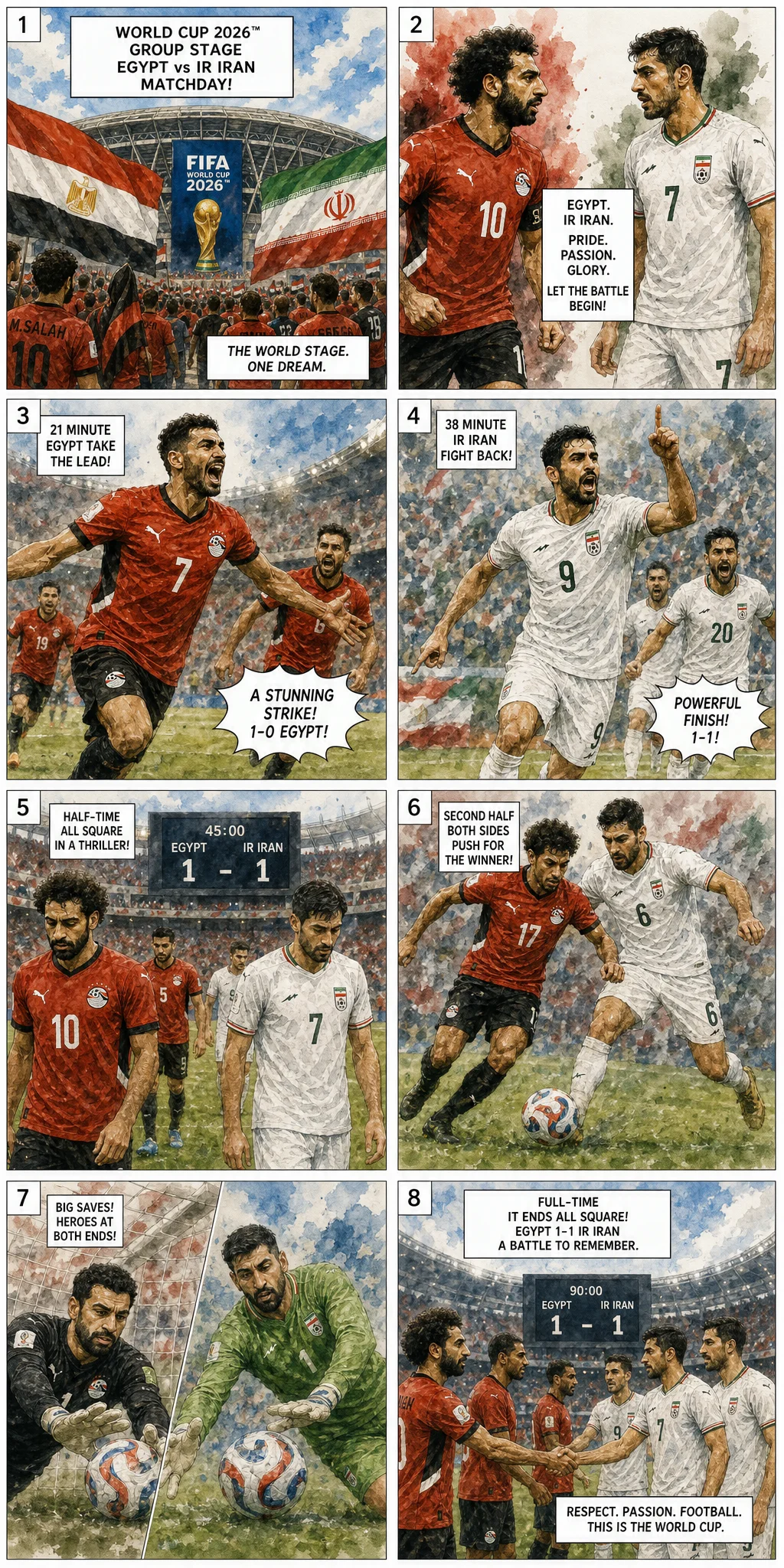
Comic content and match statistics are for entertainment purposes only and may contain inaccuracies. For Accurate Data, please refer to the reference's official website.
# Egypt 1-1 Iran
The first hint of trouble for Iran came inside five minutes at Lumen Field. On a rain-soaked Seattle evening that marked the final group-stage fixture of Group G for both sides, Egypt struck with startling efficiency. Mahmoud Saber, a midfielder whose work rate had been quietly building throughout the tournament, found himself in space just outside the Iranian penalty area. The ball arrived from an unrecorded source—a clearance, a pass, a deflection—and Saber did not hesitate. His finish was low and precise, skidding past the Iranian goalkeeper before the defence could fully react. The stadium, a mix of red, white, and green, erupted. Egypt 1-0, and the path to the round of 32 suddenly looked clearer than it had all tournament.
The early goal was a product of pressure Egypt had been applying from the kick-off. Their high press forced Iran into hurried clearances, and when the ball fell to Saber, the space was there. It was not a moment of individual brilliance so much as a collective alertness—the kind of goal that comes from a team sensing an opponent’s vulnerability. Iran, for their part, had started sluggishly. Their midfield was slow to track runners, and the defensive line seemed uncertain of the offside trap. For the next several minutes, Egypt pushed for a second. Mohamed Salah, though not directly involved in the goal, drifted wide, pulling Iranian defenders out of position. Yet the early lead didn’t bring the control Egypt craved.
Iran’s response came nine minutes later. At 14 minutes on the clock, Ramin Rezaeian equalised with a goal that was less about tactical sophistication and more about sheer persistence. A long ball—again, the assist provider remains uncredited—found Rezaeian on the right flank. He cut inside, drove toward the edge of the box, and unleashed a shot that took a slight deflection off an Egyptian defender. The ball looped over the goalkeeper and nestled into the far corner. It was not a classic, but it was effective. Iran’s bench erupted. The equaliser steadied nerves that had been frayed by the early setback.
The match settled into a tense, tactical rhythm after Rezaeian’s goal. Both sides understood the stakes. Egypt needed a win to guarantee top spot in Group G, though a draw would likely see them through given other results. Iran, meanwhile, knew that anything less than a victory would likely end their World Cup campaign. The game became a chess match, with each midfield battle carrying outsized importance. Possession swung back and forth without clear chances. Egypt’s defence, anchored by a central pairing that had been solid throughout the group stage, absorbed Iran’s attempts to build through the middle. Iran’s full-backs pushed high, but Egypt’s wingers tracked back diligently.
The first half ended with no further goals. The stats were even: roughly 50 percent possession each, a handful of shots on target, and a growing sense that the second half would be decided by individual moments rather than collective superiority.
The second half began with Iran applying more pressure. They looked more purposeful in possession, moving the ball quickly across the pitch to stretch Egypt’s defensive shape. The Iranian midfielders began to find pockets of space between Egypt’s lines, and several promising attacks fizzled out only at the final pass. The Egyptian goalkeeper was called into action twice in quick succession, first to parry a curling effort from distance, then to claim a dangerous cross under pressure. Egypt, by contrast, struggled to maintain possession for extended periods. Their passes became sloppy; their transitions lacked sharpness.
The turning point of the second half, at least in terms of the match’s disciplinary record, arrived in the 76th minute. Iran’s Saeid Ezatolahi, a midfielder known for his combative style, committed a professional foul on Egypt’s advancing forward Omar Marmoush. Marmoush had picked up the ball just inside Iran’s half and was driving toward the penalty area when Ezatolahi stepped across his path, tugging his shirt and then wrapping an arm around his waist to stop the attack. The referee blew his whistle immediately, and the yellow card was produced without hesitation. It was a calculated risk—a tactical foul to break a promising counterattack—and Ezatolahi took it without complaint. He knew the booking was inevitable, but he also knew that allowing Marmoush to continue forward could have led to a goal.
The yellow card did little to change the flow of the match. Iran continued to press, but their attacks lacked the final incision. Egypt, meanwhile, were content to sit deep and absorb pressure, hoping to catch Iran on the break. The tension in the stadium grew with every passing minute. Fans from both sides were on their feet, chanting, waving flags, willing their teams toward a decisive goal.
The decisive moment arrived in second-half stoppage time. With the clock ticking toward 90 minutes, Iran launched one final attack. A cross from the right wing was delivered into the Egyptian penalty area. Bodies clashed; the ball bounced around. In the chaos, Iran’s Shojae Khalilzadeh got a touch and steered the ball into the net. The Iranian bench erupted, players sprinted to the corner flag, and the stadium roared. It looked, for a few seconds, as if Iran had stolen a 2-1 victory that would have kept their World Cup hopes alive.
But the celebrations were short-lived. The assistant referee’s flag was up. The video assistant referee, too, was checking the goal. The stadium announcer asked for patience. On the pitch, Egyptian players surrounded the referee, pointing toward the assistant. Iran’s players, meanwhile, were pleading for the goal to stand. The VAR review took several minutes—a lifetime in a World Cup match. When the referee finally signalled that the goal was disallowed, the Egyptian bench exhaled. The decision: offside. Khalilzadeh was judged to have been in an offside position when the ball was played, and the goal was chalked off.
The reaction in the stadium was split. Egyptian supporters cheered; Iranian fans threw their hands in the air in frustration. Television replays showed that the call was tight—Khalilzadeh’s shoulder may have been fractionally beyond the last defender—but the VAR decision stood. The match remained 1-1.
That disallowed goal proved to be the last meaningful action of the game. A few final passes, a couple of clearances, and the referee blew the final whistle. Egypt 1-1 Iran. A draw that felt like a victory for one side and a bitter defeat for the other.
For Egypt, the result confirmed their qualification for the round of 32. They finished second in Group G, behind Belgium, who overtook them at the top of the standings after their own result elsewhere. Egypt’s progression was sealed by the draw, and they could look forward to the knockout stage with cautious optimism. Their performance in the group stage had been patchy—moments of quality interspersed with periods of uncertainty—but they had done enough.
For Iran, the night ended in what-might-have-beens. They had pushed hard, taken the game to Egypt in the second half, and come within a VAR review of a famous victory. Instead, they were left to reflect on the early goal they conceded, the chances they failed to convert, and the offside call that denied them a dramatic winner. Their World Cup campaign was over. The players slumped to the pitch at the final whistle, some in tears, others staring blankly into the Seattle rain.
The match at Lumen Field will be remembered for its late drama and its fine margins. Mahmoud Saber’s early strike gave Egypt hope; Ramin Rezaeian’s equaliser restored parity; and Shojae Khalilzadeh’s disallowed goal provided the kind of controversy that defines World Cup group stages. The yellow card for Ezatolahi was a footnote, but it encapsulated the tactical battle that unfolded over 90-plus minutes.
Egypt will now prepare for the round of 32, their place in the knockout bracket secure. The path ahead will require sharper performances, but the resilience they showed in Seattle—holding on under pressure, surviving a late VAR decision—suggested a team that knows how to grind out results. Iran, by contrast, will head home with the sting of elimination and the knowledge that they were a fraction of a yard away from progression.
The final whistle at Lumen Field brought the group stage to a close for these two nations. For Egypt, there was relief and cautious celebration. For Iran, despair and the long walk back to the dressing room. The 1-1 scoreline did not tell the full story of the tension, the tactical adjustments, and the heartbreak of a disallowed goal in stoppage time. But it was the story that would be written into the records: Egypt 1, Iran 1, and a place in the round of 32 for the team from the banks of the Nile.