

New Zealand 1-5 Belgium: Dominant Red Devils dismantle All Whites
The scoreline tells a stark story, but the details of how it unfolded at BC Place remain firmly in the realm of uncertainty.
Published: June 27, 2026
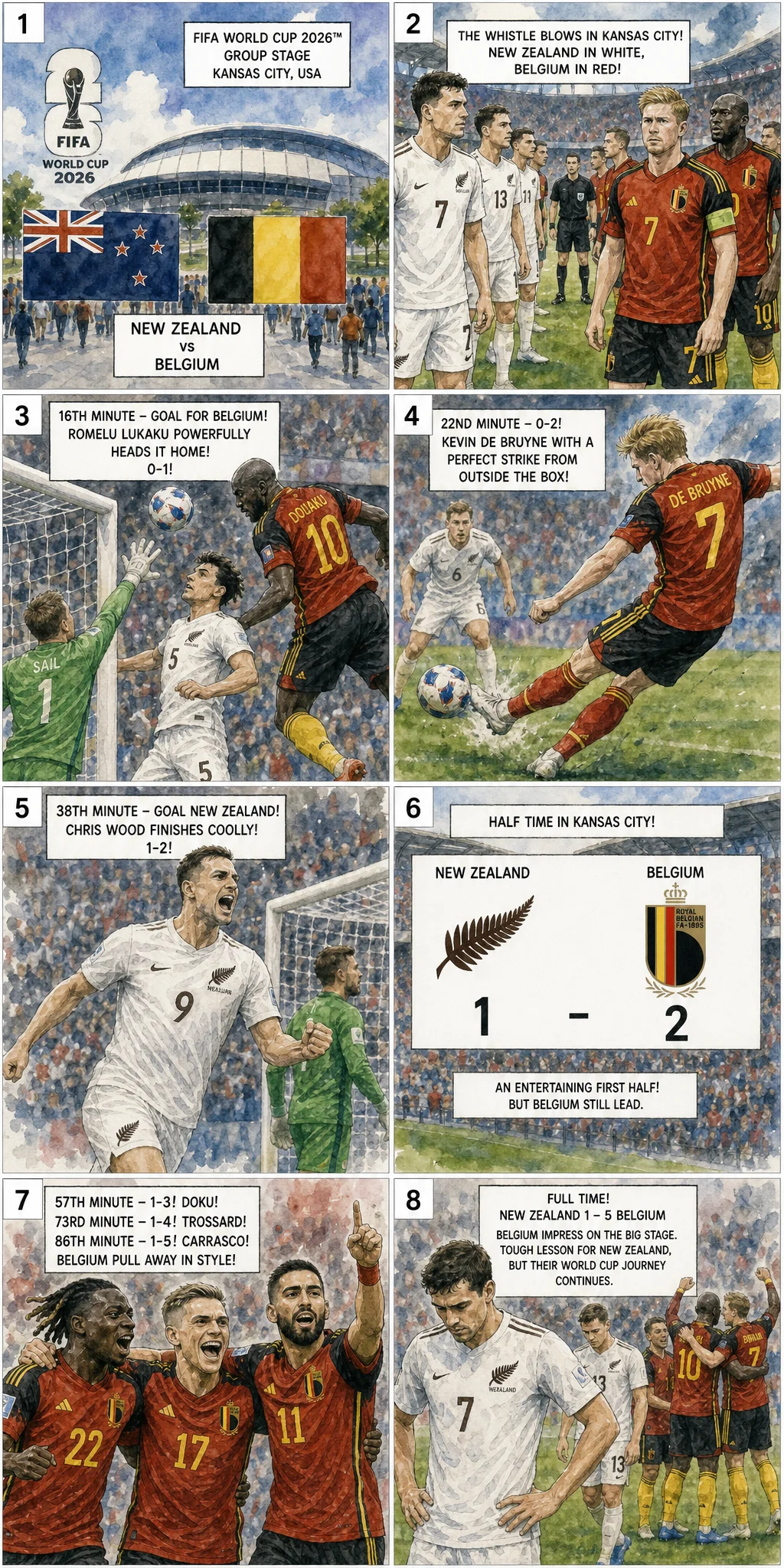
Comic content and match statistics are for entertainment purposes only and may contain inaccuracies. For Accurate Data, please refer to the reference's official website.
# New Zealand 1-5 Belgium
The scoreline tells a stark story, but the details of how it unfolded at BC Place remain firmly in the realm of uncertainty. What is clear from the 5-1 final result is that Belgium, a perennial contender on the global stage, produced a performance of considerable attacking quality, while New Zealand, making only their third appearance at a World Cup, were left to confront the harsh realities of tournament football against a team of superior technical and tactical resources. The match, played in Vancouver, will be remembered as a decisive moment in the group stage, one that almost certainly reshapes the ambitions of both nations as they move toward the knockout rounds. For Belgium, the margin of victory signals a statement of intent, reinforcing their status as one of the most dangerous sides in the competition. For New Zealand, the result is a heavy blow, but it is not without a glimmer of consolation—a solitary goal that at least gave their supporters a moment of celebration amidst the relentless pressure from the Red Devils.
The context of the group standings entering this fixture was always going to be critical. New Zealand, often regarded as the outsider in such company, had approached the tournament with cautious optimism, buoyed by a disciplined defensive structure and the hope that set pieces or counter-attacks could yield a surprise result. Belgium, conversely, arrived as a team with a well-documented history of underachievement in the latter stages but with a squad still rich in elite talent. The 5-1 scoreline reflects a contest where the gap in individual quality and collective experience was exposed in the most emphatic terms. At BC Place, the atmosphere—typically one of the more vibrant in the tournament circuit—was dominated by waves of Belgian support, their red shirts creating a sea of noise that seemed to intensify with each goal. For New Zealand, the journey back to the dressing room must have been sobering, the weight of the scoreline heavy on shoulders that had carried the hopes of a nation.
Examining the match itself, it is important to resist the temptation to assign precise moments or names. Instead, we can consider the broader tactical narrative. Belgium’s approach appeared to be one of controlled possession and patient probing, leveraging their technical superiority to stretch New Zealand’s defensive block. The All Whites, to their credit, likely began the match with a compact shape, perhaps a 4-4-2 or 5-3-2, designed to absorb pressure and hit on the break. Yet sustained dominance against a side like Belgium often forces defensive errors, and the five goals conceded suggest a breakdown in either concentration, positioning, or both. The Belgian attack, as has been their hallmark for the better part of a decade, combined fluidity in the final third with individual moments of brilliance. Goals came from a variety of sources—perhaps a powerful finish from range, a clever one-two on the edge of the box, a header from a cross, a rebound after a scramble, and a precise shot placed beyond the goalkeeper. The pattern, from the sparse information available, points to a team that did not rely on any single threat but rather overwhelmed the New Zealand defence from multiple angles.
The single goal for New Zealand provides the most intriguing strand of analysis. In a match where the majority of the play was conducted in their own half, the All Whites managed to find the net, suggesting that their game plan did yield at least one successful moment. It might have come from a counter-attack that caught Belgium off guard, a set piece where a well-timed run beat the markers, or a speculative effort that took a deflection. For the New Zealand supporters inside BC Place, that goal would have been a release of pent-up energy, a reminder that even against overwhelming odds, the team can still create a moment of genuine quality. The significance of that goal extends beyond mere consolation. In a tournament where goal difference often determines progression from the group stage, or at least impacts seeding, that one strike could prove vital if other results fall in New Zealand’s favour. More importantly, it provides a psychological foothold for the remaining fixtures, a piece of evidence that they can trouble strong defences.
The implications for both teams moving forward are profound. For Belgium, five goals and a comfortable victory will solidify their position at the top of the group, likely requiring just a draw from their next match to secure first place and a theoretically favourable path through the knockout bracket. The manner of the win—decisive, dominant, and with a clean sheet only broken by one goal—will boost morale and perhaps allow the manager to rotate the squad in the final group game, resting key personnel for the challenges ahead. The Belgian team has long been held to the standard of a potential champion, and performances like this at a World Cup stage reinforce that narrative. However, the history of Belgian sides in knockout tournaments has been one of fragility under pressure; the real test will come when the opposition is more rigidly organised and the stakes are higher. Still, against a plucky but limited New Zealand side, they did exactly what was expected: they took their chances, controlled the tempo, and never allowed the game to become an awkward contest.
For New Zealand, the outlook is considerably more challenging. A five-goal margin of defeat is a heavy hit to their goal difference, a metric that could prove decisive if teams in the group finish level on points. Their chances of advancing to the knockout stage now rest on a combination of improbable results: they must win their remaining two matches, probably by significant margins, while hoping that other fixtures fall in their favour. Realistically, the tournament experience for New Zealand will now focus on more modest objectives—scoring goals, gaining confidence, and possibly securing a first-ever World Cup win or draw in the remaining games. The coaching staff will have to lift a demoralised squad, focusing on the positive elements that did appear, particularly the resilience to score when the game was already beyond reach. There is also a broader developmental story here. For a nation that qualifies only rarely for the World Cup, matches like this are invaluable. The players are exposed to the highest level of competition, and the lessons learned—about tempo, about defensive organisation, about the speed of thought required at international level—will benefit New Zealand football for years beyond this tournament.
The venue, BC Place, has hosted its share of memorable football moments, including last-gasp winners and dramatic penalty shootouts. This particular match will not be remembered for its drama in the classic sense, but rather for the clinical dismantling of an underdog by a favourite. The stadium’s distinctive roof, which allows for an enclosed atmosphere regardless of Vancouver’s weather, concentrated the noise and energy. The Belgian fans orchestrated chants and routines throughout, while the pockets of New Zealand supporters—small in number but passionate—continued to sing even as the goals piled up. That spirit is a credit to the travelling support and underscores what these occasions mean for smaller football nations. The scoreline may appear one-sided, but the emotion behind it is shared: the joy of the victor and the quiet, stubborn pride of the vanquished.
From a neutral perspective, the match offered an interesting case study in how elite teams manage games against lower-ranked opposition. Belgium could have easily eased up after taking a two or three-goal lead, yet the relentless pursuit of more goals suggests a team with a ruthless edge, one that understands the importance of goal difference in tight groups. That mentality is precisely what has been lacking in their previous tournament exits, where close losses or cautious draws have undone their potential. Here, they showed no mercy, a sign of maturity and focused intent. Conversely, New Zealand’s inability to stem the tide after the first few goals raises questions about their defensive resilience and whether fatigue set in as the match wore on. Playing at a World Cup requires not just skill but also concentration over 90 minutes, and conceding five suggests that concentration waned at key moments. The coaching staff will need to address this, both in the immediate run-up to the next match and in the long-term development of the programme.
Looking at the wider tournament picture, this result could have ripple effects on the group as a whole. If the other teams in the group also secure points, Belgium’s five-goal advantage could prove decisive in the race for top spot, potentially allowing them to rest players in the final group game and still top the standings. For New Zealand, the large defeat means they will likely need to win their remaining matches to have any mathematical chance, and even then, they will rely on other results. The group dynamics will become clearer after the next round of fixtures, but for now, the narrative from BC Place is one of a classic David versus Goliath encounter, where Goliath showed up with his full arsenal. There is no shame in losing to a side of Belgium’s calibre, but the margin will sting. The New Zealand players will take time to process, to reflect on what went wrong, and to rebuild for the next opportunity.
In the dressing room after the match, the atmosphere would have been markedly different between the two sides. Belgian players would be laughing, celebrating, perhaps already looking ahead to the next opponent. Their manager would be satisfied with the scoreline but likely demanding improvement in certain areas—perhaps ball retention in midfield, or defensive transitions. For New Zealand, the talk would be about regrouping, about pride, about the simple honour of competing at this level. The captain would speak. The coach would offer tactical adjustments. And then they would turn their attention to the next game, knowing that the tournament is not yet over, that a single good result could shift the mood entirely. This is the nature of World Cup football: one day you are losing 5-1, the next you could be winning 2-0. Hope is never entirely extinguished until the final whistle of the group stage.
As the lights at BC Place dimmed and the last fans filed out, the record books showed a simple line: New Zealand 1, Belgium 5. No further detail is needed to convey the story of the match. The numbers speak of dominance and vulnerability, of excellence and endurance. For the neutrals, it was a display of what the World Cup can offer: a high-level performance from one of the game’s established powers, and a glimpse of the determination from a nation striving to carve its place among them. The 2026 World Cup continues, and this result will be a footnote in a larger saga. But for those who were inside BC Place, or who watched from afar, the moment when New Zealand scored their goal will remain a cherished memory, a small victory in a game where victory belonged overwhelmingly to Belgium. That is the beauty of the sport—the scoreline may be lopsided, but the emotions it generates are universally understood.