

DR Congo 3-1 Uzbekistan: Wissa Double Powers Dramatic Comeback
ATLANTA — In a World Cup group stage match that unfolded within the cauldron of Mercedes-Benz Stadium, DR Congo staged a dramatic second-half comeback to defeat Uzbekistan 3-1, snatching a place in…
Published: June 28, 2026
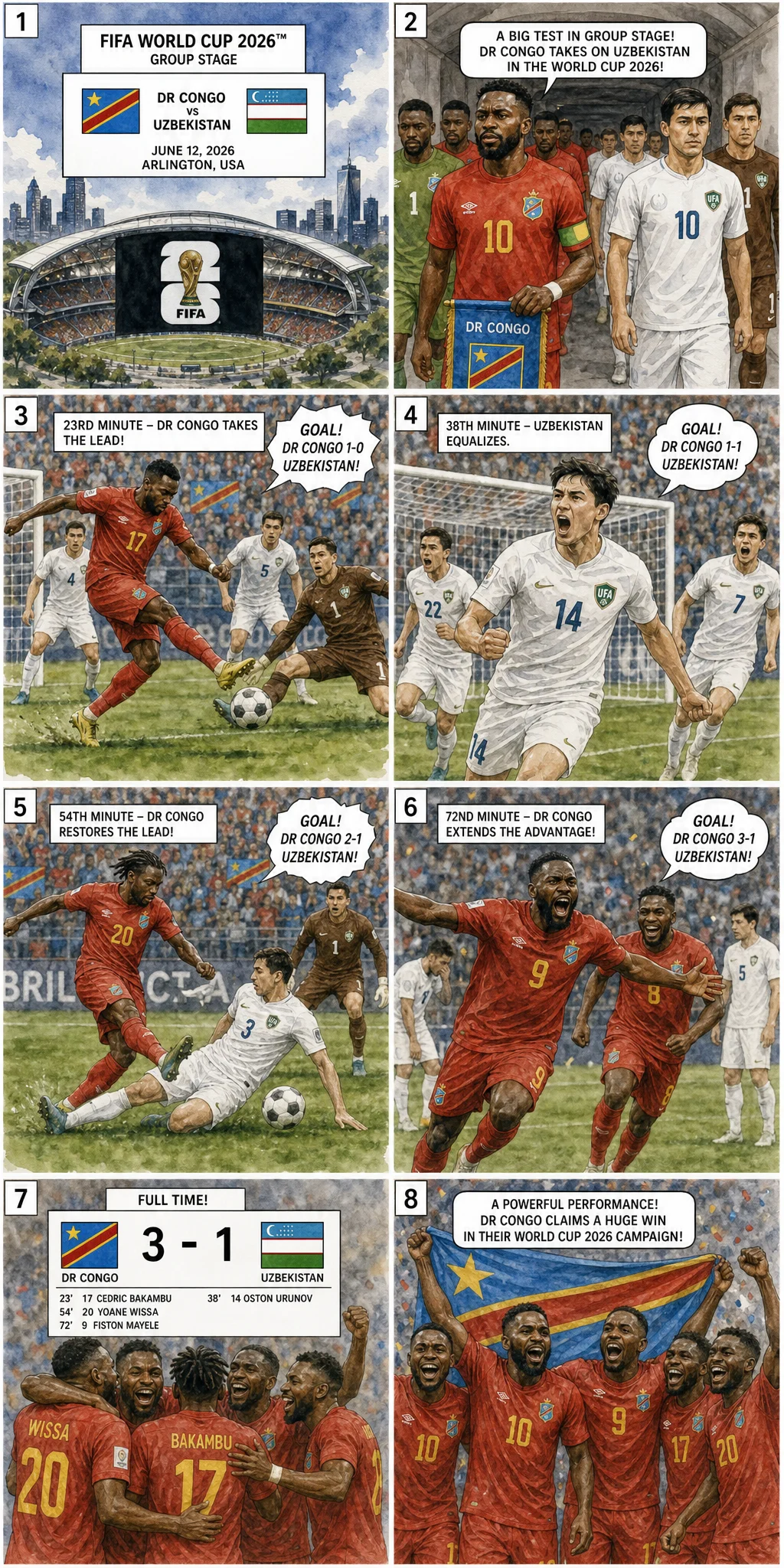
Comic content and match statistics are for entertainment purposes only and may contain inaccuracies. For Accurate Data, please refer to the reference's official website.
# DR Congo 3-1 Uzbekistan: Wissa Double Powers Dramatic Comeback
ATLANTA — In a World Cup group stage match that unfolded within the cauldron of Mercedes-Benz Stadium, DR Congo staged a dramatic second-half comeback to defeat Uzbekistan 3-1, snatching a place in the knockout round and condemning their opponents to a heartbreaking exit. The result, secured by a Yoane Wissa double and a Fiston Mayele strike, was the first victory of the tournament for the Congolese, who had entered the fixture needing a win to advance. For Uzbekistan, the dream of a maiden World Cup point evaporated in the final minutes after holding the lead for more than an hour.
The opening minute of the match delivered a jolt that silenced a significant portion of the crowd. Uzbekistan’s veteran striker Eldor Shomurodov, a player with a reputation for decisive moments, struck with devastating efficiency. Inside the first 60 seconds, a sequence of passes carved open the Congolese defense, and Shomurodov, showing the predatory instincts that have defined his career, swept the ball into the net. The goal, timed officially at one minute, was a hammer blow to DR Congo’s ambitions. They had arrived in Atlanta knowing that a draw would not be enough to secure progression, and now they faced the prospect of chasing a deficit against a side that had shown discipline in their opening group matches.
The early concession forced DR Congo to abandon any tentative approach. For the remainder of the first half, they dominated possession but struggled to translate territorial advantage into clear chances. Uzbekistan, comfortable in a compact defensive shape, sat deep and invited pressure, trusting in their organization to see out the lead. Their game plan was simple: protect the goal Shomurodov had gifted them, and hope for a counter-attack that might seal the result. For long stretches, it worked. The Congolese midfield, energetic but lacking incision, found themselves repeatedly running into a wall of blue shirts. Crosses were dealt with, shots from distance were blocked, and Uzbekistan goalkeeper Utkir Yusupov had little serious work to do.
As the half wore on, DR Congo’s frustration became palpable. Their best chance came from a set piece, but a headed effort drifted wide. The atmosphere inside the stadium, initially electric with anticipation, began to sag as the scoreboard remained unchanged at the interval. With one half remaining, Uzbekistan were 45 minutes away from a result that would have rewritten their nation’s footballing history—a first ever World Cup point, secured in only their second match at this level.
The second half began with DR Congo showing greater urgency. Manager Sébastien Desabre made a tactical adjustment, pushing his full-backs higher and instructing his midfielders to take more risks. The early exchanges were scrappy, with both sides guilty of misplaced passes and heavy touches. Yet the Congolese pressure slowly built. In the 68th minute, it finally broke through. A surging run into the box by a Congolese attacker drew a clumsy challenge from an Uzbek defender. The penalty was clear, the contact undeniable. Yoane Wissa, the Brentford forward who had been the focal point of his team’s attacking efforts, stepped up to take the spot-kick. He sent the goalkeeper the wrong way, placing the ball low and hard into the corner. The equalizer sent a wave of relief through the Congolese bench and ignited the stands. From that moment, the momentum swung decisively.
Uzbekistan, suddenly exposed, struggled to regroup. Their defensive line, which had been so disciplined in the first half, began to show cracks. The midfield, tasked with protecting the back four, found themselves overrun. DR Congo smelled blood. In the 78th minute, they struck again. Fiston Mayele, a striker who had been introduced as a substitute earlier in the second half, pounced on a loose ball inside the penalty area after a goalmouth scramble. With the Uzbek defense caught in disarray, Mayele reacted quickest, firing a shot that beat the goalkeeper at his near post. The stadium erupted as DR Congo completed their turnaround. From 1-0 down, they now led 2-1 with less than 15 minutes left on the clock.
Uzbekistan, desperate to salvage something, threw bodies forward in search of an equalizer. They had tasted the possibility of a historic point, and the fear of losing everything drove them to abandon their defensive shape. But in doing so, they left themselves vulnerable to the counter-attack. DR Congo, now playing with the confidence of a team that had rediscovered its identity, exploited the space ruthlessly. The final blow came in first-half stoppage time—91 minutes had elapsed when Wissa completed his brace. A break down the right flank saw a cross driven into the box, and Wissa, arriving at the back post, steered the ball into the net with a composed finish. The goal was academic in terms of the result, but it added a gloss to the scoreline that reflected the second-half dominance.
When the final whistle blew, the Congolese players collapsed in celebration. Their first win of the tournament had come at the perfect moment, propelling them into the round of 32. For Uzbekistan, the pain was acute. They had been 22 minutes plus stoppage time away from earning that elusive first World Cup point. Shomurodov’s early strike had given them the platform, but the inability to see out the game against a resurgent opponent will haunt them. Their tournament ends without a point, but they depart with the knowledge that they were within touching distance of a breakthrough.
The match was a tale of two halves, but more precisely, it was a tale of one moment turning a game on its head. The penalty awarded in the 68th minute was the hinge on which the result swung. Before that, Uzbekistan had been organized, disciplined, and on course to achieve something historic. After it, they were a team unravelling, unable to stem the tide of Congolese momentum. The warning signs had been there in the minutes leading up to the spot-kick—the Congolese had been building pressure, winning second balls, and forcing errors—but the penalty itself was the decisive inflection point.
For DR Congo, the victory was a testament to resilience. Coming from behind is never easy, especially in a World Cup match with knockout stakes. Yet they did not panic after Shomurodov’s early goal. They stuck to their plan, increased the tempo in the second half, and took their chances when they arrived. Wissa, with two goals, was the obvious hero, but the collective effort was undeniable. The defence, shaky early on, tightened after the equalizer. The midfield, overrun in the first half, asserted control in the second. And the substitutes, Mayele in particular, made a tangible impact.
Uzbekistan will look back at this match with regret, but also with a sense of progress. They had never been this close before. To lead a World Cup match for more than 90 minutes—including stoppage time—only to lose is a cruel fate. Yet the fundamental issue was clear: when the pressure mounted, they could not handle it. Their discipline evaporated, their decision-making faltered, and they conceded three goals in a chaotic second half. Against a more experienced side, those errors are punished.
The atmosphere at Mercedes-Benz Stadium, a venue that has hosted major sporting events but rarely a World Cup match of such emotional complexity, was electric throughout. The Congolese supporters, despite the early setback, never stopped singing. The Uzbek fans, hopeful for so long, fell silent in the final stages. For one team, joy; for the other, heartbreak.
DR Congo now advance to the round of 32, a stage where any result is possible. Their first win of the tournament has come at the perfect time, and the momentum from this comeback could prove invaluable. For Uzbekistan, the dream is over, but the lessons are clear. They were 22 minutes away from history. Next time, they will need to close the deal.