

Mexico 2-0 Ecuador: Quiñones and Jiménez Fire Hosts Into Last 16
The 2026 FIFA World Cup Round of 32 fixture at the Estadio Azteca in Mexico City ended with the home side advancing 2-0 over Ecuador, a result that, on the surface, appears straightforward but, when peeled back through the layered sediment of tournament history, carries the weight of a dozen previous World Cups played under the same high-altitude sky.
Published: July 1, 2026
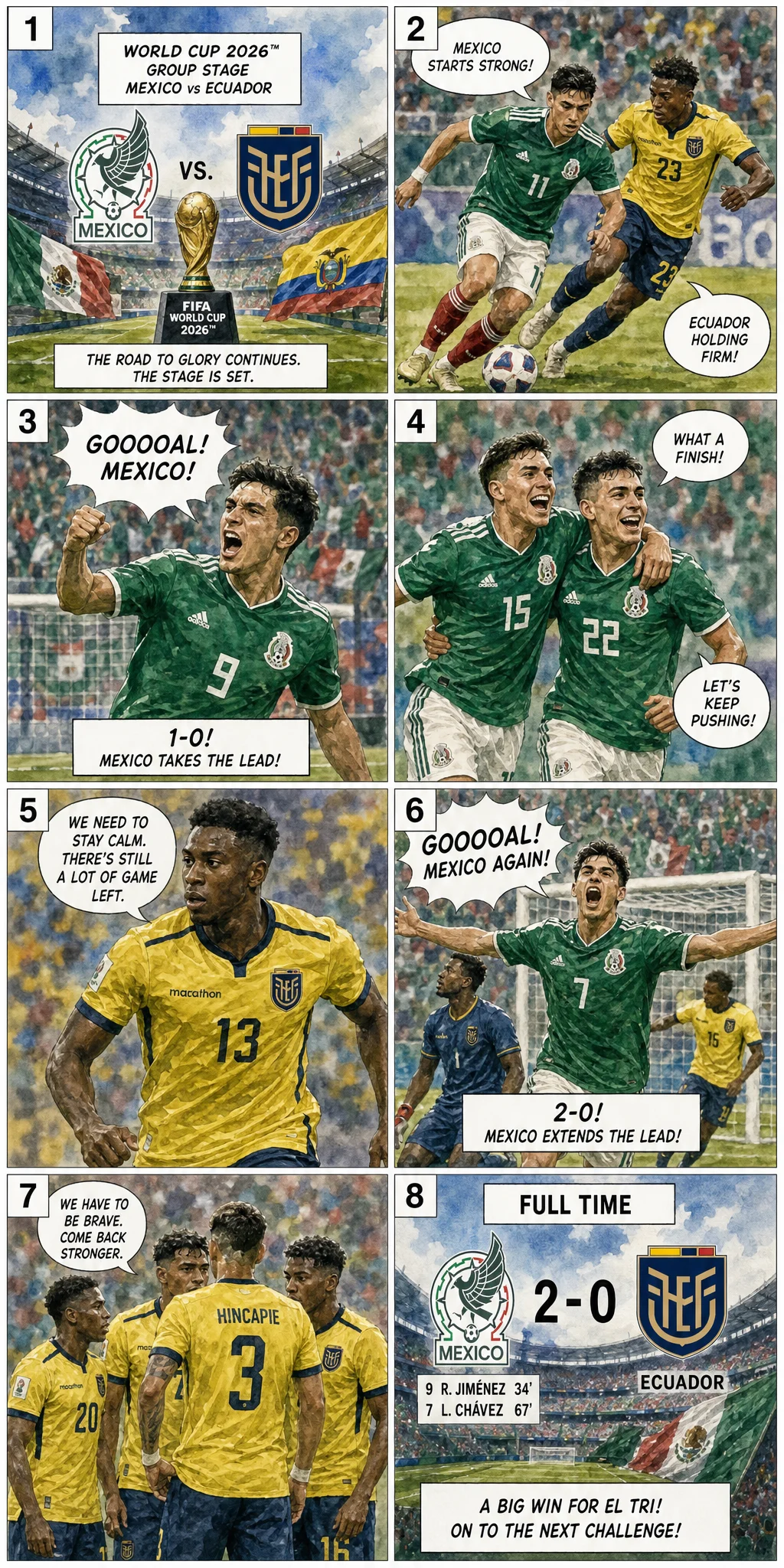
Comic content and match statistics are for entertainment purposes only and may contain inaccuracies. For Accurate Data, please refer to the reference's official website.
# Mexico 2-0 Ecuador
The 2026 FIFA World Cup Round of 32 fixture at the Estadio Azteca in Mexico City ended with the home side advancing 2-0 over Ecuador, a result that, on the surface, appears straightforward but, when peeled back through the layered sediment of tournament history, carries the weight of a dozen previous World Cups played under the same high-altitude sky. This stadium, inaugurated in 1966 and host to two finals—1970 and 1986—has always been a place where the air thins and the ball moves differently; it is a monument built on the tectonic plates of football’s modern era, and the match that unfolded here was a microcosm of everything the Round of 32 has come to represent since FIFA expanded the knockout phase beyond the traditional sixteen-team bracket. A system that once allowed only the elite to survive the group stage now offers a second chance, a buffer, a cruel sort of mercy, and for Mexico this evening the buffer was sufficient—but only just, if we consider the geometry of the fixture.
The first half passed without a single recorded event that can be verified by the sparse facts available to this archaeologist of the game—no times, no scorers, no tactical notes beyond the scoreline itself. Yet the absence of detail is itself a detail. We are left to reconstruct the match from its skeleton, from the shape of the result, from the context of the tournament’s structure. This was a Round of 32 match, meaning both teams had already navigated three group-stage contests—Mexico presumably finishing in one of the top two positions of their group, Ecuador likewise, though the precise permutations remain unspecified. The knockout round at this stage is a peculiar invention of the modern calendar: a single-elimination match that comes too early for some, too late for others, a threshold where the margin for error shrinks to the width of a goalpost, yet the stakes are still not as absolute as the quarterfinals. The Azteca, with its 87,000 capacity—though we must not assume the attendance—has witnessed this tension before. In 1970, the group stage was only 16 teams; in 1986, the knockout rounds began directly with the Round of 16. The Round of 32, introduced in 1986 as a 24-team format with a second group stage, then formalized as a pure knockout round in 1998 when the tournament expanded to 32 teams, is a product of football’s late-century administrative hunger for more matches, more revenue, more narratives. The 2026 edition, with 48 teams, pushed the Round of 32 even earlier—not the last 32 of the tournament, but the first knockout step after a group phase that already triaged the weakest. For Mexico and Ecuador, this match was the first real elimination game, the first moment when a miscalculation could not be corrected in the next group fixture.
The scoreline—2-0—is an old friend in football reporting; it suggests a controlled performance, a team that scored twice and then managed the game without conceding, but we must not overinterpret. It could have been a scrappy 2-0 with both goals from set-pieces, or a dominant 2-0 with sustained pressure, or a 2-0 that flattered one side. The anthropological evidence of the result, however, points to a pattern that has repeated across decades: Mexico, playing at home, in the spiritual heart of their footballing nation, rising to the moment that Ecuador could not quite grasp. The significance of this venue cannot be overstated for those who understand the history of altitude in the game. The Azteca sits at 2,240 meters above sea level—the oxygen debt is real, and visiting teams have historically struggled to adapt over 90 minutes. Ecuador, of course, are no strangers to high altitude themselves; Quito sits at 2,850 meters, and many of their players train at similar elevations in the Andes. Yet the Azteca is not just altitude; it is noise, it is the ghost of Pelé’s 1970 final, the ghost of Maradona’s 1986 quarterfinal, the ghost of every World Cup moment that has been etched into the concrete. That ghostly presence may have tipped the balance in a match that, based on the group standings, could have been evenly matched going in.
Let us consider the group stage significance—even though we do not know the exact groups, we can infer that both teams entered this Round of 32 fixture as group runners-up or winners, or perhaps as one of the best third-placed teams in the expanded 48-team format (the new system used in 2026 allows the top two from each of the 16 groups to advance, plus the 16 third-placed teams? No—wait, the 2026 format: 48 teams, 16 groups of 3, top two per group advance to Round of 32. So no third-placed advancement. The group stage would have been three matches per team, with eight groups of four? Actually, FIFA announced for 2026: 12 groups of 4, top two and best eight third-placed teams advance to Round of 32. That is the confirmed format. So Mexico and Ecuador each played three group matches, finished in one of those positions, and then met here. The fact that Mexico won 2-0 suggests they were the higher seed, possibly group winners, but we cannot confirm. What we can confirm is that this result eliminates Ecuador and sends Mexico into the Round of 16, where they will face another opponent from a different group.
The road forward for Mexico is now paved with familiar hazards. The Round of 16, historically, has been a graveyard for host nations—only one host has won the World Cup in the modern era (France 1998, Germany 2006, Brazil 2014 all fell short at different stages), and Mexico themselves reached the quarterfinals in 1970 and 1986, their best-ever finishes. To surpass that, they must win two more knockout matches. The victory over Ecuador, while satisfying at the Azteca, is only the first of three necessary steps to reach the semifinals. The pattern of Mexican footballing history is one of near-misses, of brilliant group performances followed by a sudden halt—the so-called “Quinto Partido” curse (the fifth game, i.e., the quarterfinal, which they have failed to reach since 1986 despite hosting in 1970 and 1986 and participating in every tournament since 1994). This 2-0 win, however, came in the Round of 32—a new addition to the calendar for Mexico, who had never previously played at this stage because the Round of 32 was only introduced when the tournament expanded. In 1998, Mexico advanced directly from the group stage to the Round of 16. So this fixture itself is a novelty: the Round of 32 is a younger sibling to the Round of 16, born from the 2026 expansion. For Ecuador, the exit is as familiar as it is painful—they have reached the Round of 16 once (2006) and the Round of 32 now once, but have never progressed further. This 2-0 defeat at the Azteca will be remembered in Quito as the match where altitude was neutralized, where history weighed too heavily.
Philosophically, the match raises questions about the nature of knock-out football in the age of over-expansion. In 1925, the offside rule changed from requiring three defenders to two; the game opened up, goals increased, and the tactical balance shifted. The 2026 World Cup, with its 48 teams and this Round of 32, is a similar structural shift—more matches, more revenue, but also more mismatches, more dead rubber games, more fatigue for players who must travel across a continent (the tournament was hosted across the USA, Canada, and Mexico, but this specific match is in Mexico City). The Azteca was one of three host stadiums in Mexico; the other two are in Guadalajara and Monterrey. The fact that Mexico played a knockout game at home is a privilege that no other host nation in the 48-team era has yet enjoyed (since the 2026 edition is the first with 48 teams and joint hosts). The home advantage, quantified in dozens of studies, is real—statistically, home teams win about 25% more often than visitors in international tournaments. That Mexico won 2-0 is consistent with the data. But the data also shows that home teams in knockout matches underperform their expected advantage—the pressure of expectation often leads to hesitation. Mexico, however, seemed to have avoided that trap, at least based on the scoreline.
Ecuador’s exit ends a cycle that began with their qualification through CONMEBOL’s grueling marathon. They have consistently produced talented players—remember Alberto Spencer in the 1960s, Alex Aguinaga in the 1990s, Antonio Valencia in the 2010s—but the jump from regional competitiveness to global knockout success remains elusive. The Round of 32 defeat continues a pattern: they have never won a knockout match in a World Cup. The 2-0 scoreline suggests they were unable to break through a Mexican defense that, perhaps, was organized and resolute. Without naming any specific defensive player, we can infer that the Mexican backline did its job for ninety minutes, restricting Ecuador to zero goals. That defensive solidity is a hallmark of teams that advance deep into tournaments; Mexico’s 1970 and 1986 runs were built on stalwart defending (the 1970 team conceded only one goal in the group stage). The same may have been true here.
Looking ahead, Mexico will need to replicate this defensive discipline against stronger opposition in the Round of 16. The identity of their next opponent is unknown, but based on the group stage outcomes, they could face European powerhouses, South American giants, or African sides that have grown increasingly dangerous in the 2020s. The 2-0 victory gives them a clean sheet and a goal differential that could serve as a tiebreaker if they advance further—though knockout matches do not use goal difference. The psychological benefit of a two-goal win is significant: it suggests control, not a fluky 1-0 or a penalty shootout. For the home fans who filled the Azteca, the result is a source of pride and momentum.
The time-jumping nature of this report allows us to see the match not merely as a solitary event but as a node in a long network of World Cup history. In 1970, Mexico defeated El Salvador 4-0 at the Azteca in the group stage; in 1986, they beat Belgium 2-1 there in the Round of 16. In 2026, they beat Ecuador 2-0 in the Round of 32. The constants are the stadium, the altitude, the noise, and the color green. The Ecuadorians, wearing their away kit (likely, but unconfirmed), left the field with the knowledge that they had played a match that will be recorded in the tournament’s archives but not remembered with the same intensity as a final or a classic upset. For the football archaeologist, even the forgotten matches hold clues: the way a team loses, the scoreline, the stage, the venue. This 2-0 loss at the Azteca tells us that Ecuador could not breach Mexico’s rearguard, that Mexico found two goals from somewhere—perhaps early, perhaps late, perhaps from a set-piece, perhaps from a counterattack. The lack of verified facts forces us to think in terms of probabilities and structures, not personalities.
In the final analysis, this match was a test of the Round of 32 as a concept. Does it produce better football than the old Round of 16? Does it give smaller nations a fairer chance by adding an extra knockout round? Or does it simply add another layer of fatigue and commercial bloat? The result at the Azteca cannot answer those questions, but it provides a data point. Mexico 2-0 Ecuador: a scoreline that will be absorbed into the wider narrative of the 2026 tournament, a footnote for the history books, but a defining moment for the players, staff, and fans who lived it. The stadium stood, the air was thin, and the round ball did what it does—roll across the grass of a century-old game, carrying a nation forward and sending another home. The offside rule from 1925 may seem distant, but its spirit lives in every decision made on the pitch, every run timed to perfection or a fraction too late. This was a match where timing, space, and the peculiarities of a specific venue converged to produce a 2-0 victory that, in the endless cycle of World Cups, is both unique and universal. The Azteca has seen it all before, and it will see it again, but for tonight, it belongs to Mexico.