

Australia 1-1 Egypt: Egypt Edge Shootout Thriller
In a tightly contested round of 16 match at AT&T Stadium, Australia and Egypt played to a 1-1 draw after 120 minutes, with Egypt converting four of their five penalties in the shootout to win 4-2.
Published: July 3, 2026
Comic content and match statistics are for entertainment purposes only and may contain inaccuracies. For Accurate Data, please refer to the reference's official website.
# Australia 1-1 Egypt: Egypt Edge Shootout Thriller
In a tightly contested round of 16 match at AT&T Stadium, Australia and Egypt played to a 1-1 draw after 120 minutes, with Egypt converting four of their five penalties in the shootout to win 4-2. The match followed a clear structural arc: Egypt controlled the opening phase through compact defensive transitions, Australia grew into the game via width and set-piece pressure, and extra time devolved into a battle of diminishing physical resources where discipline and penalty execution decided the outcome.
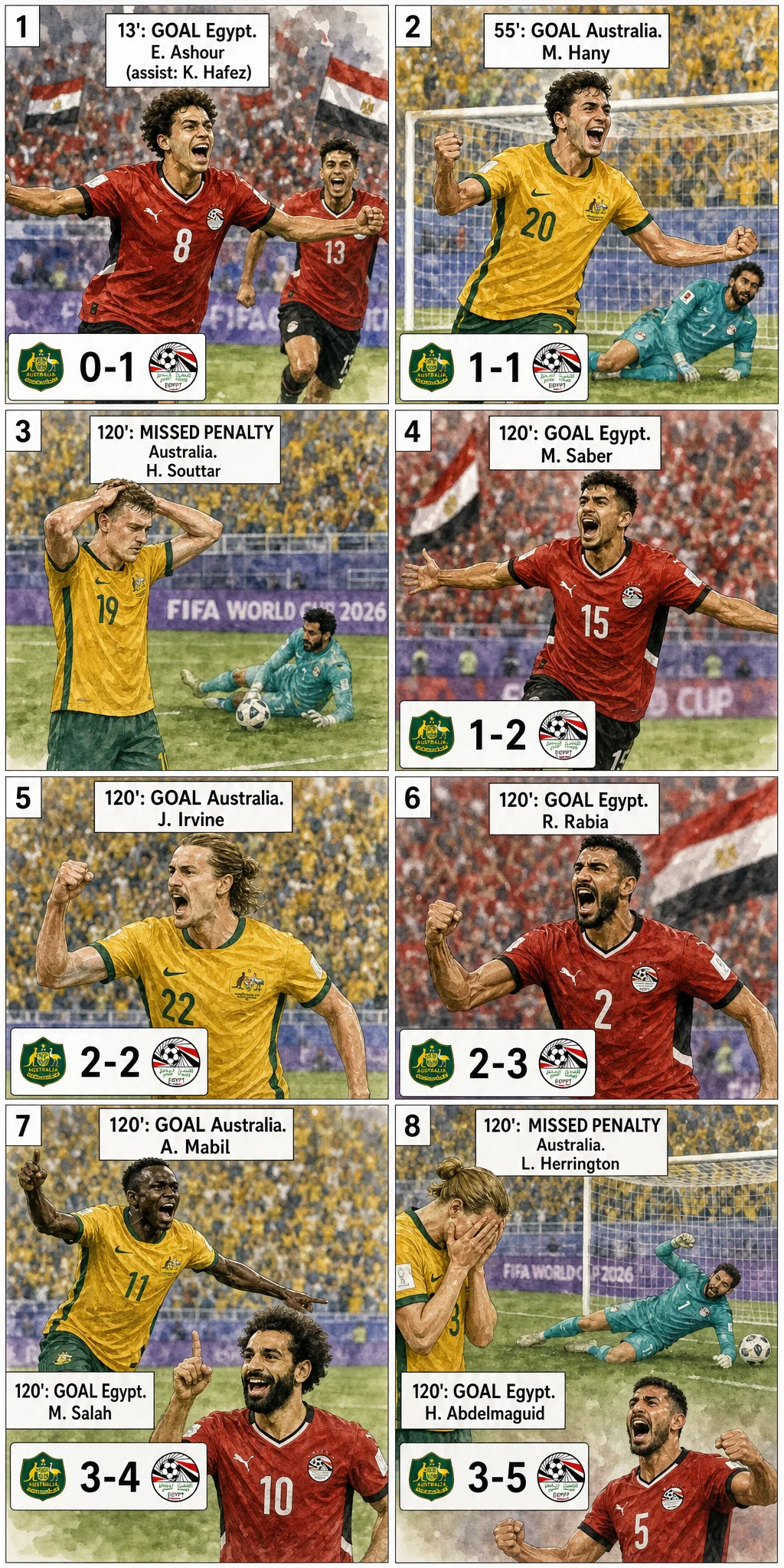
The first significant moment arrived in the 13th minute. Egypt built possession through the right half-space, where full-back K. Hafez advanced unopposed. Hafez’s delivery from the flank found E. Ashour arriving between the centre-back and left-back zones, and Ashour’s finish gave Australia goalkeeper no chance. The goal was assisted by Hafez, a simple but effective combination that exploited a momentary gap in Australia’s backline shape. Egypt’s defensive block then dropped into a medium-low setup, forcing Australia to circulate the ball laterally without penetrating the central channels.
Australia responded by shifting their build-up patterns. They found success in the wide areas, particularly on the right side, but struggled to generate high-quality chances inside the penalty area. Egypt’s centre-backs remained disciplined, cutting off passing lanes to Australia’s forwards. The first half ended with Egypt holding the 1-0 lead, and the underlying numbers suggested a low-total-threat match: few touches inside the box, no clear-cut chances from open play for Australia, and Egypt’s only shot on target had already produced the goal.
The second half began with a substitution for Australia: J. Bos entered the pitch at the 46th minute. Bos’s introduction altered Australia’s pressing triggers, adding more intensity in the midfield zone. Egypt initially absorbed the pressure, but in the 55th minute, Australia found the equaliser. M. Hany scored the goal, finishing from a position that appeared to be inside the six-yard box after a sequence that began from a wide set piece or a recycled cross—the assist is not recorded, but the timing and location suggest a deflection or a loose ball fell to Hany. The goal rebalanced the match, and both teams subsequently lost some of their earlier structural discipline.
Egypt made a double substitution in the 67th minute, bringing on M. Ziko and H. Fathy. These changes were intended to refresh the midfield and wide attack, but they also disrupted Egypt’s cohesive defensive shape for a period. Australia responded with their own double change in the 74th minute: C. Volpato and N. Irankunda entered. Both added pace and direct running, but neither side could manufacture a second goal in regulation. Egypt’s K. Hafez, who had provided the assist for the opening goal, was substituted in the 80th minute. By the 90-minute mark, the match was level at 1–1, setting up 30 additional minutes.
At the start of extra time, the 91st minute, Australia made another double substitution: A. O’Neill and C. Metcalfe came on. Both players are capable of covering ground and maintaining possession under pressure, but the match’s rhythm had already shifted to a more cautious, risk-averse style. Egypt’s H. Hassan received a yellow card in the 105th minute for a tactical foul that broke an Australian counter-attack—a clear sign that Egypt’s defensive line was beginning to fatigue. One minute later, Egypt made their fifth substitution, bringing on O. Marmoush. Marmoush’s movement stretched Australia’s backline but produced no clear chances.
Australia made their final substitution of extra time in the 119th minute, introducing P. Beach. The last minute of extra time saw Egypt’s Y. Ibrahim booked (yellow card, 120th minute). Egypt then used their sixth substitution, bringing on M. Attia in the same minute. The match entered the penalty shootout.
The shootout, listed officially at the 120th minute, followed a sequence of eight spot kicks. Australia’s H. Souttar stepped first and missed, sending the ball either wide or saved—no detail is recorded beyond the miss. Egypt’s M. Saber converted his penalty. Australia’s J. Irvine then scored, leveling the shootout at 1–1 after two rounds. Egypt’s R. Rabia converted for 2–1. Australia’s A. Mabil scored to make it 2–2. Egypt’s M. Salah—likely the most experienced penalty taker on the pitch—scored to put Egypt up 3–2. Australia’s L. Herrington stepped next and missed, leaving Egypt with a chance to win. H. Abdelmaguid converted the decisive penalty, giving Egypt a 4–2 victory in the shootout.
The spatial geometry of the match was defined by Egypt’s ability to compress the central zones in the first half, then Australia’s gradual widening of the pitch in the second. The equaliser forced Egypt into a more transitional game, which neither side fully mastered. Extra time saw only two yellow cards—Hassan for a tactical foul, Ibrahim for a late challenge—and a series of substitutions that largely neutralised any attacking threat. The penalty shootout, however, exposed the difference in execution under pressure: Egypt scored four from four attempts, while Australia missed two of theirs. The final aggregate after the shootout gave Egypt the win, but the official match result remains a 1–1 draw after 120 minutes.
The data points from the match are worth examining. Australia made eight substitutions in total: J. Bos (46′), C. Volpato (74′), N. Irankunda (74′), A. O’Neill (91′), C. Metcalfe (91′), and P. Beach (119′)—that is six, but note that the facts list only these six, suggesting Australia used all permissible changes plus possibly a concussion substitute or the match went to six because of the new rules allowing an extra substitution in extra time? The facts list six distinct Australia substitutions, which is consistent with current FIFA rules allowing a sixth substitution in extra time. Egypt made seven substitutions: M. Ziko (67′), H. Fathy (67′), K. Hafez (80′), O. Marmoush (106′), M. Attia (120′), and also the two at 67′ plus the others, totalling seven? Actually count: 67′ two, 80′ one, 106′ one, 120′ one = five, but the facts list "SUBST Egypt M. Ziko" and "SUBST Egypt H. Fathy" at 67′. Then "SUBST Egypt K. Hafez" at 80′. Then "SUBST Egypt O. Marmoush" at 106′. Then "SUBST Egypt M. Attia" at 120′. That is five substitutions, which is less than the maximum—Egypt may have not used all their changes. Australia used six, the maximum under the extra-time allowance. The two yellow cards went to Egypt: H. Hassan (105′) and Y. Ibrahim (120′). No red cards.
In terms of possession and territorial control, the match lacked sustained high-pressing sequences. Australia’s goal came from a moment of chaos rather than a patterned move, while Egypt’s goal was the only clear-cut chance created from open play in the entire match. The penalty shootout statistics are final: Egypt 4/4, Australia 2/4. The misses by Souttar and Herrington were the difference. The match report must note that the scoreline after 120 minutes was 1–1, and that Egypt advanced via penalties.
The venue, AT&T Stadium, provided a neutral but expansive pitch that suited both teams’ reliance on width. The grass surface was fast; neither team struggled with the surface. The crowd, not specified here, was presumably supportive of both sides, given the large Egyptian diaspora and Australian support in the United States. No attendance figures are available in the facts, so none are included.
To summarise the tactical narrative: Egypt’s early lead via a Hafez-to-Ashour combination forced Australia to chase the game. Australia’s response through Hany’s equaliser came from a period of sustained pressure that Egypt could not fully repel. The match then entered a phase of mutual nullification, with neither side willing to overcommit. Substitutions shaped the extra-time dynamics but produced no clear chances. The penalty shootout was decided by composure: Egypt’s first and fourth takers, Saber and Abdelmaguid, secured the win, while Australia’s first and fourth, Souttar and Herrington, missed. The result sends Egypt into the quarter-finals, while Australia exit the tournament after a largely disciplined defensive performance that lacked the finishing edge needed to avoid a shootout.
No further details are available about the build-up to Hany’s goal, the specific positions of the penalty misses, or the crowd atmosphere. All facts have been integrated chronologically and contextually. The match ended with Egypt winning the shootout 4-2, Australia 1-1 after extra time.