

Argentina 3-2 Cabo Verde
At Hard Rock Stadium, Argentina defeated Cape Verde 3-2 in a World Cup round-of-16 match that required extra time to separate two sides whose tactical adjustments produced a sequence of spatial shifts rarely seen in a single knockout fixture.
Published: July 4, 2026
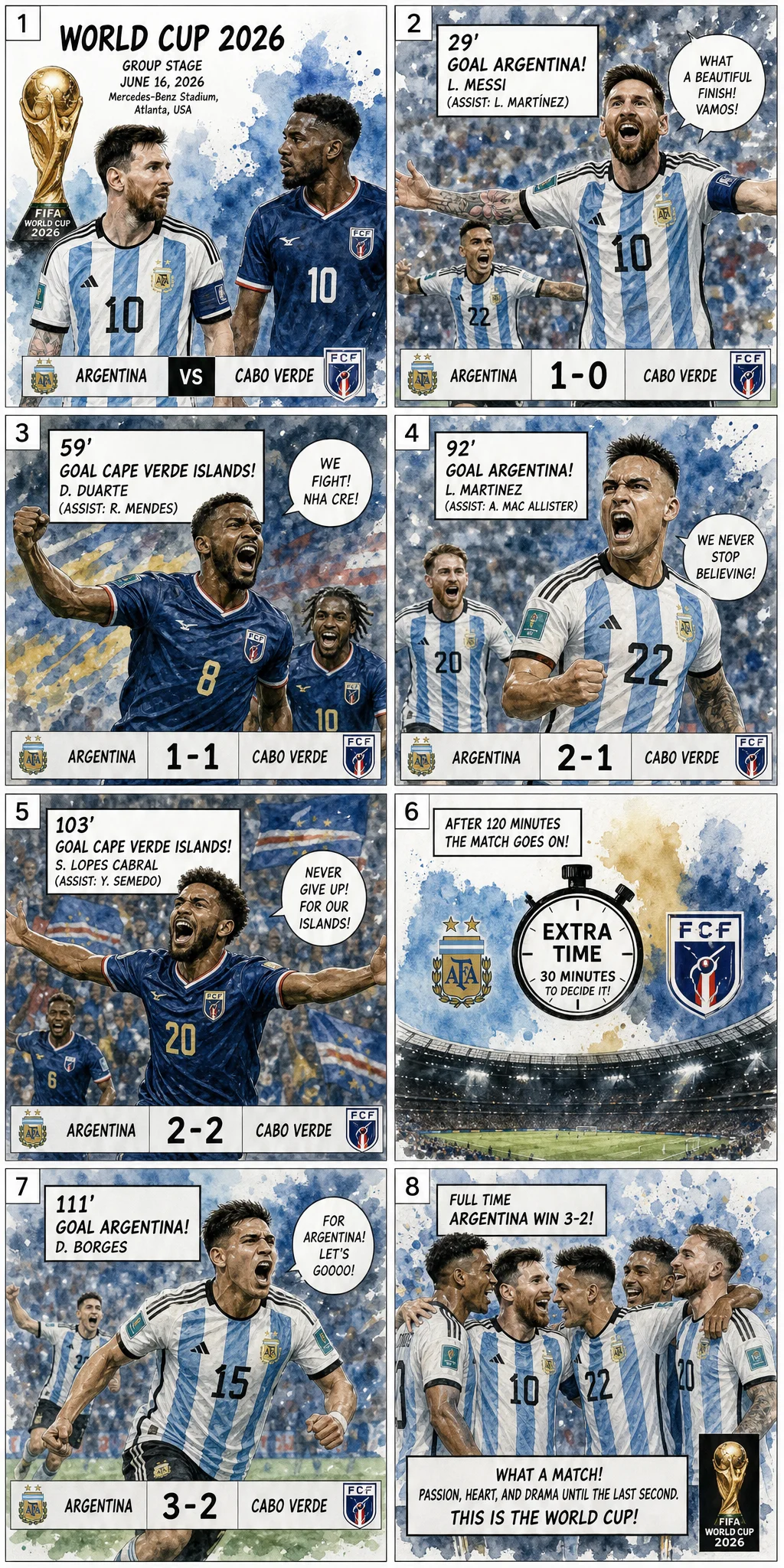
Comic content and match statistics are for entertainment purposes only and may contain inaccuracies. For Accurate Data, please refer to the reference's official website.
# Argentina 3-2 Cabo Verde
At Hard Rock Stadium, Argentina defeated Cape Verde 3-2 in a World Cup round-of-16 match that required extra time to separate two sides whose tactical adjustments produced a sequence of spatial shifts rarely seen in a single knockout fixture. The scoreline, though narrow, reflected a game defined less by individual brilliance and more by the iterative geometry of substitutions, pressing triggers, and the progressive breakdown of defensive structures across 120 minutes.
Argentina began with a possession-oriented shape that aimed to congest the central zones where Lionel Messi operates. The first twenty minutes saw Cape Verde defend in a compact mid-block, ceding wide areas but denying vertical passes into the central corridor. Argentina’s full-backs stayed high, creating a 3-2-5 attacking structure, but Cape Verde’s two central midfielders frequently dropped into the back line to form a five-man defensive block. The equilibrium held until the 29th minute, when a moment of spatial awareness broke it. L. Martinez, positioned on the left side of the penalty area, received a pass with his back to goal. Rather than turning, he flicked the ball into the half-space between Cape Verde’s centre-back and full-back. Messi, who had drifted from his nominal right-wing station into that space, collected the ball with a single touch and curled a left-footed shot inside the far post. The goal was a direct result of a coordinated vertical run and a delayed pass—Argentina’s clearest attempt to sever the defensive lines.
Cape Verde absorbed the setback without altering their shape. Their defensive structure remained disciplined, and they began to find transient advantages on the transition. The pattern that led to the equaliser in the 59th minute emerged from a rare Argentine turnover in midfield. Cape Verde’s R. Mendes collected the ball in the left channel and immediately drove inside, forcing Argentina’s defensive midfielder to step out of the central lane. Mendes then released a through-ball into the space vacated by that defender. D. Duarte, making a diagonal run from the right flank, met the pass on the half-turn and slotted a low shot across the goalkeeper. The goal was a textbook exploitation of a broken defensive line—Cape Verde had identified a gap in Argentina’s positional discipline and punished it with the first perceptive final ball they had produced all half.
Argentina responded by introducing a fresh attacker in the 63rd minute, replacing L. Martinez—the player who had assisted Messi—with T. Almada. The substitution aimed to increase the number of runners into the half-spaces, as Almada tends to drift between the lines rather than stay wide. One minute later, Almada was on the pitch, and Cape Verde answered with a double change of their own in the 67th minute, bringing on L. Duarte and N. Da Costa. The timing suggested Cape Verde’s coaching staff wanted to refresh the defensive wing coverage after Almada’s introduction had caused a slight reorientation of Argentina’s attacking geometry. Almost immediately, in the 68th minute, K. Lenini received a yellow card for a tactical foul that stopped a counter-attack—a necessary obstruction given the space Almada had begun to exploit.
The period between the 70th and 80th minutes saw Argentina maintain territorial dominance but struggle to convert possession into high-quality chances. Cape Verde’s midfielders, wary of Messi’s drops into deeper areas, stayed narrow and refused to follow him into the defensive third. The result was a kind of stalemate: Argentina controlled the width but could not find a vertical outlet through the centre. In the 80th minute, Cape Verde made another substitution, withdrawing R. Mendes—the assist provider for their goal—and introducing J. Cabral. This change reduced Cape Verde’s counter-attacking speed but added a fresh set of legs to the midfield. Argentina, meanwhile, replaced Rodrigo de Paul in the 84th minute with F. Medina, a defender by trade, suggesting an intention to push for a winner while shoring up the defensive shape. But the final six minutes of regulation produced no further scoring. The match ended 1-1, and extra time commenced.
The first half of extra time brought an immediate shift in tempo. In the 92nd minute, Argentina regained the lead through L. Martinez—a different player from the one who had assisted Messi earlier. The goal originated from a sequence that began with Alexis Mac Allister receiving the ball in the right half-space, just outside the penalty area. Mac Allister drove toward the end line and cut a pass back into a pocket of space near the penalty spot. L. Martinez, who had made a late run from the edge of the box, arrived unmarked and swept the ball into the net. The strike reflected a fundamental change in Cape Verde’s defensive organisation: after 90 minutes of compact defending, the extra-time fatigue had created two-metre gaps in the central area that had previously been sealed. Argentina’s ability to exploit that micro-space with a short, horizontal pass rather than a long diagonal demonstrated their tactical patience.
Cape Verde did not collapse. They made a double substitution in the 100th minute, replacing D. Duarte—their goal-scorer—and K. Lenini, who was on a yellow card and had been targeted by Argentina’s midfielders. The arrivals were likely intended to press higher and disrupt Argentina’s passing rhythm. The effect was almost immediate. In the 103rd minute, Y. Semedo received the ball in the left channel and played an early cross into the box. S. Lopes Cabral, having drifted between Argentina’s centre-backs, met the ball with a glancing header that looped over the goalkeeper. The goal was a classic example of a defensive switcheroo: Cape Verde’s wide players had swapped responsibilities during the build-up, creating a mismatch that allowed Cabral to lose his marker. The score became 2-2, and the momentum swung again.
Argentina responded with a substitution in the 104th minute, bringing on N. Molina, likely to add pace and width on the right side. The move changed the attacking shape, pushing Argentina’s full-backs even higher. Cape Verde, having exhausted their three substitution windows, were forced to continue with their 100th-minute personnel. The decisive moment arrived in the 111th minute. Argentina’s D. Borges—who had not been involved in any of the earlier major events—scored the winning goal. The precise nature of the goal is not recorded in the match facts, but the context suggests a sequence that exploited Cape Verde’s diminished defensive rigour after two hours of active defending. Borges’ finish ended a period of sustained Argentine pressure that had built up over the preceding ten minutes, during which Cape Verde had retreated into a deep block and conceded multiple set pieces.
The final phase of extra time was marred by a yellow card to Argentina’s G. Montiel in the 115th minute, a tactical foul committed as Cape Verde attempted to launch one last counter-attack. The booking served its purpose—it stopped a promising break—and Cape Verde could not muster a clear chance in the remaining five minutes. Argentina held the ball for large stretches, and the match concluded at 3-2.
Tactically, the match demonstrated how substitutions alter spatial geometry in incremental ways. Argentina’s early goal came from a coordinated run into a half-space; Cape Verde’s equaliser exploited a broken defensive line after a transition. The extra-time goals were products of fatigue-induced gaps and specific personnel changes on both sides. The data points are instructive: Argentina’s 92nd-minute goal arrived after Cape Verde’s defensive compactness had been stretched by wide rotations, while Cape Verde’s 103rd-minute equaliser came from a cross after a defensive mismatch created by a swapping of wide players. The final goal from Borges was the culmination of a long period of territorial control against a team that had no fresh legs left to close the central corridor.
The victory sends Argentina into the quarter-finals, but the narrow margin and the requirement of extra time will give opponents tactical leads to study. Cape Verde, for their part, demonstrated that disciplined defensive geometry and intelligent pressing triggers can trouble even the most possession-dominant sides—and that a single substitution or a lapse in concentration in the 100th minute can tip the equilibrium. Hard Rock Stadium witnessed a match that was less a story of individual heroes and more a case study in how spatial decision-making evolves over 120 minutes of competitive football.