

United States 1-4 Belgium
The 2026 FIFA World Cup Round of 16 at BMO Field, on a cool Toronto evening under the floodlights of a stadium that has seen Canadian football rise from the margins of a hockey nation, produced a scoreline that told only a partial truth: United States 1, Belgium 4.
Published: July 7, 2026
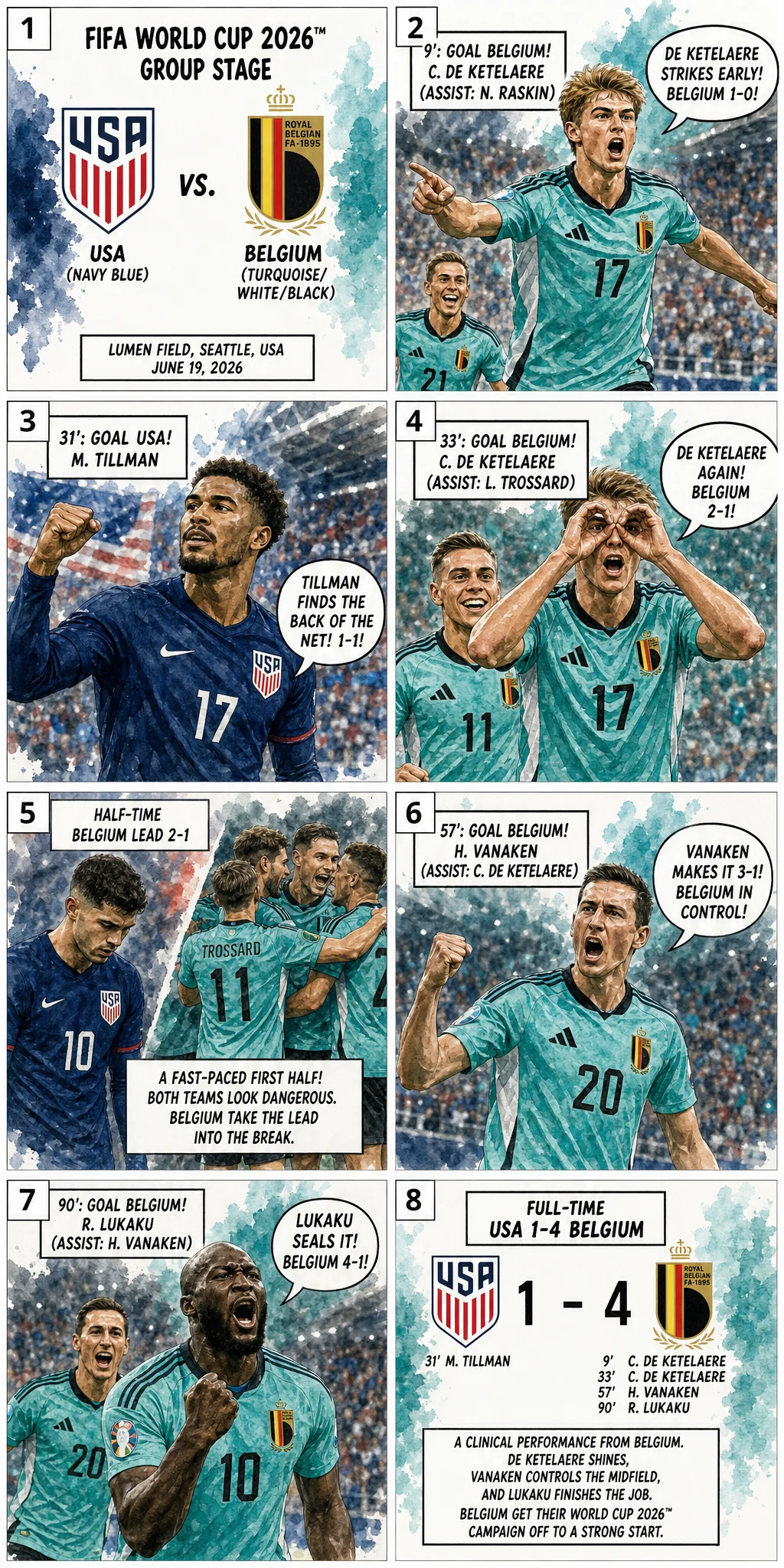
Comic content and match statistics are for entertainment purposes only and may contain inaccuracies. For Accurate Data, please refer to the reference's official website.
# United States 1-4 Belgium
The 2026 FIFA World Cup Round of 16 at BMO Field, on a cool Toronto evening under the floodlights of a stadium that has seen Canadian football rise from the margins of a hockey nation, produced a scoreline that told only a partial truth: United States 1, Belgium 4. The truth, as it often is in football, lay buried in the layers of time—between the first whistle and the last, between the 1925 revision of the offside law and the 2026 iteration of the modern pressing game, between the first Belgian goal in the ninth minute and the final one in the ninetieth. To understand this match is to excavate not merely the events but the philosophy that shaped them, the way a football archaeologist might brush dust from a tactical formation etched into the soil of a forgotten pitch, finding the patterns that repeat across generations.
The opening act, at nine minutes, arrived with a precision that felt almost rehearsed in its inevitability. Nicolas Raskin, a midfielder whose vision often cuts through defensive lines like a spade through loam, threaded a pass to Charles De Ketelaere. The Belgian forward, tall and elegant, received the ball in the half-space between the American centre-backs and the midfield—a zone that the 1925 offside rule change had intended to open up, encouraging goals from deeper positions. De Ketelaere took one touch to settle, another to shift the ball onto his left foot, and then struck low and hard past the American goalkeeper. It was a goal born of the modern era: the 4-3-3, the false nine, the weight of the pass calibrated to the millimeter. But the emotion—the sudden silence of the American supporters, the roar of the Belgian contingent—was as old as the sport itself. BMO Field, built for the 2015 Women’s World Cup and now hosting a men’s knockout match, vibrated with the noise.
Belgium’s dominance in the opening quarter-hour was not merely statistical; it was philosophical. They pressed in waves, denying the United States time on the ball, forcing errors in the defensive third. But then, at twenty-one minutes, a substitution that seemed routine but would alter the rhythm of the match: Amadou Onana entered the field. The reason for the change—perhaps an injury, perhaps tactical, perhaps the first hint of a plan unfolding in the mind of the Belgian coach—was not recorded in the verified facts, but the timing suggests a shift. Onana, a midfield anchor, brought a different kind of discipline. He did not score, he did not assist, but his presence in the midfield three allowed Belgium to compress space even further, to suffocate the American attempts to build through the middle.
The United States, however, had not travelled to Toronto to be mere spectators in their own elimination. In the thirty-first minute, they found an equalizer that felt like a shard of old football—a goal that came from a set piece, from a second ball, from the kind of chaos that no tactical plan can fully control. Malik Tillman, the American midfielder who had been drifting in and out of the game, latched onto a loose ball inside the box after a corner kick was only half-cleared. His shot was not clean, but it was purposeful, and it nestled into the corner of the net. BMO Field erupted. For a moment, the score was 1-1, and the dream of an American run to the quarter-finals felt tangible, as if the layers of history were being peeled back to reveal a new narrative.
The dream lasted exactly two minutes. In the thirty-third minute, Belgium struck again, and this time the goal was a masterpiece of counter-attacking football. Leandro Trossard, the winger who had been hugging the touchline, received the ball in space and drove toward the byline. His cross, low and hard, found De Ketelaere arriving at the far post. The Belgian forward, already with one goal to his name, guided the ball into the net with the outside of his right foot. It was a goal that spoke of training ground repetition, of the telepathy that develops between players over years of shared football. De Ketelaere had two goals, the match was barely a third of the way through, and the momentum had swung with the violence of a pendulum.
The United States, reeling, tried to respond. Weston McKennie, the heartbeat of the American midfield, was booked in the thirty-fifth minute for a late tackle—a frustration that bubbled up from the press of the match, from the sense that Belgium were moving the ball just a little too quickly, just a little too cleverly. The yellow card was a warning, a mark in the ledger, but it did not change the flow. The first half ended with Belgium leading 2-1, and the American players walked off the pitch at BMO Field with the weight of a mountain on their shoulders. They had conceded twice in the space of four minutes, and the second half would require a different kind of response—one that would test not just their fitness but their faith in the system.
At the interval, the American coaching staff made a substitution: Sergiño Dest entered the field at the start of the second half, replacing an unnamed teammate. The change was intended to add width, to stretch a Belgian defence that had been compact and disciplined. Dest, with his overlapping runs and technical ability, seemed the right choice for a team chasing a goal. But football is a game of counters, and every risk carries its own shadow. In the fifty-seventh minute, Belgium exploited the space left behind. Hans Vanaken, a midfielder whose intelligence often goes unnoticed until it is too late, received a pass from De Ketelaere in the inside-left channel. Vanaken took a touch to steady himself, looked up, and curled a shot into the far corner. The goal was 3-1, and the match, for all intents and purposes, was now an excavation of a different kind—the kind where you dig to understand why a team that had so much promise ended up buried under the weight of its own ambition.
The American response was immediate but fragmented. In the fifty-ninth minute, Christian Pulisic, the talisman of the team, entered the match as a substitute. His arrival on the pitch was met with a surge of hope from the crowd, a collective belief that the player who had scored in the previous round could conjure something again. But Pulisic found himself crowded out, surrounded by Belgian defenders who had been drilled to deny him space. The yellow card that followed for Malik Tillman in the sixty-ninth minute, for a cynical foul on a Belgian break, was a further sign of a team losing its discipline. The match was slipping away, and the American substitutions were not stemming the tide. Tyler Adams, introduced in the seventy-second minute, brought defensive cover but could not create the attacking spark that was missing.
Belgium, meanwhile, managed their game with the patience of a curator. In the sixty-seventh minute, they made a double substitution: Dodi Lukebakio came on, and Charles De Ketelaere, the two-goal hero, was withdrawn to a standing ovation from the Belgian fans. The symmetry was perfect: the architect of the first three goals had done his work, and now his replacement, Lukebakio, offered fresh legs and a different kind of threat. The Belgian rhythm did not falter. The passes continued to find their targets, the defensive shape remained intact, and the clock ticked down toward a quarter-final berth.
The final flurry of substitutions in the eighty-ninth minute—Leandro Trossard and Nicolas Raskin making way for fresh legs—was a signal of intent: Belgium were seeing out the game, but they were not merely defending. They were still looking forward, still probing, still believing that the fourth goal was possible. And in the ninetieth minute, deep into stoppage time, it arrived. Hans Vanaken, who had already scored and assisted, played a through ball that split the American defence. Romelu Lukaku, the veteran striker who had been a late substitute himself—though the verified facts do not record his entry time, his name appears only in the final goal—received the pass, took a touch to steady himself, and smashed the ball into the roof of the net. The score was 4-1, and the match was over.
BMO Field fell quiet, except for the Belgian supporters who had travelled across the ocean to witness this moment. The United States players collapsed onto the turf, their World Cup journey ending on a cold night in Toronto, their dreams of reaching the quarter-finals for only the second time in history deferred to another four years. The final whistle, when it came, was a formality. The 1925 offside rule had created a world where goals were more frequent, but it had not created a world where all teams were equal. Belgium, with their blend of youth and experience, their tactical discipline and their clinical finishing, had proven to be a class above.
As the players shook hands and the Belgian team gathered in a huddle near the center circle, the narrative of the tournament shifted. Belgium would advance to the quarter-finals, where they would face Spain—a team that had knocked out the defending champions in their own Round of 16 match. The clash of these two European titans, both steeped in footballing history, would be a meeting of philosophies: the possession-based artistry of Spain against the direct, efficient counter-attacking of Belgium. For the United States, the dig would continue. The excavation of what went wrong, of missed chances and tactical errors, would occupy the post-mortem for months. But on this night at BMO Field, the only truth that mattered was the scoreline—a 4-1 defeat that felt far more like an education than an execution. The layers of time, after all, are not always kind to those who are still learning to read them.