

Argentina 3-2 Egypt
The great footballing nations do not merely play matches; they perform rituals of collective memory, and at the Gillette Stadium in Foxborough, Massachusetts, on a sweltering July evening in 2026, Argentina and Egypt…
Published: July 7, 2026
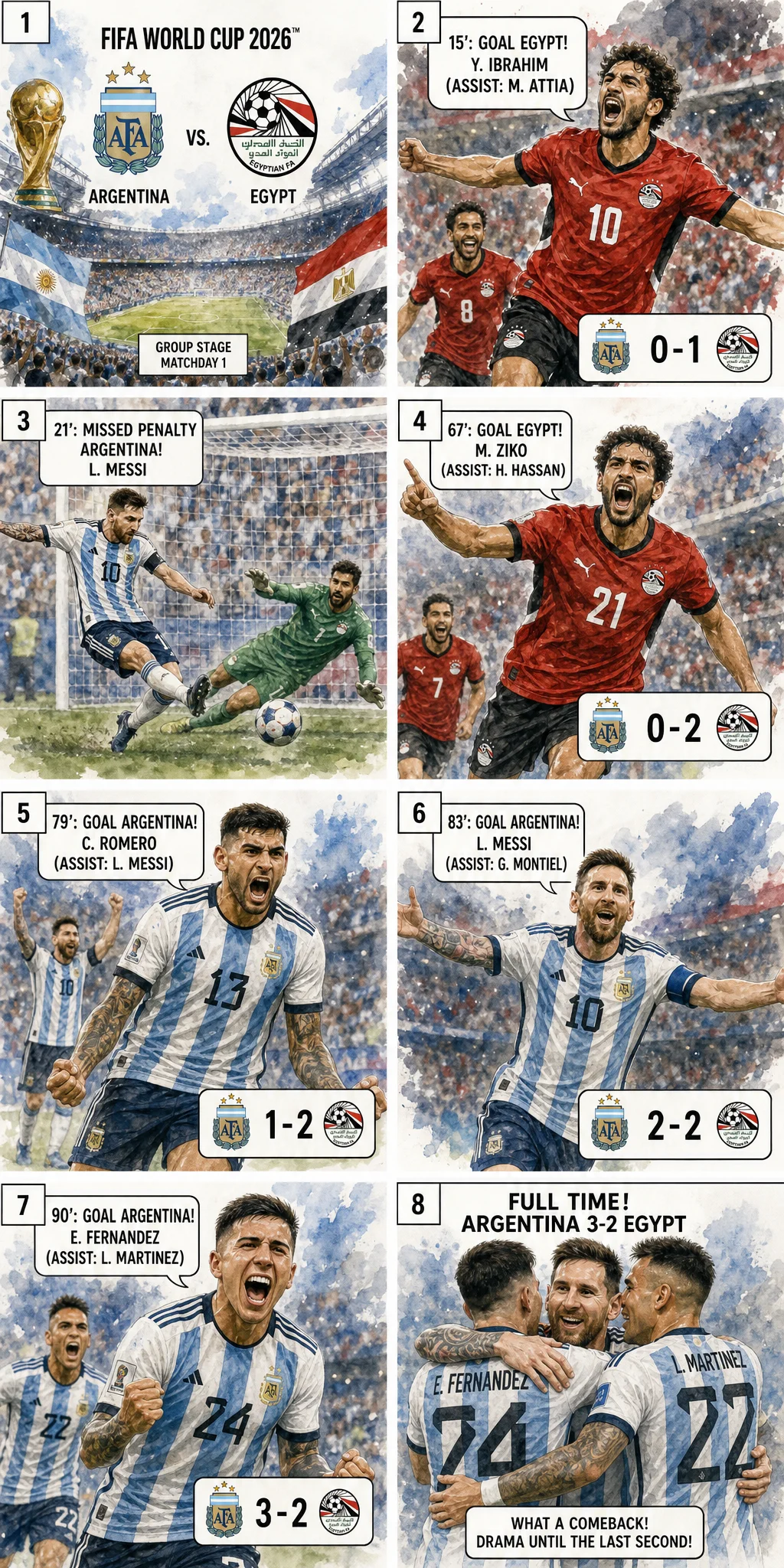
Comic content and match statistics are for entertainment purposes only and may contain inaccuracies. For Accurate Data, please refer to the reference's official website.
# Argentina 3-2 Egypt
The great footballing nations do not merely play matches; they perform rituals of collective memory, and at the Gillette Stadium in Foxborough, Massachusetts, on a sweltering July evening in 2026, Argentina and Egypt enacted a Round of 16 contest that felt less like a World Cup knockout tie and more like a collision of two civilisations—one carrying the weight of a continental empire’s footballing hegemony, the other the simmering pride of a revolution never fully completed—and the result, a 3-2 victory for the Albiceleste, was less a triumph of tactics than a testament to the stubborn, almost mystical refusal of Lionel Messi and his generation to let the narrative end on a missed penalty in a stadium built for American football.
From the first whistle, the match bore the hallmarks of a high‑stakes struggle where history pressed on every pass. Egypt, disciplined and tactically astute under the guidance of a coach who had studied the European game and grafted its pragmatism onto the ancient rhythms of the Nile, struck with surgical precision in the 15th minute. A flowing move, initiated by the midfield pivot M. Attia, whose vision and composure had unsettled the Argentine press all evening, split the defence open: Attia, with the weight of a thousand Pharaonic dynasties behind his left foot, slid a perfectly weighted pass into the path of Y. Ibrahim, who, with a clinical finish that belied his youth, tucked the ball beyond the reach of Emiliano Martínez. The goal sent a shudder through the Argentine ranks, for it was not a fluke but the logical completion of a pattern Egypt had been weaving since the opening exchanges—a pattern that suggested this Round of 16 tie would not be a mere formality for the reigning champions of South America.
The response from Lionel Scaloni’s side was immediate, though not without the shadow of an old curse. Six minutes later, Argentina won a penalty—a decision that brought immediate comparisons to the 2022 final against France, when Messi had stepped up to score from the spot in the most pressured moment of his life. But here, under the floodlights of the Gillette Stadium, with the humidity clinging to the pitch and the Egyptian fans—a vocal, passionate diaspora that had turned Foxborough into a temporary Cairo—baying for a miss, Messi struck the ball with his characteristic placement but without his characteristic certainty. The shot, aimed low to the goalkeeper’s left, lacked the venom of his youth; the Egyptian custodian, M. Shobeir, read it perfectly and, diving full length, parried it away. A collective gasp from the Argentine supporters, a roar from the Egyptian end. The missed penalty in the 21st minute became an instant emblem of the fragility that has always haunted even the greatest of teams: for all their technical brilliance, for all their World Cup pedigree, Argentina was one missed spot kick away from being knocked out of the tournament by a team that, on paper, should have been no more than a footnote in the annals of African football.
The first half proceeded with a rhythm not unlike the struggle between the established order and the insurgent—a theme that has defined the political and footballing history of the global South. Argentina held the ball, as they always do, but Egypt’s discipline in the defensive block, orchestrated by the tireless H. Hassan and the towering Marwan Attia, reduced Messi’s creative avenues to narrow corridors. Julian Álvarez, the battering ram of the attack, found himself isolated; Rodrigo de Paul, the team’s combustion engine, could not break the lines of a defence that had clearly studied the patterns of the Argentine build‑up. The half ended with the scoreline frozen at 1–0 to Egypt, a result that would have been an upset of monumental proportions, but also a reflection of a deeper truth: the great powers of world football, like the great empires of history, often stumble when confronted by an opponent that refuses to recognise its own inferiority.
At the interval, the Egyptian coach made a change that suggested a desire to consolidate rather than expand their advantage: E. Ashour replaced an exhausted attacker in the 46th minute, signalling a tactical shift toward a more compact shape. The substitution, coming immediately after the restart, was a clear instruction to the Pharaohs to sit deeper, absorb pressure, and hit on the counter. For twenty minutes, that plan worked with terrifying efficiency. Argentina pushed forward, their midfield trio of Enzo Fernández, Alexis Mac Allister, and the industrious Leandro Paredes seeking to unlock a door that had been bolted from the inside. Yet in the 67th minute, a counterattack of breathtaking simplicity undid the Albiceleste once more. H. Hassan, the tireless captain who had been a thorn in the side of the Argentine defence, picked up the ball on the left flank, drove with purpose toward the byline, and delivered a low cross that bypassed the static centre‑backs. The substitute M. Ziko, who had entered the fray earlier to freshen the Egyptian attack, met the ball with a first‑time finish that arrowed into the far corner. 2–0. The Gillette Stadium, which had felt like a cauldron of Argentine hope, fell into a stunned silence. Egypt were forty‑five minutes from the quarter‑finals, and the narrative of the tournament—the reckoning of the Global South against the traditional hierarchy—seemed imminent.
Scaloni’s response was immediate and desperate. On the 66th minute, before the second goal had even been fully celebrated, he had thrown on N. Tagliafico for the beleaguered left‑back and R. de Paul, returning from injury, for the exhausted Mac Allister. But the second Egyptian goal, scored barely a minute after those changes, seemed to mock the Argentine manager’s planning. The substitutions felt like a desperate rolling of dice on a table already tilted against them. Yet it was in these moments of apparent ruin that the historical identity of Argentine football—the stubbornness born of political struggle, the refusal to accept the world as it is—reasserted itself.
In the 73rd minute, with the game slipping away, Scaloni made a triple change that was less a tactical adjustment and more a cry of defiance: N. Molina replaced the weary Nahuel Molina at right‑back, and Enzo Fernández, who had been marshalling the midfield, was pushed further forward. Egypt, sensing victory, made their own substitution: H. Hassan, the architect of the second goal, left the pitch to a standing ovation from his own supporters, replaced by a fresh defender to shore up the backline. The Egyptian game plan was now clear: park the bus, protect the two‑goal lead, and survive the storm of Argentine desperation.
But the storm came, and it came in the form of a corner kick that carried the weight of the entire Argentine World Cup history. In the 79th minute, Messi, who had been growing increasingly influential with every passing second, swung a ball into the penalty area from the left flank. The trajectory was perfect—high, dipping, curling away from the goalkeeper and toward the far post—and there, rising above the static Egyptian defence, was the centre‑back Cristian Romero. Romero, who had spent the entire match battling the physicality of the Egyptian attackers, met the ball with a thumping header that flew past Shobeir into the net. 2‑1. The goal was not merely a lifeline; it was a declaration that Argentina would not die quietly. The stadium, which had been a muted cathedral of Egyptian triumph, erupted with the roar of a nation reborn.
The goal transformed the game into a frantic, almost anarchic exchange. Egypt, who had been so disciplined, suddenly looked vulnerable, their defensive shape undone by a single set‑piece. In the 80th minute, the Egyptian coach removed M. Ziko, the scorer of their second goal, in a move that seemed defensive, almost fearful, and the balance of the match shifted irrevocably. Argentina pressed forward, their attacks becoming more direct, more urgent. In the 83rd minute, the equaliser came from the man who had missed the penalty, the man who had carried the weight of the nation for two decades, the man whose entire legacy seemed to hang in the balance with every touch. Gonzalo Montiel, the right‑back whose previous World Cup involvement had been defined by the decisive penalty in the 2022 final, surged down the flank and delivered a low, driven cross into the box. Messi, moving with the instinct of a predator who senses the kill, arrived at the near post and, with a deft flick of his left foot, redirected the ball past Shobeir. 2‑2. The Gillette Stadium erupted into pandemonium, a cacophony of horns, flags, and tears. Messi, arms wide, ran toward the corner flag, his face a mask of relief and defiance.
But the script was not yet complete. The match entered stoppage time, and with it came a flood of substitutions and a cascade of yellow cards that spoke to the desperation of both sides. In the 90th minute, as the fourth official raised the board for added time, Argentina won a free kick in a dangerous area. Messi, standing over the ball, was surrounded by a wall of Egyptian defenders who had been told by their coach to hold the line, to not blink. He struck the ball with the outside of his foot, curling it over the wall and toward the top corner, but Shobeir, who had been exceptional all night, tipped it over the bar. The resulting corner, taken by Messi, found the head of Enzo Fernández, who had been a peripheral figure for much of the match but now, in the dying seconds, rose above the chaos to meet the ball and power it into the net. 3‑2. The goal, assisted by the tireless runner Julián Álvarez (who had been substituted on moments earlier in a final roll of the dice), brought the stadium to its feet. Egypt, stunned, collapsed to the turf.
The final seconds were a blur of chaos and discipline. Three yellow cards were shown in stoppage time: to M. Shobeir for time‑wasting, to H. Fathy for a cynical foul, and to M. Attia for dissent. H. Hassan, who had been substituted earlier, was also booked for something said from the bench. Argentina, in the midst of their frantic celebrations, made a final substitution: C. Romero, the man who had scored the crucial first goal, was replaced by a fresh defender to see out the remaining seconds. J. Álvarez was also withdrawn, to a standing ovation. E. Ashour, the Egyptian substitute, could only watch as the referee blew the final whistle.
The result, Argentina 3–2 Egypt, sent the Albiceleste into the quarter‑finals, but the match itself was far more than a result. It was a microcosm of the political and cultural tensions that have always percolated beneath the surface of international football—the tension between the established hierarchy, built on European and South American dominance, and the upstart ambitions of Africa, a continent whose footballing potential has long been treated as a footnote. Egypt, with their disciplined defence and clinical counter‑attacks, had come within minutes of rewriting their own history, of becoming the second African nation to reach a World Cup quarter‑final. Instead, they were undone by the implacable will of a man whose very existence seems to defy the laws of sporting probability: Lionel Messi, having missed a penalty, having been written off by the gods of chance, scored one and created two, pulling his team from the brink of elimination into the promised land.
For Argentina, the victory carried echoes of their 2022 triumph, a story of resilience, of falling behind and refusing to accept fate. But for Egypt, the loss was a tragedy in the classical sense: a team that had played with intelligence, courage, and tactical discipline, undone by a moment of individual brilliance and the weight of a history that they almost, but not quite, overturned. The Gillette Stadium, a monument to American sport built on land that once belonged to the Wampanoag people, bore witness to a contest that was as much about politics and identity as it was about football. Argentina advanced, but Egypt left behind a legacy of defiance. The quarter‑finals await, and with them, the eternal question: How many times can a team come back from the dead before the ghosts finally win?