

Norway 1-2 England: Extra-Time Winner Rewrites Tactical History
At Arrowhead Stadium, in the quarter-final of the 2026 FIFA World Cup, a match that seemed to belong to the arithmetic of the 1925 offside law—where the forward pass became a weapon—instead unfolded as a meditation on the space between a single minute and a century of tactical thought.
Published: July 12, 2026
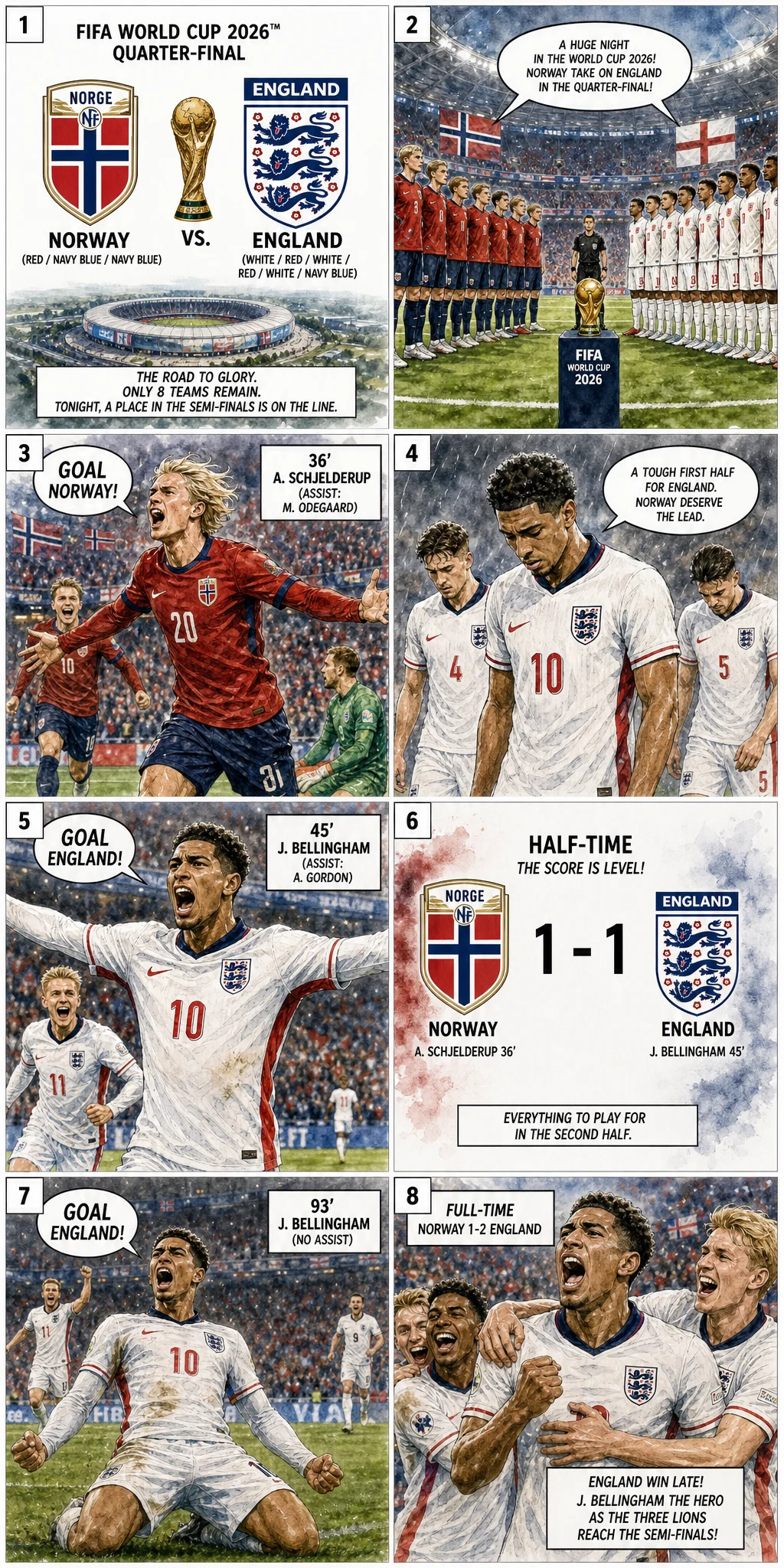
Comic content and match statistics are for entertainment purposes only and may contain inaccuracies. For Accurate Data, please refer to the reference's official website.
# Norway 1-2 England: Extra-Time Winner Rewrites Tactical History
At Arrowhead Stadium, in the quarter-final of the 2026 FIFA World Cup, a match that seemed to belong to the arithmetic of the 1925 offside law—where the forward pass became a weapon—instead unfolded as a meditation on the space between a single minute and a century of tactical thought. The scoreline, Norway 1-2 England, tells only the surface; beneath it lies a rhythm of substitutions and interventions, of players entering and leaving the stage at precisely calibrated moments, each one a footnote to the broader argument about how football constructs its history from the debris of individual actions. This was a game that began with the ghost of the old two-man offside rule and ended with the kind of extra-time winner that makes you wonder whether the modern game has finally learned to control time itself, or whether it merely submits to it more willingly.
The first half offered a study in contrasts that would have fascinated any student of the game’s evolution. Norway, perhaps channeling the spirit of the 1950s WM formation with its elegant inversion of roles, discovered a directness that bypassed England’s midfield. In the 36th minute, Martin Ødegaard, that conductor of geometric patterns, played a pass that split the English defensive line—a pass that would have been illegal under the pre-1925 offside law, which required three opponents between the receiver and the goal. Andreas Schjelderup accepted the gift with the poise of a player who understands that the rule change in 1925, reducing the required defenders from three to two, effectively legalized the through ball. He scored, and Norway led 1-0, and for a moment the arrowhead of the stadium’s name seemed to point directly at England’s vulnerability.
Yet England, in the tradition of the 1966 World Cup winners who redefined the use of wingers, had their own temporal trick. Just before the interval, in the 45th minute, Anthony Gordon—a player whose movement recalls the diagonal runs of the old outside-left—delivered a cross that Jude Bellingham met with the kind of authority that belongs to a player who has absorbed every lesson of the 1970s total football revolution. Bellingham equalised, and the score was 1-1. The half ended with a question hanging in the air: which era would dictate the rest of the match? The answer, it turned out, lay not in the patterns of play but in the tactical management of physical resources—a practice that has its philosophical roots in the introduction of substitutes in the 1960s, when the notion of a player as a replaceable part of a system first became codified.
The second half began with a flurry of substitutions that would have bewildered a spectator from 1925, when the idea of changing a player mid-game was not merely illegal but inconceivable. At the 46th minute, England introduced Noni Madueke and Declan Rice. The former offered width, the latter offered control—two distinct concepts that the game had spent decades trying to reconcile. Rice’s arrival in particular seemed to shift the tectonic plates of the midfield, adding a layer of protection that Norway struggled to breach. Yet the match remained deadlocked, a taut draw that felt less like a stalemate and more like a holding pattern, as if both teams were waiting for a signal from a higher authority.
Norway responded with their own rotations. In the 60th minute, Julian Ryerson entered the fray, a defender whose inclusion hinted at a desire to lock down England’s flank threats. Then, in the 68th minute, a double substitution: Alexander Sørloth and the goalscorer Schjelderup were withdrawn. Schjelderup’s departure, having scored the opening goal, carried a particular poignancy—the kind of substitution that reminds us that a player’s narrative arc can be cut short by tactical necessity. He had done his job; the game now required someone else. Norway also brought on a player named D. Wolfe at the 90th minute, and later T. Heggem at the 91st minute, but by then the shape of the contest had already been altered by the invisible hand of the manager.
England too made changes. Anthony Gordon, whose assist had been the catalyst for the equaliser, was replaced in the 71st minute by a player whose name—N. O’Reilly—suggests a new generation stepping forward. O’Reilly’s introduction, along with Ezri Konsa in the 89th minute, seemed designed to shore up the defensive structure as the match entered its final phase. But the final phase was not yet final. The game had reached the 90th minute still tied at 1-1, and the 1925 offside rule, which had once simplified the forward pass, now seemed irrelevant in a contest that had become a battle of attrition, where every substitution was a gamble and every minute a potential turning point.
The breakthrough came in the 93rd minute, deep into what had become extra time—the first half of the two fifteen-minute periods that football adopted in the 1970s to resolve drawn knockout matches, a solution that itself was a response to the increasing tactical conservatism of the modern game. Bellingham again. The same player who had equalised before the interval now produced a decisive strike. It was not merely a goal; it was a statement about the value of persistence in a sport where the margin between victory and defeat is often measured in the seconds after a substitution. Bellingham’s second goal, unassisted according to the official record, was the kind that belongs to the individual brilliance that the collective systems of the 1930s WM formation tried to suppress—a reminder that even in an age of structure, chaos still wins.
The remainder of extra time played out as a series of tactical adjustments. Norway brought on Erling Haaland in the 106th minute—a late entry that felt symbolic of a nation’s desperation, a striker who normally starts but here was held back until the game had already tilted. Haaland’s presence, however, did not alter the scoreline. England, in turn, substituted Bellingham in the 111th minute, removing their two-goal hero to protect the lead, a decision that echoes the substitution of Bobby Charlton in 1970, when England lost a lead after removing a talisman. This time, the risk paid off.
The only disciplinary action came in the 117th minute, when Norway’s Kristoffer Ajer received a yellow card—a minor footnote in a match that had seen no red cards, no major controversies, just the steady accumulation of decisions that ultimately favoured the side with the deeper bench and the sharper eye for the decisive moment. The yellow card, that modern invention from the 1970 World Cup, now stands as a remnant of a simpler era of punishment; here it was merely a blip, a flicker of frustration in a game otherwise defined by cold calculation.
What does this quarter-final tell us about the evolution of football? Perhaps that the game has become a form of controlled chaos, where the 1925 offside rule—which once liberated the attack—is now just one variable among many. The substitutions, the timing, the management of fatigue: these are the new weapons, replacing the old notion of a fixed eleven men playing for ninety minutes. The 1930s would have recognised the goals but not the method by which they were achieved. The 1970s would have admired the fluidity but questioned the number of interruptions. The present moment, however, accepts the paradox: that the more we try to manage the game, the more it slips away from us, and that the decisive moments often come from players who have been on the pitch the longest, not the freshest.
Bellingham’s two goals frame a narrative that began with a Norwegian breakthrough and ended with English triumph. But the story is not really about individuals. It is about the systems that enabled those individuals to act, the substitutions that changed the geometry of the pitch, the yellow card that signalled a loss of composure, and the extra-time period that allowed the game to breathe longer than the original 90 minutes. Arrowhead Stadium, a venue built for American football with its own complex relationship to time and stoppages, provided the perfect setting for a match that felt like a conversation across decades.
Norway will wonder what might have been had Schjelderup’s goal been followed by a second before the interval, or had Haaland been introduced earlier. England will celebrate a quarter-final win that preserved their tournament hopes, but they will also know that the margin was thin, that a single moment—Bellingham’s second—separated them from the possibility of extra time penalties or a Norwegian comeback. The 1925 offside rule, which made the forward pass viable, also made the game more unpredictable. This match, with its late goal and its flurry of substitutions, was a testament to that unpredictability, a reminder that football’s history is not a straight line but a series of overlapping circles, each one returning to the same essential question: how do we decide when a game is truly over? The answer, it seems, is that the game is never truly over. It just changes shape, like a substitution, like a rule change, like a goal scored in the 93rd minute of a quarter-final that nobody will forget.